

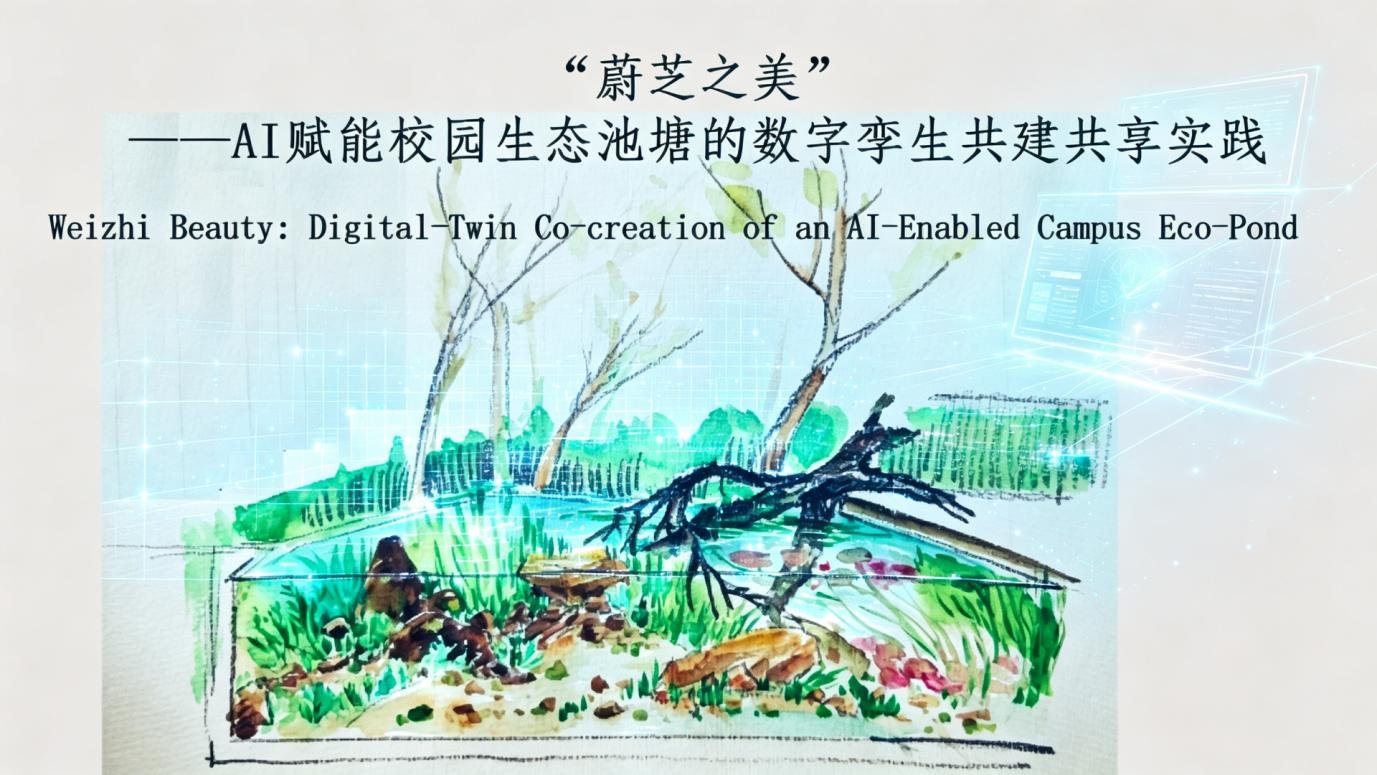
Company/Organization Profile
Shanghai Nanyang Model High School — founded in 1901, it is one of the earliest modern schools established by the Chinese themselves and a Model High School of Shanghai. Over the past two decades, the school has been deeply committed to environmental science and technology education, centering on green, low-carbon and sustainable development, and has built a three-in-one green education system of "curriculum – platform – project".
Building on hands-on platforms such as the Environmental Innovation Laboratory and the Digital-Twin Water Quality Monitoring Station, the school has developed signature programs including the Weizhi Beauty – Eco-Pond Construction project, which weaves together cross-disciplinary practices in water quality testing, ecological restoration and digital modeling to explore synergistic solutions for "clean water and low-carbon" governance, nurturing students' environmental awareness and leadership for global sustainable development.
Over time, the school has developed a multi-tiered, progressively structured cultivation model led by distinctive curricula and programs. In the past three years alone, students have earned more than 100 awards; the school has represented China three times at the Stockholm Junior Water Prize and clinched the world's top prize in 2006 — a record it has upheld ever since.
机构简介
上海市南洋模范中学是中国人自己创办的最早新式学堂之一,创建于1901年,是上海市实验性示范性高中。学校深耕环境科技教育二十余年,紧扣绿色低碳与可持续发展,构建了“课程-平台-项目”三位一体的绿色教育体系。依托环境创新实验室、数字孪生水质监测站等实践平台,开发了“蔚芝之美——生态池塘构建”等特色项目,贯穿水质检测、生态修复、数字建模等跨学科实践,探索“净水-低碳”协同治理方案,培养学生的环保意识与全球可持续发展领导力。逐步形成以特色课程为孵化,特色项目为引领,多层次有梯度的培养模式,学生近三年获奖100于次,曾三次代表中国角逐斯德哥尔摩国际水奖青少年奖,并于2006年捧得最高奖,保持至今。

Project Overview
Weizhi Garden is an ecological garden on campus. In 2023, it was plagued by pond subsidence and leakage, long-neglected vegetation that had left the ecological structure monotonous, and an aging, rundown landscape — prompting the launch of the "Weizhi Beauty" eco-pond construction project.
Current problems:
The old garden consisted of little more than basic flower beds and a pond, with no consideration for green, low-carbon development or ecological maintenance;
Students knew "low-carbon" and "ecology" only at a superficial level — they could observe the physical garden space but had little understanding of the ecological principles behind it. They "could not see the daily changes in the water body," and maintenance had to rely on experience;
The digitization of physical indicators could not be coupled with the underlying mechanisms of ecosystem change — students could not see how the water-quality fluctuations and purification-efficiency shifts they observed were linked to microbial community structure and functional gene profiles.
Root causes: The traditional garden was out of step with new composite ecological spaces; the physical ecological space was disconnected from digital environmental indicators; abstract digital models were disconnected from students' tangible perception; and the digitization of physical indicators was disconnected from the underlying mechanisms of ecosystem change.
Improvement goals: Taking the "Weizhi Beauty" project as the vehicle, the school aims to upgrade the campus eco-pond from an "engineered water body" into a "co-created, shared green space." It will build a composite aquatic space that integrates landscape, stormwater retention and purification — a "closed pond – overflow constructed wetland" — serving rainwater retention, water purification and ecological education.
Digital twin technology will be introduced to develop a coupled "meteorological– water quality – microbiome" model, leading teachers and students from "seeing the pond" to "understanding the ecology."
项目背景
蔚芝园是学校的一处生态花园,2023年面临池塘下陷漏水、植被长期缺乏管理生态结构单一、景观破旧老化等问题。遂启动“蔚芝之美”生态池塘构建项目。
问题现状:1、旧有花园仅包含基础花坛、池塘,并未考虑绿色低碳与生态维护等理念;2、学生对于“低碳”、“生态”知其然不知其所以然,仅观察到外在的花园物理空间,并不了解背后的生态原理,学生“看不见水体的日常变化”,运维只能凭经验;3、“物理指标数字化”无法与生态系统变化的深层机理偶联,学生不了解观察到的水质波动、净化效率改变与微生物群落结构、基因功能特征存在怎样的关系。
原因分析:传统花园与新型复合生态空间脱节,物理生态空间与数字化环境指标脱节;抽象数字模型与具象学生感知脱节;物理指标数字化与生态系统变化的深层机理脱节。
改进目标:以“蔚芝之美”项目为载体,将校园生态池塘从“工程化水体”升级为“共建共享的绿色空间”。打造集景观、调蓄与净化于一体的“封闭池塘—溢流人工湿地”复合水生态空间,承担雨水调蓄、水质净化与生态美育功能。并引入数字孪生技术,构建“气象—水质—微生物”耦合模型,让师生从“看得见的池塘”走向“看得懂的生态”。
Project Implementation
The project is advanced in three phases.
Phase I: Co-creating the eco-pond to activate space users (from March 2024).
To address the single-function campus water body and the limited participation of teachers and students, the school launched the "Weizhi Beauty" eco-pond creative construction initiative. Student teams were organized by class, with expert training delivered by the Aquascaping Committee of the China Fisheries Association.
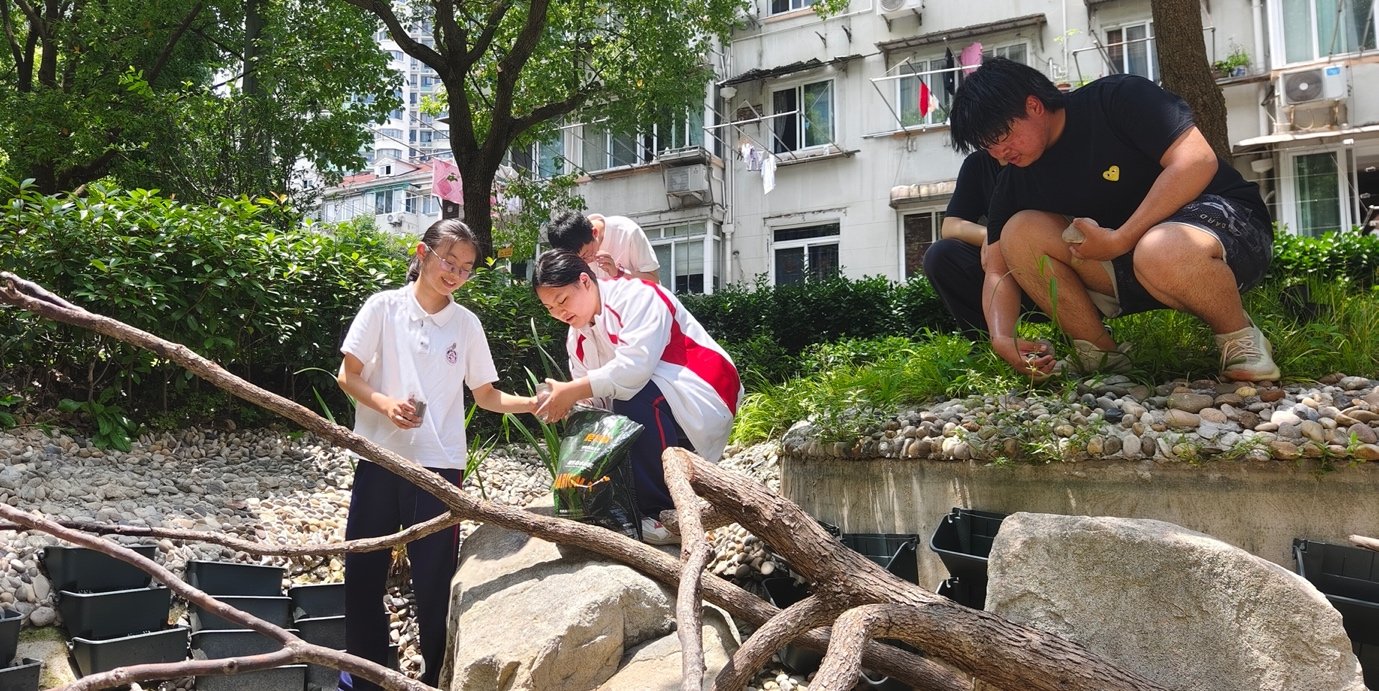
Students independently completed the "Weizhi Beauty" creative design, the "Weizhi Style" model building and the "Weizhi Fun" landscape creation — hand-making aquascape skeletons and planting aquatic plants — turning the pond into an "outdoor comprehensive laboratory" that all teachers and students can participate in, observe and learn from.
The project designed a "pond – overflow constructed wetland" system as a typical small-scale artificial aquatic purification unit: through deep-water retention in the pond and adsorption-degradation by wetland substrates and plant roots, the water body achieves self-purification, while a rain garden and solar panels make full use of green energy.
Following the principle of "prioritizing existing resources", the project reused original facilities to achieve low-cost, high-participation co-creation and to spawn research-oriented projects.
Phase II: Digital twin + smart IoT to make the space "speak" (from 2025).
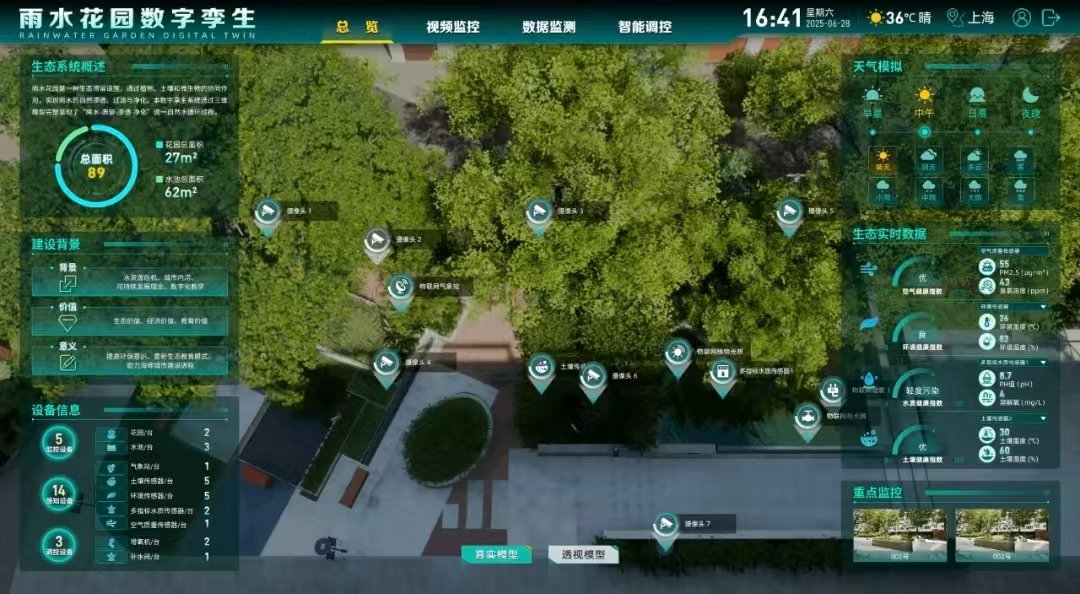
To tackle the pain point of "being unable to see the daily changes of the water body", the school implemented a "digital twin + smart IoT" upgrade: deploying an IoT weather station on Weizhi Garden (collecting over 10 environmental indicators every 5 minutes) and a water-environment digital twin system (5 monitors, 14 water-quality sensors and 3 control devices), while teachers and students built low-cost ESP32 monitoring terminals on their own, forming an integrated "water–air–soil" sensing network.
This enabled 24/7 monitoring, intelligent analysis and anomaly early warning, projecting the physical ecology into a digital twin in real time and making it remotely accessible across the whole school — a "super dashboard" and "remote control console".
Phase III: AI for Biology to decode the mechanism (from 2026).
To break the bottleneck of a digital twin "with physical indicators but no biological mechanism", the student team launched the "Weizhi Beauty" rain-garden ecology decoding project: conducting a panoramic ecological survey of the pond–wetland system to build species inventories and distribution maps;
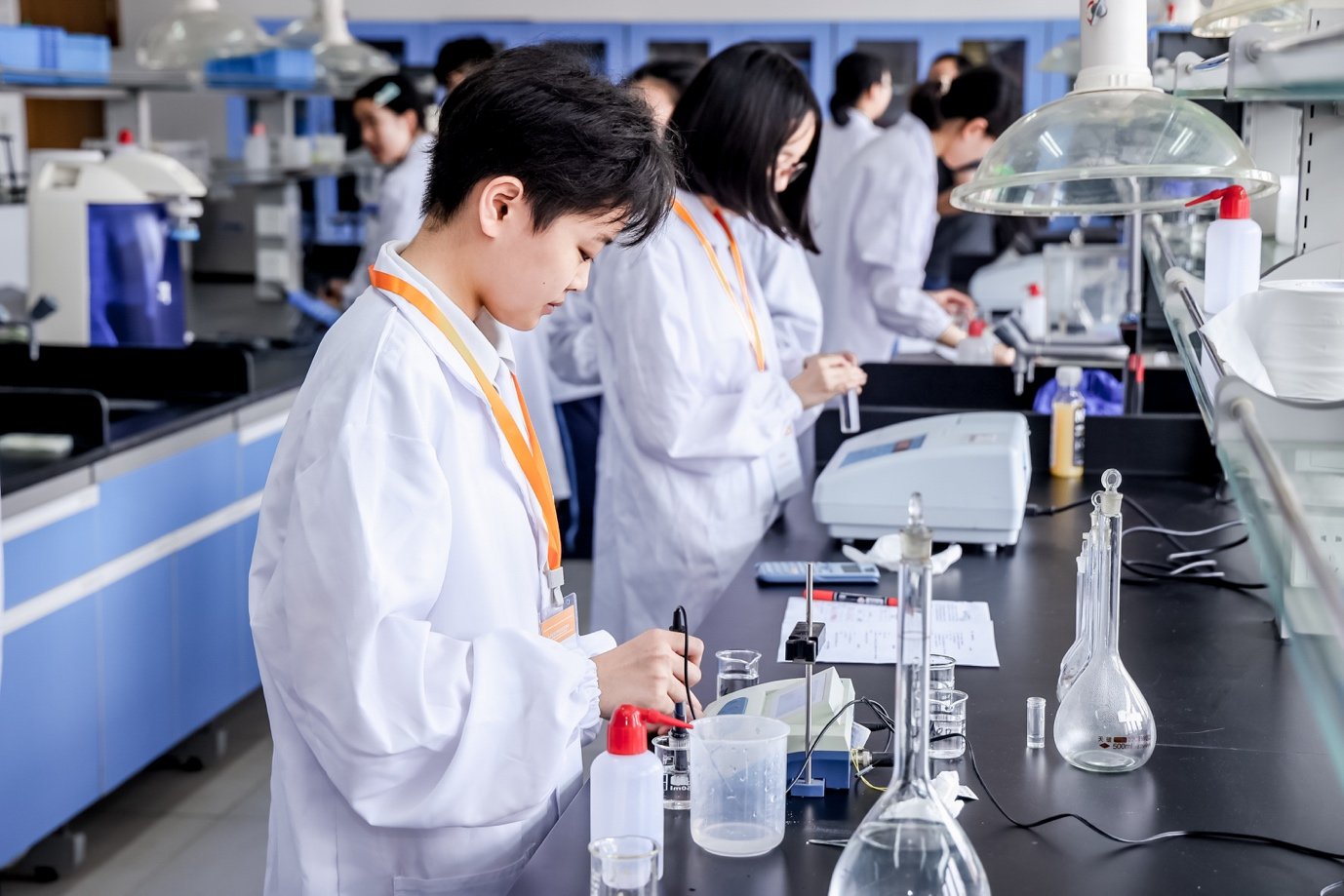
Collecting two core sample groups — pond-bottom water and wetland matrix surface (3 replicates each) — and commissioning metagenomic high-throughput sequencing with NR/NT, KEGG and CAZy annotation to analyze the abundance of key functional genes; 3D-printing the Acorus-root rhizosphere gradient model; and integrating macroscopic ecology, microscopic imaging, metagenomics and hydrological/water-quality data into a coupled "hydrology – water quality – microbiome" digital twin model, enabling purification-efficiency prediction and extreme-scenario early warning.
Organizational mechanism: The project is initiated by the school (with cumulative participation exceeding 1,200 person-times) and led by student teams from innovation clubs, organized into working groups for creative design, model building, landscape creation, ecological survey, microscopic imaging, experimental analysis, 3D creation and digital twin.
Subject teachers provide guidance throughout, with technical support from university laboratories and professional sequencing institutions.
Key problems and solutions: To address the three major challenges — the aging, leaking pond, difficulties in mobilizing students, and the high threshold of metagenomics — the project introduced expert training and model validation, set up the "Weizhi Beauty" challenge project, and partnered with universities and institutions with the aid of AI, ultimately achieving low-cost co-creation, intelligent early warning and the decoding of ecological mechanisms.
项目实施
本项目分三阶段推进。
第一阶段:生态池塘共建共享,激活空间使用者(2024年3月起)。针对校园景观水体功能单一、师生参与不足的问题,学校发起“蔚芝之美”生态池塘创意构建行动,以班级为单位组建项目小组,邀请中国渔业协会水族造景分会专家开展主题培训,学生自主完成“蔚芝之美”创意设计、“蔚芝之型”模型搭建、“蔚芝之趣”景观营造,亲手制作水景骨架、种植水生植物,打造为师生可参与、可观察、可教学的“户外综合实验室”。
项目设计了“池塘-溢流人工湿地”系统作为典型的小型人工水生态净化单元,通过池塘深水滞留、湿地基质与植物根系吸附降解,实现水体自我净化,同时设计雨水花园,太阳能板等充分利用绿色能源。坚持“优先使用既有资源”,复用原有设施,实现低成本、高参与度的共建共享,并衍生研究型课题。
第二阶段:数字孪生+智能物联,让空间“会说话”(2025年起)。针对“看不见水体的日常变化”的痛点,学校实施“数字孪生+智能物联”升级计划:在蔚芝园布设物联网气象站(每5分钟采集10余项环境指标)、水环境数字孪生系统(5台监控、14台水质感知、3台调控设备),师生自主搭建ESP32低成本监测终端,构建“水—气—土”一体化感知网络,实现24小时监测、智能分析与异常预警,将物理生态实时投射为数字孪生体,全校可远程访问,形成“超级仪表盘”与“远程控制台”。
第三阶段:AI for Biology 生态解码,让机理“看得懂”(2026年)。针对数字孪生“只有物理指标、缺乏生物机理”的瓶颈,学生团队发起“蔚芝之美”雨水花园生态解密项目:开展池塘—湿地全景生态普查,建立物种名录与分布地图;
采集池塘底层水样与湿地基质表层样2组核心样本(各3个平行样),委托专业机构完成宏基因组高通量测序与NR/NT、KEGG、CAZy注释,解析关键功能基因丰度;制作菖蒲根系—根际微环境梯度3D模型;
整合宏观生态、微观影像、宏基因组与水文水质数据,构建“水文—水质—微生物”耦合数字孪生模型,实现水质净化效率预测与极端情景预警。
组织机制:项目由学校发起(累计参与人数达1200余人次),创新社团学生团队主导,分创意设计、模型搭建、景观营造、生态普查、微观影像、实验分析、3D造物、数字孪生等工作小组,学科教师全程指导,对接高校实验室与专业测序机构提供支持。
主要问题及解决:针对旧塘渗漏改造难、学生发动瓶颈、宏基因组门槛高等三大难题,先后引入专家培训与模型验证、设置“蔚芝之美”挑战项目、对接高校机构并借力 AI 辅助,最终实现低成本共建、智能预警与生态机理解码。
Project Outcome
The project has achieved a leap from a "mere landscape" to a "co-created, shared green space," yielding four innovative highlights.
1. Mechanism innovation — from "users" to "co-creators". A mechanism of "student-led co-creation + teacher guidance + expert support" runs through all three phases, with students leading throughout and forming a closed loop of "survey – design – practice." Green ideas are thus turned into tangible, inheritable spatial actions that have engaged over 1,200 teachers and students schoolwide.
2. Technological innovation — a coupled "meteorology – water quality – microbiome" digital twin model. Breaking the limitation of campus ecological digital twins that focus solely on physicochemical indicators, the project integrates metagenomic functional-gene data into the model, enabling education on the mechanisms of ecological-environmental change. Water-quality monitoring has been upgraded from "manual sampling with a single indicator" to "24/7 real-time multi-indicator monitoring + AI early warning."
3. Collaborative innovation — a cross-disciplinary green space. Integrating life sciences, artificial intelligence, IoT and 3D printing, the project builds a "sense – decide – create" capability chain and establishes a badge certification system for "digital samplers," "eco programmers" and "intelligent engineers."
4. Educational innovation — a long-term mechanism of "landscape as classroom." Project outcomes have been consolidated into the pyramid curriculum and a mentor–mentee ("old leading new") inheritance mechanism within school clubs, incubating over 40 "AI + environment" projects annually. The project demonstrates remarkable sustainability and replicability, offering a model for the development of similar campus green spaces.
成果亮点
项目实现从“单纯景观”到“共建共享绿色空间”的跨越,形成四大创新亮点。
机制创新,从“使用者”到“共建者”:构建“学生主导共建+教师指导+专家支持”机制,三大阶段均由学生全程主导,实现“调研—设计—实践”闭环,让绿色理念转化为可触摸、可传承的空间行动,累计覆盖全校师生(1200余人次)。
技术创新,“气象—水质—微生物”耦合数字孪生模型:突破校园生态数字孪生仅关注物理化学指标的局限,将宏基因组功能基因数据融入模型,实现生态环境变化机理教育,水质监测从“人工抽检、指标单一”升级为“24小时多指标实时监测+AI预警”。
协同创新,跨界融合的绿色空间:融合生命科学、人工智能、物联网、3D打印等多学科,构建“感知—决策—创造”能力链,形成“数字采样师”“生态程序员”“智能工程师”能力徽章认证体系。
教育创新,“景观即课堂”的长期机制:项目成果沉淀为金字塔课程体系与社团“老带新”传承机制,每年孵化40余项“AI+环境”课题,具有显著的持续性与可复制性,为同类校园绿色空间建设提供范式。
Project Highlights
Ecological benefits. Driven by the coupled "meteorology – water quality – microbiome" model, the Weizhi Garden rain garden and the pond–wetland system have shifted from "experience-based" to "data-driven" operation, enabling real-time monitoring of green and low-carbon performance and efficient removal of pollutants such as nitrogen and phosphorus.
Purification efficiency has been steadily improved, while submerged plants and wetland habitats continue to sequester carbon and enhance carbon sinks, infusing the campus's blue-green spaces with low-carbon value.
Social impact. Anchored at the school, the project has mobilized students, families and the community to join green actions, engaging the whole school while radiating to surrounding communities.
Its outcomes have repeatedly won first prizes in competitions such as the National Water Science and Technology Contest, the "Tomorrow's Star of Science and Technology" program and the Shanghai "Dual Carbon" Scheme Contest.
成果影响力
生态环境效益:依托“气象—水质—微生物”耦合模型,蔚芝园雨水花园以及池塘—湿地系统实现从“经验运维”到“数据驱动”的转变,实现绿色低碳实时监控、氮磷等污染物得到高效削减,系统水质净化效率稳定提升,沉水植物与湿地生境持续发挥固碳增汇作用,为校园蓝绿空间注入低碳价值。
社会影响:项目以学校为支点带动学生、家庭与社区共同参与绿色行动,累计覆盖全校师生并辐射周边社区;相关成果在全国水科技大赛、明日科技之星、上海“双碳”方案大赛等赛事中屡获一等奖。
Reviews & Honors
Awards and honors. The school has accumulated over 100 national and municipal environmental science and technology awards. In the past three years, it has repeatedly won first prizes in competitions such as the National Water Science and Technology Contest, the "Tomorrow's Star of Science and Technology" program and the Shanghai "Dual Carbon" Scheme Contest.
The team also delivered high-quality ecological survey, microscopic imaging and metagenomic analysis at the 2026 Youth AI + Life Sciences "Digital Twin Ecology" academic showcase, earning professional acclaim.
Expert evaluation. Experts of the Aquascaping Committee of the China Fisheries Association have provided professional guidance and high recognition for the eco-pond co-creation project, while university laboratories and professional sequencing institutions have guaranteed the rigor of the metagenomic analysis.
Social recognition. The school has for years been honored with the titles of "National Ecological Civilization School" and "National Resource-Conserving Green Campus," and is the only high school in China to have won the Global Grand Prize of the Stockholm Junior Water Prize. Its water science and technology education has been featured in media special reports on multiple occasions, forming a demonstration effect that is verifiable and publicly citable.
评价与荣誉
奖项荣誉:学校累计获国家级、市级环境科技奖项百余项,近三年在全国水科技大赛、明日科技之星、上海“双碳”方案大赛等赛事中屡获一等奖;团队在2026青少年AI+生命科学“数字孪生生态”学术展示中高质量完成生态普查、微观影像、宏基因组分析,获专业好评。
专家评价:中国渔业协会水族造景分会专家对生态池塘共建项目给予专业指导与高度认可;高校实验室与专业测序机构对宏基因组分析的严谨性予以保障。
社会认可:学校多年被授予“全国生态文明校”、“全国资源节约型绿色校园”称号,是全国唯一获得斯德哥尔摩青少年水奖世界最高奖的高中,水科技教育多次获媒体专题报道,形成可核实、可公开引用的示范效应。

近零碳社区的美育升级---- 长寿苑社区 “低碳实践 + 影像科普” 共建项目
4天前 · 来源:成都市武侯区火车南站街道长寿苑社区居民委员会 · 作者:成都市武侯区火车南站街道长寿苑社区居民委员会

以绿色金融之力推动中国新质生产力!
4天前 · 来源:国泰海通证券研究所ESG及美丽中国研究组 · 作者:国泰海通证券研究所ESG及美丽中国研究组
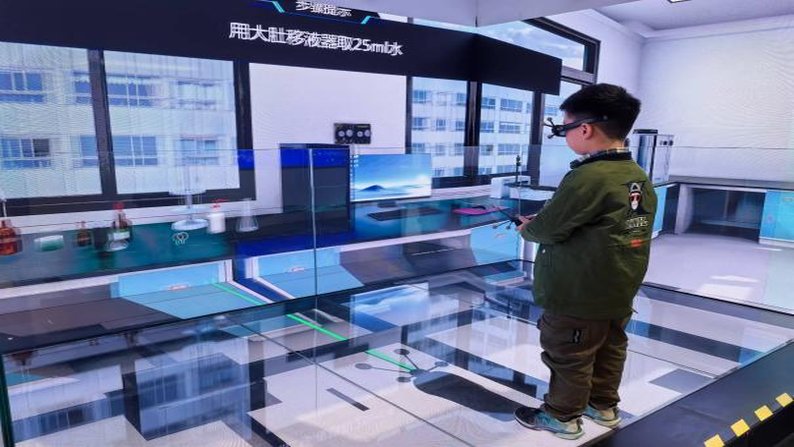
不择知行细流,蕴蓄蓝绿成深:雄安新区生态环境共享中心科普宣传空间营造雄安新区生态环境共享中心VR虚拟实验室(数字化仿真替代实体化学实验,实现科普零危废、低能耗)
6天前 · 来源:雄安新区生态环境监控中心 · 作者:雄安新区生态环境监控中心
