

Company/Organization Profile
Coca-Cola is one of the most well-known international brands in China, where we have more than 20 brands and offer around 100 beverage choices to local consumers. Since our return to the Chinese mainland in 1979, the Coca-Cola China system has invested more than $13 billion and established a total of 46 plants in China. The Coca-Cola China system today employs more than 49,000 people across the country, 99% of whom are local hires. Coca-Cola China and its bottling partners are committed to providing Chinese consumers with broad portfolio of beverages, at the same time, driving sustainable development of the local communities, environment, and economy for a better shared future.
机构简介
可口可乐是中国家喻户晓的国际品牌之一。可口可乐公司秉承“畅爽世界,因我不同”的初心,为中国消费者提供20多个品牌、约100多种产品。自1979年重返中国大陆市场至今,可口可乐系统累计在华投资超过130亿美元,建有46家工厂,系统员工超过49000人,其中99%为本地员工。在为中国消费者带来多元饮料选择的同时,可口可乐中国与装瓶合作伙伴携手推动本地经济的可持续发展,助力生态环境与社会经济的共荣共生,共创美好的共享未来。
Project Overview
Nanjing Hongshan Forest Zoo is widely recognized for its commitment to animal welfare, biodiversity conservation, and nature education. Welcoming more than 8 million visitors annually, it is a representative high-traffic public space that combines strong public engagement with rich opportunities for environmental education.
Current situation: In high-traffic public spaces such as the zoo, there was no unified, visible, and accessible system for collecting and recycling disposable packaging such as beverage bottles. This made it difficult for visitors to turn green-consumption awareness into concrete action, while the environmental value of recycling and regeneration remained largely unseen and disconnected from everyday public life.
Root causes: Traditional environmental outreach often remains at the level of messaging and advocacy, without a dedicated facility or mechanism to enable sustained public participation. Visitors had limited opportunities to experience firsthand the full journey of a recycled bottle—from collection and sorting to material processing and its transformation into something new. At the same time, the zoo lacked an ongoing mechanism to connect public engagement with market-based recycling and material-processing resources.
Goal: The Coca-Cola China system and Nanjing Hongshan Forest Zoo jointly initiated the The Amazing Bottle Green Consumption Community Co-creation Project, with support from One Foundation and other partners. Through the development and ongoing operation of the The Amazing Bottle Recycling Hub, the project transforms recycled beverage-bottle plastic into infrastructure and creative products for the zoo. By making the complete “collect–regenerate–return” journey visible and participatory, the project turns green-consumption awareness into tangible, everyday action for visitors and provides a practical example of advancing green consumption and public participation in public spaces.
项目背景
南京红山森林动物园因其在动物福利、生物多样性保护和自然教育等方面的专业实践而广受认可,年接待游客超过800万人次,是华东地区高频公众消费与自然教育场景兼具的代表性公共空间。
问题现状:在此类高客流公共空间中,游客产生的饮料瓶等一次性包装物回收缺乏统一、可视化的收集与再生渠道,绿色消费理念难以转化为游客可感知、可参与的具体行动,回收再生的价值也未能被公众直观看到。
原因分析:传统环保宣传多停留在口号和倡导层面,缺少长期稳定运营的公共参与设施,游客难以在游览过程中直接体验“回收如何变成新物件”的完整链条,园区也缺少与市场化回收、再生加工资源的常态化协同机制。
改进目标:可口可乐中国系统携手红山森林动物园,并联合壹基金等多方合作伙伴,共同发起「不瓶凡」绿色消费社区共创项目。项目通过建设并常态化运营「不瓶凡」回收小屋,将回收的饮料瓶塑料再生为园区基础设施和文创用品,以公众可参与、可视化的方式呈现饮料瓶“回收—再生—回归”的完整旅程,推动绿色消费理念转化为游客可感知、可参与的日常行动,为公共空间绿色消费与公众参与共建提供实践样本。
Project Implementation
The project addresses the core question of how to make green consumption visible, participatory, and sustainable in public spaces, advancing systematically across four areas: facility development, concept communication, experiential engagement, and multi-stakeholder collaboration.
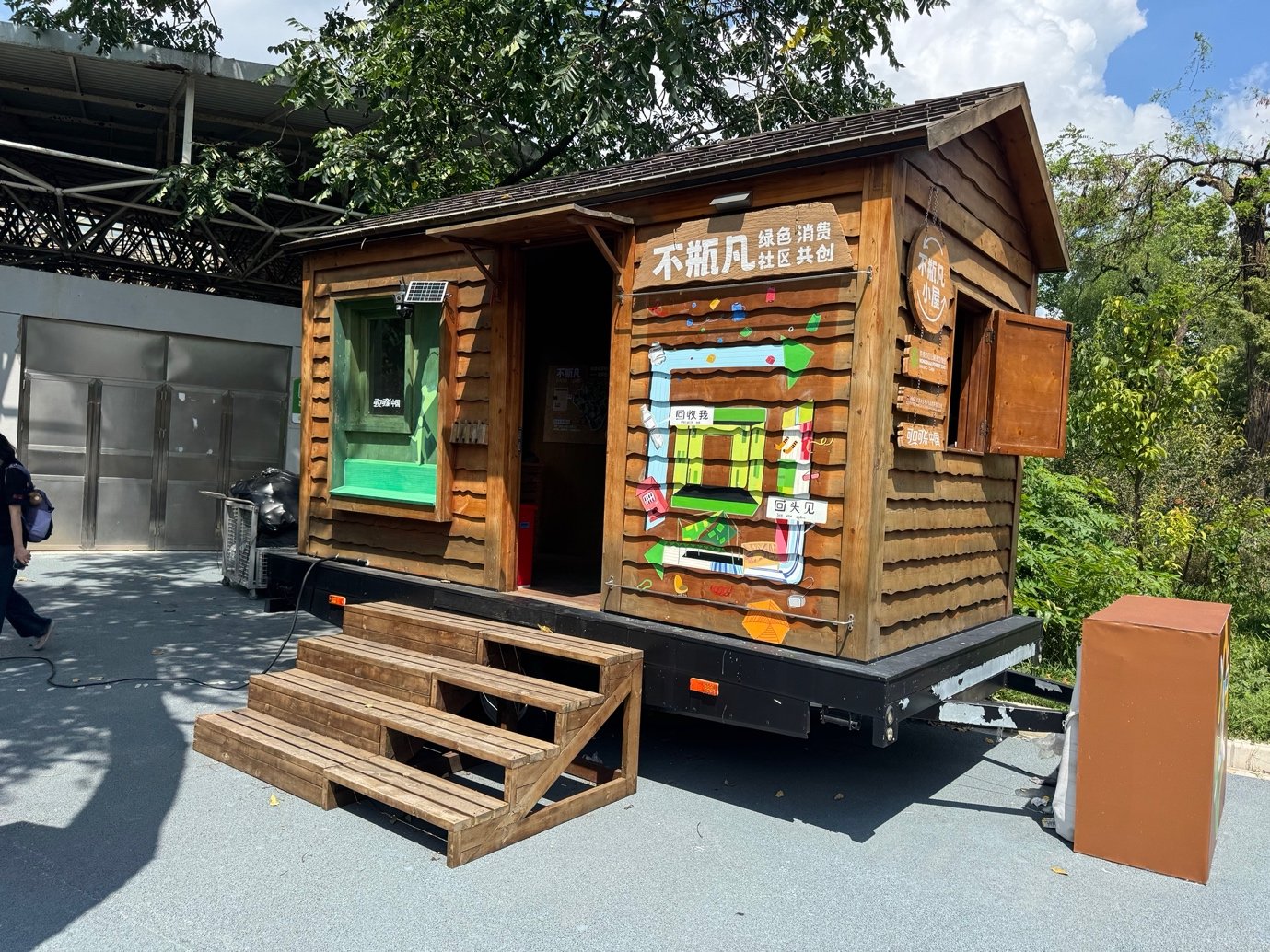
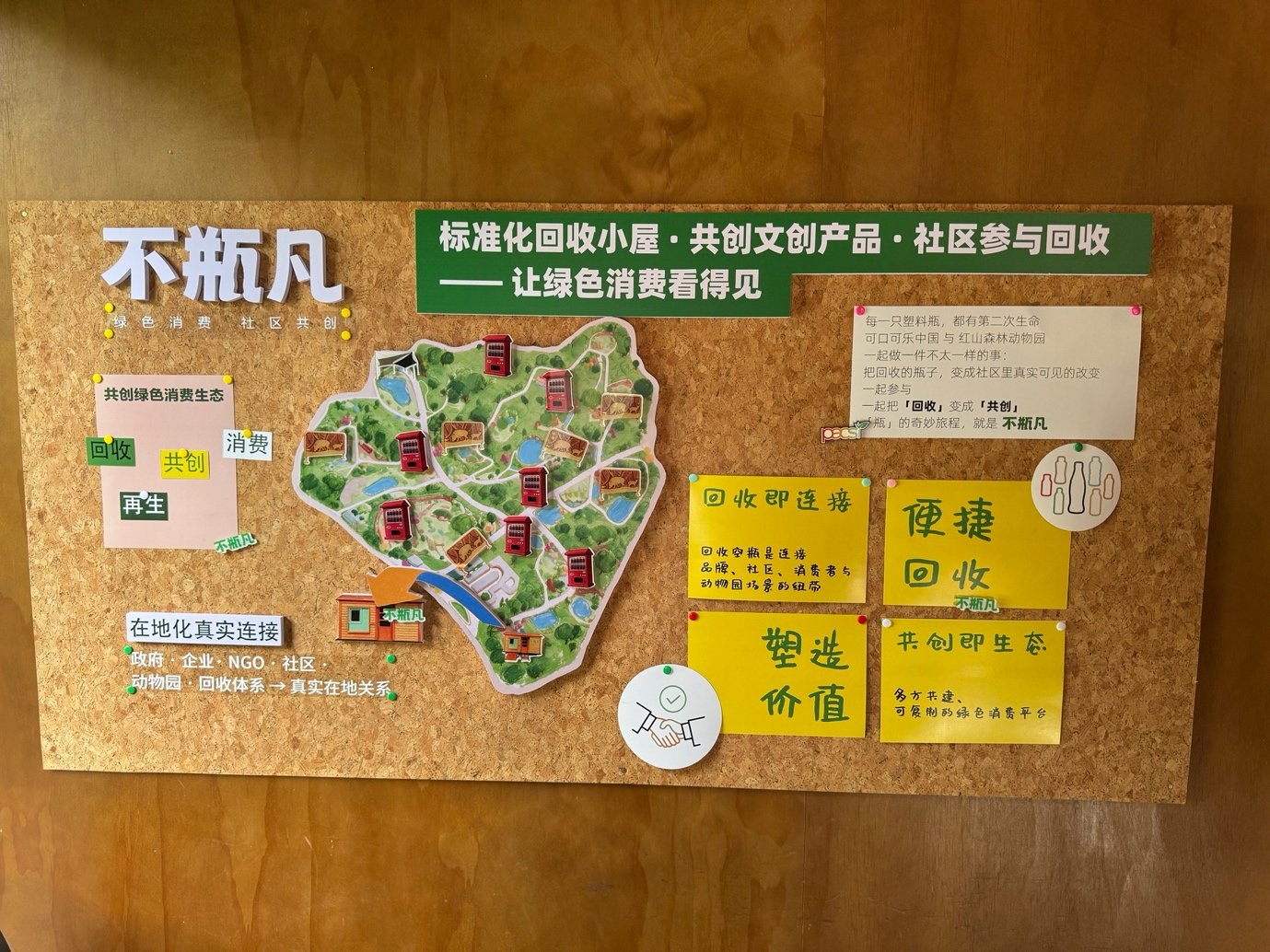
1) To address the lack of long-term public participation facilities in public spaces, the Coca-Cola China System, together with Hongshan Forest Zoo, One Foundation, and other partners, developed and now operates the 11-square-meter The Amazing Bottle Recycling Hub, creating a year-round public participation space that integrates bottle recycling into visitors’ everyday zoo experience rather than relying on one-off campaigns.
2) To address the difficulty of making environmental concepts tangible, the project developed the “Recycle Me · See You Again” concept, which runs throughout the entire process, from bottle collection and material processing to its return to the zoo in a new form, making the otherwise abstract process of “regeneration” visible, understandable, and traceable.
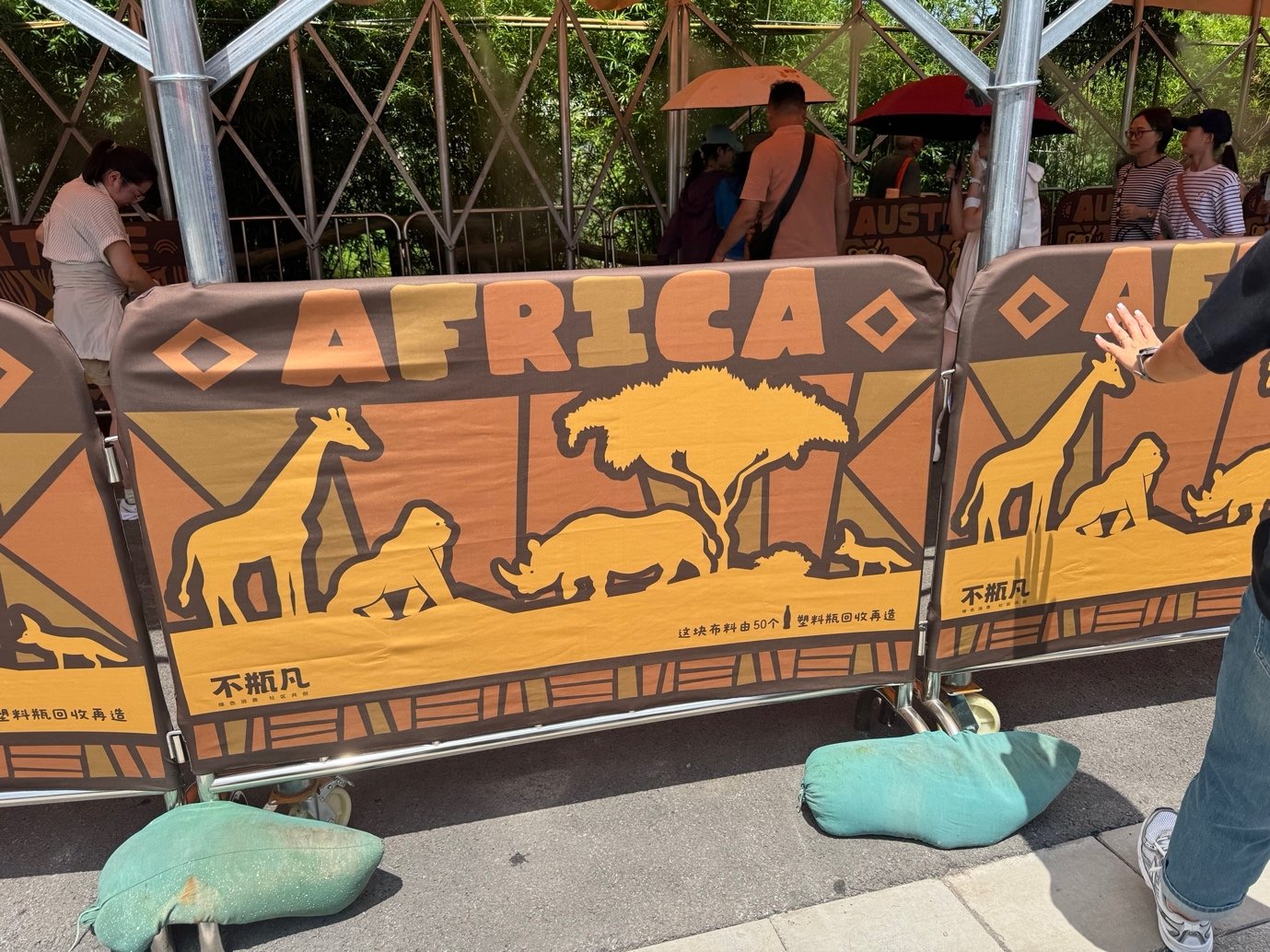
3) To address the lack of a concrete way to demonstrate the value of recycling and regeneration, collected beverage bottles are transformed into public facilities and creative products for the zoo, such as sunshade structures and barrier covers. Interactive displays allow visitors to see, touch, and experience how a beverage bottle is transformed from waste into a new object, making green consumption a tangible everyday choice.
4) To address the difficulty of sustaining long-term operations through a single stakeholder, the project was jointly initiated by the Coca-Cola China System and Hongshan Forest Zoo, with One Foundation and other partners supporting its development and operation. Swire Coca-Cola (Jiangsu) contributed practical experience from its “Zero Carbon Factory” initiatives; Hongshan Forest Zoo provided the site and nature-education context; One Foundation and third-party organizations provided recycling and operational support; and creative designers participated in product co-creation, forming a long-term, complementary multi-stakeholder operating mechanism.
The project team rolled it out progressively through site selection, space design and construction, recycling-flow design, environmental education and interpretation, ongoing operation, and iterative optimization, while continuously adjusting the Hub’s interactive content and formats based on visitor feedback. Drawing on the zoo’s more than 8 million annual visitors and rich nature-education resources, the project has evolved from a single recycling facility into a community co-creation platform integrating public participation, environmental education, and hands-on practice.
Going forward, the project will build on Hongshan Forest Zoo’s “Zero-Waste Hongshan” initiative to further enrich the Hub’s content and public participation activities, while systematically documenting its operational experience to provide a reference for green-consumption practices in public spaces across urban parks, communities, and cultural and tourism settings.
项目实施
项目围绕“如何让绿色消费在公共空间中被看见、被参与、可持续”这一核心问题,从设施建设、理念传播、场景体验、多方协同四个方面系统推进:
针对“公共空间缺少长效参与设施”的问题,可口可乐中国系统携手红山森林动物园以及壹基金等多方伙伴,共同建设并常态化运营「不瓶凡」回收小屋,打造全年持续开放的公众参与空间,将饮料瓶回收行动融入游客的日常游园动线,而非依赖一次性主题活动。
针对“环保理念难以被感知”的问题,项目通过“回收我·回头见”理念,贯穿空瓶回收、再生加工以及以全新形态回归园区的全过程,让“再生”这一原本较为抽象的过程变得可见、可理解、可追溯。
针对“回收再生价值缺乏具体呈现”的问题,项目将回收的饮料瓶再生转化为园区公共设施和文创用品(例如遮阳棚、铁马布罩等),并设置互动展示区域。游客可通过可见、可触、可体验的方式,直观感受一个饮料瓶从“废弃物”到“新物件”的转变过程,让绿色消费成为一种可以被实际体验的日常选择。
针对“单一主体难以支撑长期运营”的问题,项目由可口可乐中国系统携手红山森林动物园、壹基金等多方伙伴共同发起,江苏太古可口可乐输出“零碳工厂”实践经验,红山森林动物园提供场地与自然教育场景支持,壹基金和第三方机构提供回收和运营支撑,文创设计师参与产品共创,形成多方协同、优势互补的长期运营机制。
在推进过程中,项目团队按照项目选址、空间设计与施工、回收动线设计、宣教、常态化运营与迭代优化的节奏逐步落地,并结合游客反馈持续调整项目的互动内容与形式。依托红山森林动物园年超800万人次的客流基础和自然教育资源,项目从最初的单一回收设施,逐步发展为融合公众参与、环保宣教与实践体验的社区共建平台。
未来,项目将结合红山森林动物园“零废弃红山”建设契机,进一步丰富项目内容和公众参与活动,并系统梳理项目运营经验,为城市公园、社区及文旅场景中的公共空间绿色消费实践提供参考。
Project Outcome
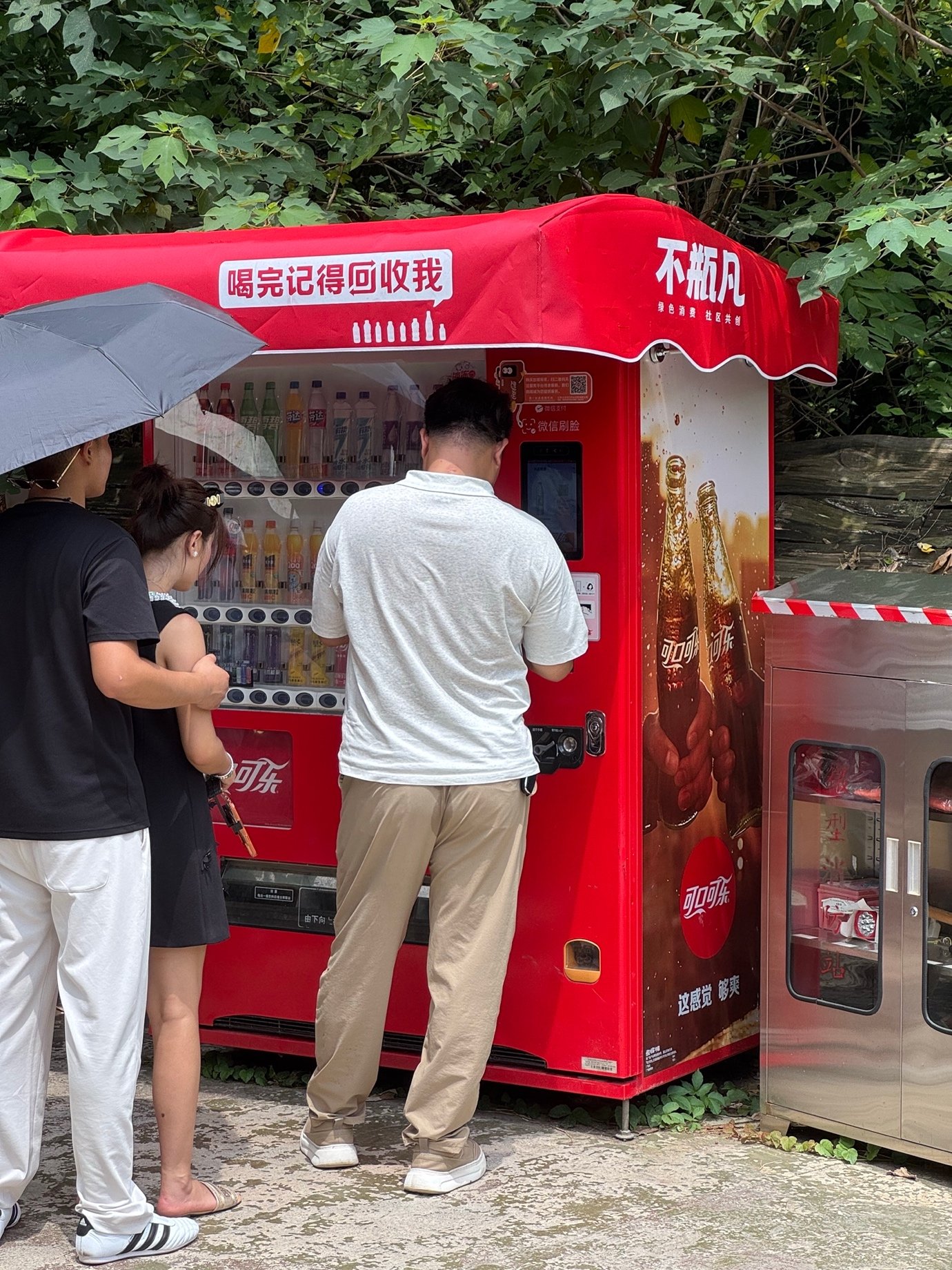
Before-and-after: Before the project, beverage bottles and other packaging generated by visitors at Hongshan Forest Zoo lacked a unified and visible recycling channel, and the concept of green consumption largely remained at the level of advocacy. As of May 2026, The Amazing Bottle Recycling Hub had collected approximately 11.02 tonnes of beverage packaging, equivalent to roughly 440,000 beverage bottles, providing visitors with a lasting, visible, and participatory entry point for green consumption practices.
Innovation highlights: In terms of model innovation, the project moved beyond the traditional model of “one-off environmental campaigns + short-term recycling activities” by developing and operating a long-term public participation facility in a public space, integrating green consumption into visitors’ everyday zoo experience. In terms of collaborative innovation, the Coca-Cola China System, Hongshan Forest Zoo, One Foundation, third-party recycling companies, and creative-design partners jointly participate in the project, with each contributing its respective expertise to form a stable, long-term collaborative operating mechanism. In terms of experiential innovation, the project is centered on the “Recycle Me · See You Again” concept and makes the entire process of collection, regeneration, and return visible, allowing visitors to directly see the transformation of a beverage bottle from “waste” into a “new object,” enhancing public engagement and a sense of participation in green consumption.
Sustainability and replicability: The project has grown from a single recycling facility into a community co-creation platform integrating public participation, environmental education, and green-consumption practices, and has established a stable long-term operating mechanism. Going forward, the project plans to systematically document its operating experience and provide a practical reference for green-consumption practices in public spaces across urban parks, communities, and cultural and tourism settings.
成果亮点
实施前后对比:项目实施前,红山森林动物园内游客产生的饮料瓶等包装物缺乏统一、可视化的回收渠道,绿色消费理念更多停留在倡导层面。截至2026年5月,「不瓶凡」回收小屋已累计回收约11.02吨饮料包装,相当于约44万个饮料瓶,为游客提供了一个持续可见、可参与的绿色消费实践入口。
创新亮点:模式创新方面,项目突破“一次性环保宣传+短期回收活动”的传统模式,建设并常态化运营公共空间内的长效参与设施,将绿色消费融入游客日常游园体验;协同创新方面,可口可乐中国系统、红山森林动物园、壹基金以及第三方回收企业、文创设计等多方伙伴共同参与,各方发挥专业优势,形成长期稳定的协同运营机制;体验创新方面,项目以“回收我·回头见”为核心理念,将回收、再生、回归的全过程可视化呈现,让游客直观看到一个饮料瓶从“废弃”到“新生”的转变,提升绿色消费的公众参与感与获得感。
可持续性与可复制性:项目已从单一回收设施发展为融合公众参与、环境教育与绿色消费实践的社区共建平台,并形成稳定的长期运营机制。未来,项目计划系统梳理运营经验,为城市公园、社区及文旅场景中的公共空间绿色消费实践提供可借鉴的参考。
Project Highlights
Ecological and environmental benefits: As of May 2026, The Amazing Bottle Recycling Hub had collected approximately 11.02 tonnes of beverage packaging, equivalent to roughly 440,000 beverage bottles, promoting the standardized and systematic recycling of single-use packaging in public spaces.
Social impact: Drawing on the zoo’s more than 8 million annual visitors, the project integrates green-consumption concepts into everyday zoo visits, engaging large numbers of visitors in beverage-bottle recycling and regeneration experiences. It also brings together multiple social forces, including the Coca-Cola China System, Hongshan Forest Zoo, One Foundation, third-party recycling companies, and creative-design partners, forming a collaborative practice for community co-creation around green consumption in public spaces, and providing practical reference for similar public, cultural and tourism, and community settings.
成果影响力
生态环境效益:截至2026年5月,「不瓶凡」回收小屋已累计回收约11.02吨饮料包装,相当于约44万个饮料瓶,促进公共空间一次性包装物的规范化、系统化回收。
社会影响效果:项目依托红山森林动物园年超800万人次的客流基础,将绿色消费理念融入日常游园场景,带动大量游客参与饮料瓶回收与再生互动体验;同时汇聚可口可乐中国系统、红山森林动物园、壹基金、第三方回收企业与文创设计伙伴等多方社会力量,形成公共空间绿色消费社区共建的协同实践,为同类公共、文旅及社区场景提供实践参考。
Reviews & Honors
Building on Hongshan Forest Zoo’s professional reputation and public influence in the fields of animal welfare, biodiversity conservation, and nature education, The Amazing Bottle Recycling Hub has received consistently positive feedback from visitors since it began regular operation. Visitors generally recognize its participatory, experiential, and visible approach to green consumption, and the zoo also regards it as an important component of its nature-education and public-participation activities.
The project has been shared internally within the Coca-Cola China System as a green-consumption case study and is planned to be further promoted as a practical example of multi-stakeholder collaboration to advance green consumption in public spaces. Going forward, the project team plans to systematically document its operating experience and continue optimizing the project, laying the groundwork for pursuing third-party certification and participating in industry awards and recognition in the future.
评价与荣誉
项目依托红山森林动物园在动物福利、生物多样性保护和自然教育领域的专业口碑与公众影响力,「不瓶凡」回收小屋自常态化运营以来,持续获得到访游客的积极反馈。游客普遍认可其“可参与、可体验、可看见”的绿色消费互动形式,园方也将其视为园区自然教育与公众参与内容的重要组成部分。
项目实践已在可口可乐中国系统内部作为绿色消费相关案例进行分享,并计划进一步作为多方协同推动公共空间绿色消费的实践样本进行推广。后续,项目团队计划系统梳理运营经验并持续优化,为未来申请第三方认证及参与行业评选奠定基础。
近零碳社区的美育升级---- 长寿苑社区 “低碳实践 + 影像科普” 共建项目
4天前 · 来源:成都市武侯区火车南站街道长寿苑社区居民委员会 · 作者:成都市武侯区火车南站街道长寿苑社区居民委员会
以绿色金融之力推动中国新质生产力!
4天前 · 来源:国泰海通证券研究所ESG及美丽中国研究组 · 作者:国泰海通证券研究所ESG及美丽中国研究组
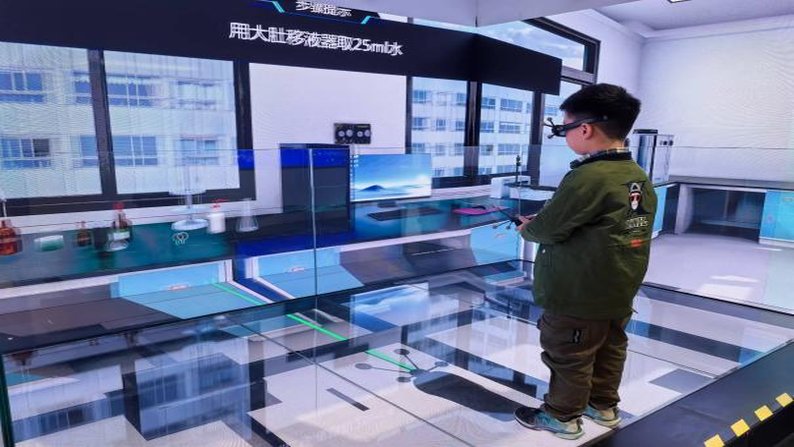
不择知行细流,蕴蓄蓝绿成深:雄安新区生态环境共享中心科普宣传空间营造雄安新区生态环境共享中心VR虚拟实验室(数字化仿真替代实体化学实验,实现科普零危废、低能耗)
6天前 · 来源:雄安新区生态环境监控中心 · 作者:雄安新区生态环境监控中心
