

Editor's Note A study indicates that without stronger measures to address sea-level rise, the Asia-Pacific region will incur massive annual coastal flood losses by 2100. Small island nations will be the hardest hit, even facing existential and economic crises.
编者按:一项研究指出,若不加强应对海平面上升的措施,亚太地区到2100年每年将蒙受巨额沿海洪灾损失,其中小岛屿国家受害最深、甚至面临生存与经济危机。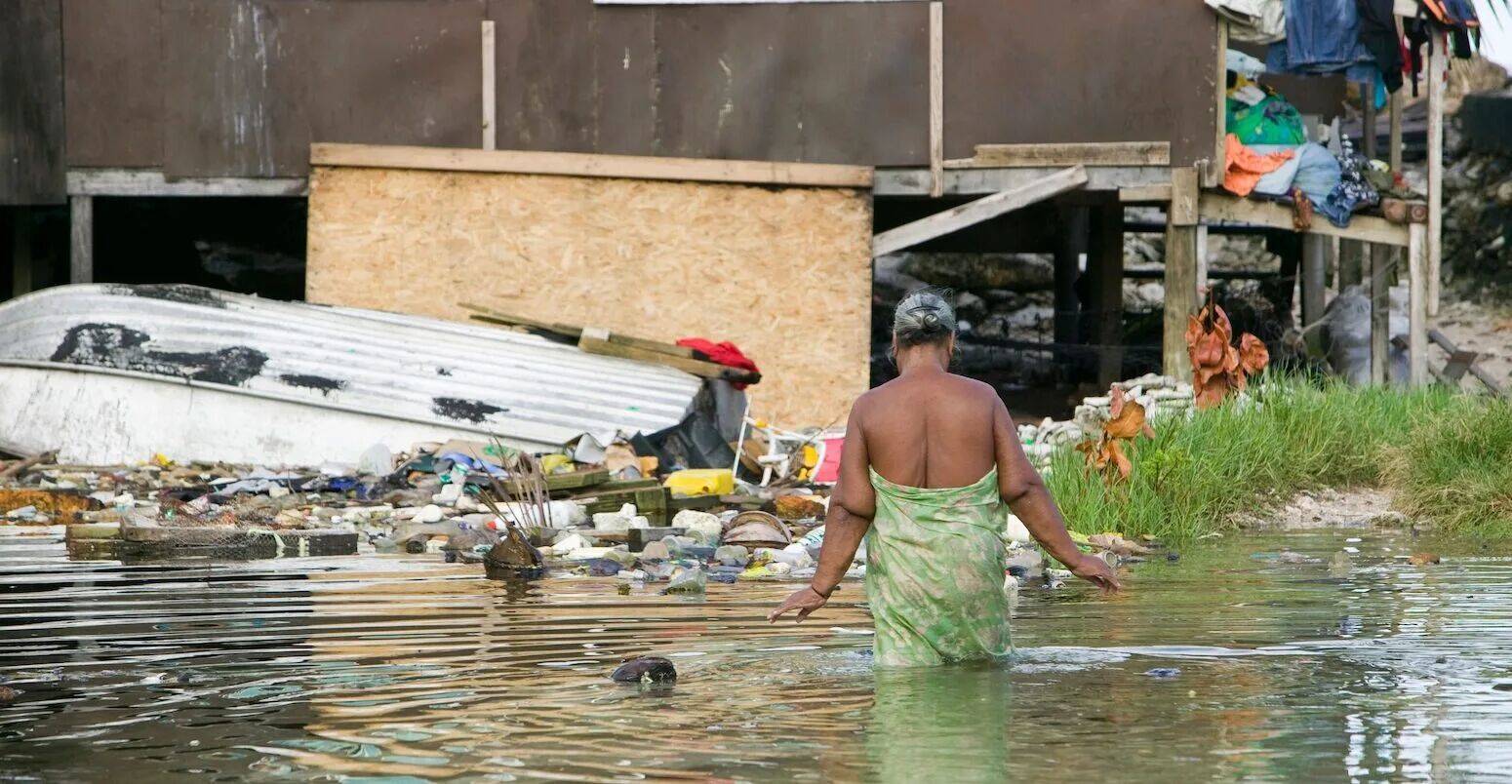
If countries fail to take measures to address sea-level rise, the Asia-Pacific region could suffer annual coastal flood losses of up to USD 500 billion by 2100.
This conclusion is drawn from a recent study published in the journal Scientific Reports. The research assesses the impact of coastal flooding on the Asia-Pacific region and uses modeling to predict the potential escalation of losses caused by sea-level rise throughout the 21st century.
The study shows that, at present, 29 countries in the Asia-Pacific region already incur annual losses of USD 26.8 billion due to coastal flooding, accounting for approximately 0.1% of the region’s gross domestic product (GDP).
如果各国不采取措施应对海平面上升,到2100年,亚太地区每年因沿海洪灾蒙受的损失可能高达5000亿美元。
这一结论出自《科学报告》(Scientific Reports)期刊最新发表的一项研究。该研究评估了沿海洪灾对亚太地区的影响,并通过模型预测了21世纪海平面上升可能导致的损失加剧情况。
研究显示,目前亚太地区29个国家每年因沿海洪灾造成的损失已达268亿美元,约占该地区GDP的0.1%。
Projections indicate that under existing policies, annual coastal flood losses in the region could surge to USD 518 billion by 2100. If global warming is limited to 1.5°C, however, these losses could be reduced to USD 338 billion.
The study highlights that small island nations face the highest risk of coastal flooding and will remain the most vulnerable as global warming continues.
Taking Tuvalu as an example, the study predicts that by the end of the century, the country’s annual coastal flood losses will be equivalent to 38% of its GDP.
预测表明,在现有政策下,到2100年该地区每年因沿海洪灾造成的损失可能增至5180亿美元。若能将全球升温控制在1.5C以内,损失则可降至3380亿美元。
研究表明,小岛屿国家面临的沿海洪灾风险最高,随着全球持续变暖,这些国家仍将首当其冲。
以图瓦卢为例,研究预测到本世纪末,该国每年因沿海洪灾造成的损失将相当于其国内生产总值的38%。
Meanwhile, small island nations such as Kiribati, the Maldives, Micronesia and Tuvalu are expected to permanently lose around 10% of their land area.
The lead author of the study stated that the report reveals the dual existential and economic threats posed by sea-level rise to low-lying islands in the Asia-Pacific region.
Speaking to Carbon Brief, the author emphasized that the research underscores a "severe inequality"—developing countries that bear minimal historical responsibility for sea-level rise are disproportionately suffering the worst impacts.
与此同时,基里巴斯、马尔代夫、密克罗尼西亚和图瓦卢等小岛屿国家预计将永久失去约10%的陆地面积。
研究主要作者表示,该报告揭示了海平面上升对亚太地区低洼岛屿构成的生存与经济双重威胁。
他向Carbon Brief指出,研究凸显了一种“严重的不平等”——那些对海平面上升历史责任较小的发展中国家,反而正遭受最严重的影响。
Coastal Losses
沿海损失
Currently, over one billion people worldwide—around 15% of the global population—live within 10 kilometers of the coastline.
Many of the world’s major cities are located in Asia, with a significant number situated along the coast, including Mumbai, Tokyo and Shanghai. Asia is home to 60% of the world’s coastal population.
Yet living close to water also comes with substantial risks.
The study points out that coastal flooding is caused by the combined
effects of gradual sea-level rise and "extreme sea level events" (such
as high tides and storm surges).
目前,全球有超过十亿人——约占世界人口的15%——居住在距离海岸线10公里以内的区域。
许多世界级大型城市位于亚洲地区,其中不少位于沿海,如孟买、东京和上海。全球60%的沿海人口分布在亚洲大陆。
然而,临水而居也伴随着诸多风险。
研究指出,沿海洪水是由海平面逐渐上升与“突发性极端海平面”(如高潮位和风暴潮)共同作用造成的。
To evaluate these two factors, the research integrated multiple elements, including ocean models and tidal height data.
The authors conducted flood simulations for all "developing member countries" in the Asia-Pacific coastal zone listed by the Asian Development Bank, which include 29 nations such as Bangladesh, the Philippines and Tuvalu.
By combining flood models, land use data, and the "asset values" of
residential, commercial, industrial, infrastructure and agricultural
sectors, the researchers calculated the potential economic losses from
flooding.
为评估这两方面因素,该研究综合运用了海洋模型与潮汐高度数据等多种要素。
作者针对亚洲开发银行所列的所有位于亚太沿海地区的“发展中成员国”进行了洪水模拟,这29个国家包括孟加拉国、菲律宾和图瓦卢等。
通过结合洪水模型、土地利用数据,以及住宅、商业、工业、基础设施和农业等领域的“资产价值”,研究人员计算了洪水可能导致的经济损失。
The authors assumed that assets in permanently submerged areas would be fully lost, while for periodically flooded regions, a model linking flood depth to the proportion of affected land was used to estimate economic losses.
The study found that current annual coastal flood losses in the Asia-Pacific region amount to approximately USD 27 billion.
China and Indonesia are the worst affected, with each suffering
annual losses exceeding USD 6 billion. The study authors note that this
is because both countries have "extensive coastlines, large populations
living in flood-prone areas, and critical economic infrastructure
concentrated along coastal zones".
However, the study also shows that small island nations bear the highest percentage of GDP losses due to flooding.
作者假设,若土地被永久淹没,相关“资产”将完全损失;而对周期性受淹的地区,则采用一套将洪水深度与受灾土地比例关联的模型来估算经济损失。
研究发现,目前亚太地区每年因沿海洪水造成的损失约为270亿美元。
其中中国和印尼的损失最为严重,年均损失均超60亿美元。研究作者指出,这是因为两国均拥有“漫长的海岸线、大量人口居住在易受洪灾影响的区域,且关键经济基础设施也集中于沿海地带”。
然而,研究也显示,小岛屿国家因洪水承受的经济损失占其国内生产总值(GDP)的比例最高。
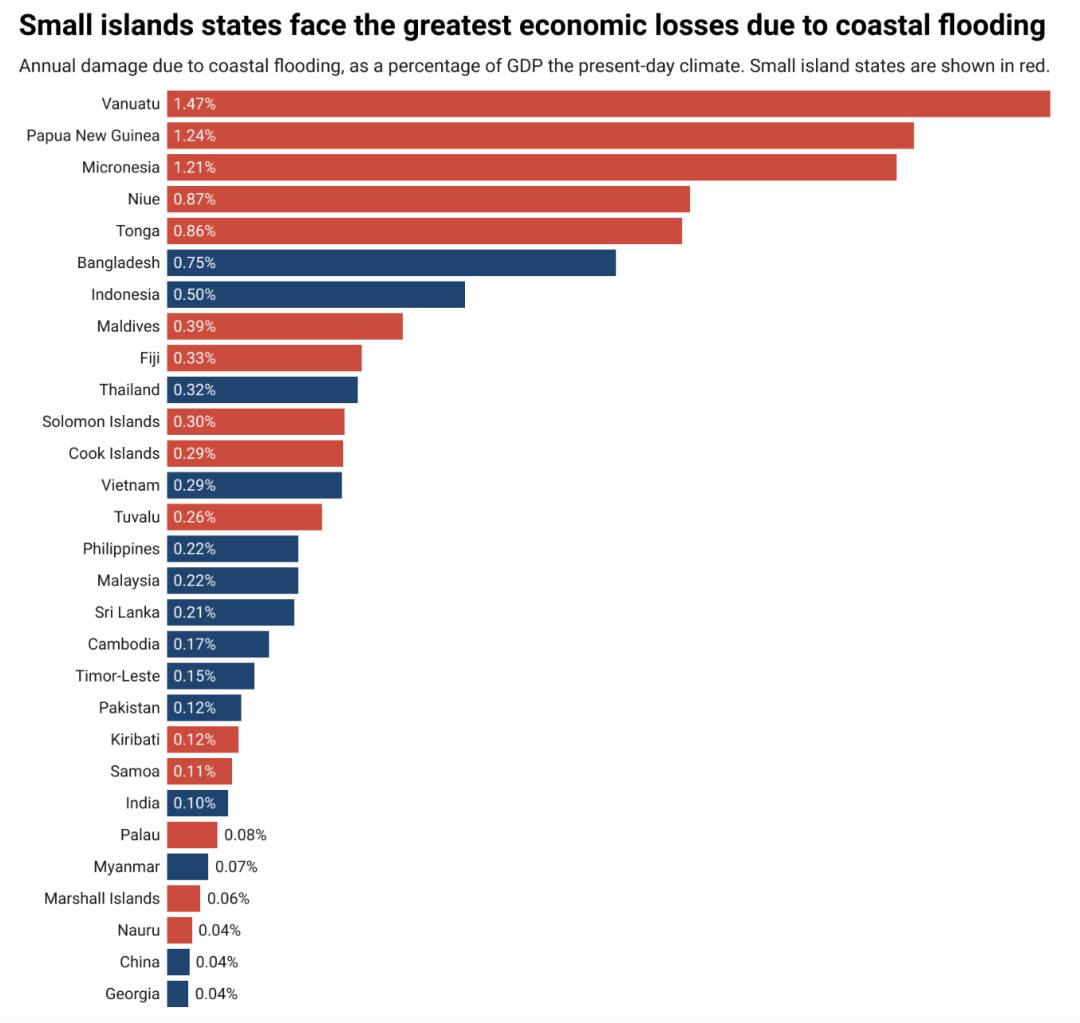
Annual GDP Loss Rate Caused by Coastal Flooding in 29 Asia-Pacific Countries. Small island nations are marked in red. Source: Monioudi et al. (2025). Chart produced by Carbon Brief.
亚太地区29个国家因沿海洪灾造成的年度GDP损失百分比。小岛屿国家以红色标示。数据来源:Monioudi等人(2025)。图表由Carbon Brief制作。
The study indicates that the five most severely affected countries are all small island nations. Vanuatu ranks first, with annual flood losses accounting for as much as 1.5% of its GDP, followed by Papua New Guinea and Micronesia.
The lead author of the study is Dr. Michalis Vousdoukas, a coastal geographer at the University of the Aegean.
He told Carbon Brief that these loss estimates are "conservative" because they do not take into account indirect economic losses, such as business disruptions, damage to critical infrastructure (e.g., airports), and social impacts like population displacement.
研究表明,受影响最严重的五个国家均为小岛屿国家。其中瓦努阿图位居首位,每年因洪水损失的GDP高达1.5%;巴布亚新几内亚和密克罗尼西亚紧随其后。
该研究的主要作者是爱琴大学(University of the Aegean)海岸地理学研究员米哈利斯·沃斯杜卡斯(Michalis Vousdoukas)博士。
他向Carbon Brief表示,这些损失估算已算“保守”,因为它们未考虑间接经济损失,例如商业活动中断、关键基础设施(如机场)损毁,以及人口迁移等社会影响。
Dr. Vousdoukas pointed out that the research "highlights a severe imbalance between responsibility and impact", explaining: "Countries that have contributed the least to global carbon emissions—especially atoll nations—are bearing the brunt of relative losses."
In the Asia-Pacific region, atoll nations composed of ring-shaped coral reefs or islands include Kiribati, the Marshall Islands and Tuvalu.
沃斯杜卡斯指出,这项研究“凸显了责任与影响之间的严重失衡”,并解释说:“那些对全球碳排放影响最小的国家——特别是环礁国家,反而承受着最严重的相对损失。”
在亚太地区,由环状珊瑚礁或岛屿构成的环礁国家包括基里巴斯、马绍尔群岛和图瓦卢。
Funding Gap
资金缺口
Countries can mitigate the impacts of coastal flooding through climate adaptation measures, including building flood defense infrastructure, enhancing the flood resilience of existing infrastructure, or organizing "managed retreat"—relocating people from high-risk areas as sea levels rise.
By simulating the costs of constructing flood protection facilities such as seawalls, dykes, sand barriers and sand dunes, the study authors assessed how to limit 21st-century coastal flood economic losses to 2020 levels.
The results emphasize that the cost of investing in these flood defense measures is far lower than the potential economic losses triggered by sea-level rise.
各国可以通过气候适应措施来减轻沿海洪灾的影响,包括修建防洪设施、提高基础设施的抗洪能力,或组织“有管理的撤离”(managed retreat)—— 在海平面上升时将民众从高风险地区转移。
该研究的作者通过模拟修建海堤、堤坝、沙堤和沙丘等防洪设施的成本,评估了如何将21世纪沿海洪灾造成的经济损失控制在2020年水平。
结果强调,投资这些防洪设施的成本远低于海平面上升可能引发的经济损失。
According to the authors’ estimates, under the 1.5°C warming scenario, the total cost of building flood defense infrastructure to cap flood losses at 2020 levels would be approximately USD 9 billion. These measures are expected to prevent USD 157 billion in coastal flood losses.
Dr. Rafael Almar, a researcher at the Laboratory of Space Geophysical and Oceanographic Studies in France who was not involved in the study, stated that the research is "of great reference value for development banks and financial institutions", helping them prioritize investments in "identified hotspot areas".
However, he also stressed that building flood defense infrastructure is "not the only solution". For example, he argues that "relocation and renaturalization"—moving residents away from the coast and restoring land to its natural state—can also enhance regional "resilience".
据作者估算,在升温1.5C的情景下,若要将洪灾损失限制在2020年的水平,修建防洪设施的总成本约为90亿美元。而这些措施预计可避免1570亿美元的沿海洪灾损失。
法国空间地球物理与海洋学研究实验室(Laboratory of Space Geophysical and Oceanographic Studies)研究员拉斐尔·阿尔玛(Rafael Almar)博士未参与此项研究。他表示,该研究“对开发银行和金融机构具有重要参考价值”,有助于它们优先对“已明确的热点区域”进行投资。
但他同时强调,修建防洪设施“并非唯一解”。例如,他认为“搬迁与再自然化”——即把居民迁离海岸、让土地恢复自然状态——也能提升地区的“韧性”。
Ranjan Panda, convener of the Combat Climate Change Network in India, who also did not participate in the study, warned that physical flood defense infrastructure "may actually trigger new local environmental crises, exacerbating the losses and harms people face from sea-level rise and flooding".
An article by Climate Home News notes that seawalls have been proven to harm wildlife—for instance, hindering animals such as sea turtles from accessing certain beaches. The article also mentions that physical flood defense infrastructure "lacks flexibility" and "often primarily benefits wealthy groups, while potentially encouraging development in high-risk coastal areas".
In international climate negotiations, how to mobilize funds for developing countries to address climate change impacts remains a persistent topic of discussion.
印度应对气候变化网络(Combat Climate Change Network)召集人兰詹·潘达(Ranjan Panda)并未参与这项研究。他也警示,实体防洪设施“实际上可能引发新的局部环境危机,加剧人们因海平面上升和洪水所遭受的损失与伤害”。
气候之家新闻(Climate Home News)的一篇文章指出,海堤已被证实会对野生动物造成危害——例如阻碍海龟等动物进入部分海滩。文章还提到,实体防洪设施“缺乏灵活性”,且“往往主要惠及富裕群体,并可能助长沿海高风险地带的开发”。
在国际气候谈判中,如何为发展中国家筹集资金以应对气候变化影响,始终是一个持续讨论的议题。
Under the Paris Agreement, a group of developed countries—including most of Europe, the United States and Japan—are obligated to provide international "climate finance" to developing countries. These funds can be used both for climate mitigation (controlling warming through emission reduction) and climate adaptation.
A recent UN report shows that developed countries provided USD 26 billion in international climate adaptation finance to developing countries in 2023. This amount is roughly equivalent to the current annual coastal flood losses suffered by countries in the Asia-Pacific region.
根据《巴黎协定》,包括欧洲大部分地区、美国和日本在内的一批发达国家,有义务向发展中国家提供国际“气候融资”。这些资金既可用于减缓气候变化(通过减排控制升温),也可用于气候适应。
联合国近期报告显示,2023年发达国家向发展中国家提供了260亿美元的国际气候适应资金。这一数额,大致相当于目前亚太地区国家每年因沿海洪灾所蒙受的损失。
(Using AI translation)
(使用AI翻译)

南方电网省域电力系统碳排放可溯源数据库发布
5天前 · 来源:南方电网报 · 作者:南方电网

2026年国际“碳中和与能源智联”论坛在京举行
05-25 · 来源:清华大学 · 作者:清华大学

重磅!虚拟电厂领域国家标准发布!
03-12 · 来源:中国电力报 · 作者:中国电力报
