

Company/Organization Profile
The School of Architecture of Chang'an University was formed through the merger of the Department of Architecture of the former Northwest Institute of Architectural Engineering and other units. It offers three five-year undergraduate programs: Architecture, Urban and Rural Planning, and Landscape Architecture. Architecture and Urban and Rural Planning are national first-class undergraduate programs. The School has a doctoral program in Urban and Rural Planning and master's programs in Architecture and Urban and Rural Planning. Relying on the Human Settlements and Building Energy Efficiency Laboratory and the Western New Urbanization Carbon Neutrality Research Institute, the School organizes faculty, students, and community residents to participate in green space creation, low-carbon community renewal, ecological planning, and heritage preservation. It promotes co-construction, co-governance, and sharing, and has produced practical outcomes with distinctive western regional features, serving the building of a Beautiful China.
机构简介
长安大学建筑学院由原西北建筑工程学院建筑系等合并组建,设建筑学、城乡规划、风景园林三个五年制本科专业,建筑学、城乡规划为国家级一流专业,拥有城乡规划学博士点及建筑学、城乡规划学硕士点。学院依托人居环境与建筑节能实验室、西部新型城镇化碳中和研究院,组织师生与社区居民参与绿色空间营造、低碳社区更新、生态规划与遗产保护,推动共建共治共享,形成西部地域特色实践成果,服务美丽中国建设。

Project Overview
Current Problems:University campuses contain many leftover wastelands with low spatial quality and little ecological education function. Meanwhile, old urban communities generally face a shortage of public space, aging facilities, and low resident participation; 56% of residents are over 60 years old, and although residents enjoy planting, they lack professional guidance.
Cause Analysis:Although campuses and communities differ in spatial attributes, they face a common dilemma rooted in the same cause: space users are “managed and arranged” and therefore lack a sense of participation and belonging. Campus green spaces are managed solely by campus logistics departments. Teachers and students, as the primary users, have long been absent from their management, resulting in a disconnect between teaching activities and actual spaces. In old communities, due to the lack of professional capacity and organizational mechanisms, residents have the will to renovate but do not know where to start, leaving spatial governance trapped in a passive cycle of “the government does, residents watch.” More importantly, there is no bridge linking the campus and the community. Universities’ ecological education resources and technical expertise cannot effectively extend to surrounding communities, while communities’ real needs and governance experience can hardly enter university classrooms. As a result, the two become isolated islands, with resources and needs misaligned in both directions.
Improvement Goals:Using the “Garden Making” course as a link, break down the resource barriers between campus and community. On the campus side, transform wastelands into mini gardens that combine ecological cycle experiments with popular science displays, and embed them into the general education curriculum so that students can “learn by doing.” On the community side, export the composting techniques, planting and maintenance experience, and participatory design methods accumulated on campus to old residential areas, thereby cultivating residents’ capacity for self-governance. Through the linkage path of “campus demonstration first—community replication and promotion,” establish a long-term operational mechanism for multi-stakeholder co-construction and sharing among “teachers and students—Community committee staff—residents,” and achieve the threefold goal of improving spatial quality, popularizing ecological awareness, and innovating social governance.
项目背景
问题现状:高校校园中存在大量边角荒地,空间品质低下且缺乏生态教育功能。同时,城市老旧社区普遍面临公共空间匮乏、设施老化、居民参与度低等困境,60岁以上老人占比56%,居民虽热爱种植但缺乏专业指导。
原因分析:校园与社区虽空间属性不同,却面临一脉相承的共性困境——空间使用者“被管理、被安排”,缺乏参与感与归属感。校园绿色空间由后勤单方管理,师生作为主要使用者长期缺位,教学活动与真实空间割裂;老旧社区则因缺乏专业力量和组织机制,居民虽有改造意愿却无从下手,空间治理陷入“政府干、居民看”的被动循环。更关键的是,校园与社区之间缺少联动桥梁——高校的生态教育资源、技术人才优势无法有效辐射周边社区,社区的真实需求与治理经验也难以进入高校课堂,二者互为“孤岛”,资源与需求双向错位。
改进目标:以“花园营造课程”为纽带,打通校园与社区之间的资源壁垒。在校园端,将荒地改造为兼具生态循环实验与科普展示功能的迷你花园,并嵌入通识课程教学体系,让学生“在做中学”;在社区端,将校园累积的堆肥技术、种植养护经验与参与式设计方法向老旧小区输出,培育居民自治能力。通过“校园先行示范—社区复制推广”的联动路径,构建“师生—社区工作人员—居民”多方共建共享的长效运行机制,实现空间品质提升、生态认知普及与社会治理创新的三重目标。
Project Implementation
In response to Problem 1: Poor spatial quality of campus leftover wasteland and lack of ecological education function
Measures taken:A spatial micro-renovation was carried out on a 128 m² debris-strewn wasteland next to the express delivery station at Chang’an University. Through the real task of the campus general education course “Garden Making,” the wasteland was transformed into a mini garden comprising an ecological cycle experiment area, handmade paths, a planting area, and a composting demonstration area. The spatial renovation highlighted “low-carbon visibility”: ecological facilities such as composting units and rainwater collection barrels were integrated into the garden in an observable and interactive manner, making the ecological cycle process “visible and tangible.”
Implemented by:A “dual-teacher” teaching team from the Department of Landscape Architecture, School of Architecture, Chang’an University, leading 20 first-year undergraduates, in collaboration with the Logistics Management Office.
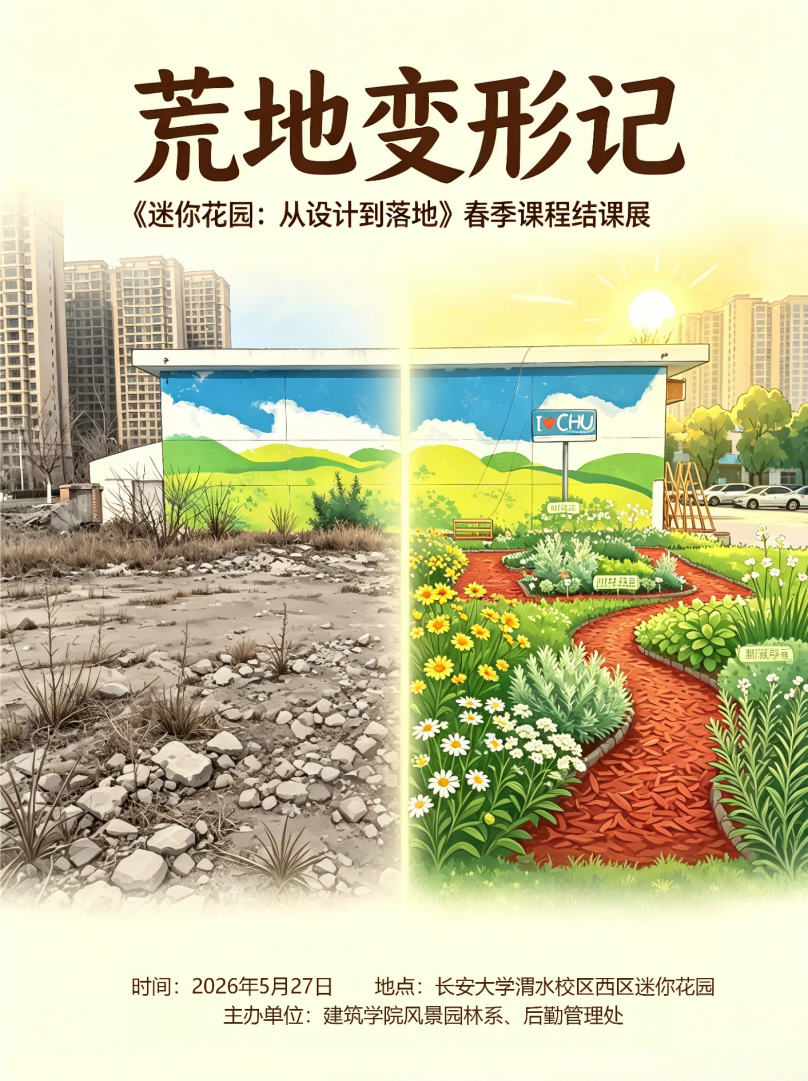
Implementation process:The course adopted six progressive teaching modules: Week 1 “Mind Blueprint” → Weeks 2–5 “Vitality Creation” → Week 6 onward “Fertile Soil Circulation” → Week 7 “Steps into Paths” → Weeks 8–10 “Mindful Maintenance” → Weeks 11–13 “Blooming Echoes.” Lasting 13 weeks (March–May 2026), it concluded with the final exhibition “Wasteland Metamorphosis,” simultaneously completing the spatial renovation and the presentation of outcomes.
In response to Problem 2: Lack of immersive scenarios for ecological and environmental science education
Measures taken:Ecological and environmental science popularization was deeply embedded into the daily use scenarios of the garden. Specifically: ① Ecological cycle comparison experiment—four composting units were set up in the garden. Students were divided into groups to conduct comparative experiments on pure leaf compost, pre-meal kitchen waste + leaf compost, and post-meal kitchen waste + leaves + coffee grounds compost. They regularly measured and recorded changes in temperature, humidity, and odor, and wrote “composting logs.” ② Nature notes and guided tours—students produced nature journals and garden guide display boards, and explained ecological cycle knowledge to all teachers and students at the “Wasteland Metamorphosis” final exhibition. ③ Science popularization signage system—ecological knowledge signs were installed at key nodes in the garden, allowing visitors to “enjoy a scene at every step and learn something from every scene.”
Implemented by:Students worked in small groups to design four plots, A/B/C/D, and completed the design of the science popularization content under the guidance of the teaching team; logistics workers assisted with site support.
Implementation process:The science popularization content was generated in tandem with the course progress. Each time students completed a practical module, they produced corresponding popular science materials, ultimately forming a complete set of “mobile science popularization exhibits” that could be displayed in the garden over the long term and also used for community outreach.
In response to Problem 3: Low participation among space users such as students and community residents and lack of guidance for green behaviors
Measures taken:Diverse user groups were organized to deeply participate in low-carbon actions.① At the student level—through the course design, 20 first-year undergraduates were transformed from “passive listeners” into “garden makers,” participating in the entire process of design, clearing, composting, planting, maintenance, and exhibition.② At the logistics worker level—logistics workers were invited to join the teaching team. Through discussions, joint planning, and collaborative maintenance, their role was transformed from “space maintainers” to “teaching co-builders.” Students spontaneously formulated a “maintenance convention,” pledging to regularly care for the garden after the course ended.③ At the community level—the campus model was replicated in Xi’an’s Xisan Road Gongshang Family Courtyard, Honghui Community in Xiyi Road Subdistrict, and the Provincial Foreign Trade Family Courtyard. Residents were organized to participate in community garden making, from participatory surveys and waste resource utilization to ecological planting training, guiding residents to shift from “bystanders” to “co-builders.”
Implemented by:The campus scenario was jointly promoted by the School of Architecture of Chang’an University and the Logistics Management Office. The community scenario was jointly implemented by a student volunteer team from the School of Architecture of Chang’an University, together with subdistrict offices, community workers, and community residents.
Implementation process:The campus scenario ensured systematic and sustained student participation through the course mechanism. The community scenario adopted a “companion-style” maintenance model and established the “Community Garden Technical Support WeChat Group,” providing remote guidance even after the university team left, thereby ensuring the long-term effectiveness of resident participation
In response to Problem 4: Lack of a long-term operational mechanism, making green spaces difficult to sustain
Measures taken:A long-term operational mechanism for co-construction and sharing was established. ① At the campus level—garden maintenance was incorporated into the follow-up management of the course, with students pledging to return regularly after the course to care for the garden; an online forum called “Garden Log” was established so that students across cohorts could take over maintenance; and a regular cooperation mechanism was set up with the Logistics Management Office to ensure maintenance support during critical periods such as summer vacation. ② At the community level—the “Community Garden Residents’ Convention” was drafted jointly with the community self-management group, clarifying rules for plot adoption, a watering duty rotation system, and composting maintenance requirements; a “Community Garden Technical Support WeChat Group” was established to provide remote technical support; and the community garden practice site was included as a community micro-governance demonstration site, gaining sustained attention and resource support from the government and social organizations.
Implemented by:The campus mechanism is jointly maintained by the teaching team, the Logistics Management Office, and students; the community mechanism is collaboratively advanced by the residents’ self-management group, social organizations, and a university volunteer team.
Implementation process:Through the three-in-one model of “convention + WeChat group + demonstration site,” the green spaces are ensured to continue operating after the project ends. The community self-management group has already used self-raised funds to purchase rainwater collection barrels, and residents have spontaneously added more composting bins and public notice boards, indicating that the mechanism has begun to operate autonomously.
项目实施
针对问题一:校园边角荒地空间品质差、缺乏生态教育功能
采取的措施:针对长安大学快递驿站旁128㎡杂物荒地实施空间微改造。通过校园通识课“花园营造”真实任务,将荒地转化为包含生态循环实验区、手作步道、植物种植区、堆肥展示区的迷你花园。空间改造突出“低碳可视”:堆肥单元、雨水收集桶等生态设施均以可观察、可互动的方式融入花园,使生态循环过程“看得见、摸得着”。
由谁实施:长安大学建筑学院风景园林系“双师”教学团队带领20名大一新生,联合后勤管理处共同完成。
如何推进:课程设置六大板块进阶式教学:第1周“心境蓝图”→第2-5周“生机营造”→第6周起“沃土循环”→第7周“步履成径”→第8-10周“静心养护”→第11-13周“花开回响”,历时13周(2026年3月-5月),最终举办“荒地变形记”结课展,实现空间改造与成果展示同步完成。
针对问题二:生态环境科普教育缺乏浸润式场景
采取的措施:将生态环境科普深度植入花园日常使用场景。具体包括:①生态循环对比实验——在花园设置4个堆肥单元,学生分组进行纯落叶堆肥、餐前厨余+落叶堆肥、餐后厨余+落叶+咖啡渣堆肥对比实验,定期测量记录温度、湿度、气味变化,撰写“堆肥日志”;②自然笔记与导览——学生制作自然笔记和花园导览展板,在“荒地变形记”结课展中向全校师生讲解生态循环知识;③科普标识系统——在花园关键节点设置生态知识标识牌,使来访者“一步一景、一景一学”。
由谁实施: 学生以小组为单位设计A/B/C/D四个地块,在教学团队指导下完成科普内容设计,后勤工人协助提供场地支持。
如何推进: 科普内容与课程进度同步生成。学生每完成一个实践环节,即制作相应科普材料,最终形成一套完整的“可移动科普展品”,可在花园内长期展示,也可用于社区推广。
针对问题三:空间使用者,如学生和社区居民的参与度低、绿色行为缺乏引导
采取的措施: 组织多元使用者群体深度参与低碳行动。①学生层面——通过课程设计,20名大一新生从“被动听课者”转变为“花园营造者”,全程参与设计、清理、堆肥、种植、养护、展览全流程;②后勤工人层面——邀请后勤工人加入教学团队,通过座谈、共议方案、联合养护实现“后勤工人从空间维护者到教学共建者”的角色转变,学生自发制定“养护公约”,承诺课程结束后定期照管花园;③社区层面——将校园模式复制至西安市西三路工商家属院、西一路街道红会社区、省外贸家属院,组织居民参与社区花园营造从参与式调研、废弃物资源化到生态种植培训,引导居民从“旁观者”变为“共建者”。
由谁实施: 校园场景由长安大学建筑学院和后勤管理处联合推进;社区场景由长安大学建筑学院学生志愿者团队联合街道办、社区工作者、社区居民共同实施。
如何推进: 校园场景通过课程机制确保学生参与的系统性和持续性;社区场景通过“陪伴式”维护模式,建立“社区花园技术支援微信群”,在高校团队离开后仍能提供远程指导,保障居民参与的长效性。
针对问题四:缺乏长效运行机制,绿色空间难以持续
采取的措施: 建立共建共享的长效运行机制。①校园层面——将花园养护纳入课程后续管理,学生承诺结课后定期回访照管;建立“花园日志”线上论坛,跨届学生可接力维护;与后勤管理处建立常态化合作机制,确保暑期等关键时期的养护保障。②社区层面——与社区自管小组共同起草《社区花园居民公约》,明确菜园认领规则、浇水轮值制度和堆肥维护要求;建立“社区花园技术支援微信群”,提供远程技术支持;将社区花园实践点纳入社区微治理示范点,获得政府和社会组织的持续关注与资源支持。
由谁实施: 校园机制由教学团队、后勤管理处、学生三方共同维护;社区机制由居民自管小组、社会组织、高校志愿者团队三方协同推进。
如何推进: 通过“公约+微信群+示范点”的三位一体模式,确保绿色空间在项目结束后仍能持续运行。社区自管小组已使用自筹经费购买雨水收集桶,居民自发增加堆肥罐和公示牌,表明机制已开始自主运转。
Project Outcome
(1) Comparison Before and After Implementation
Comparison Before and After Community Space Transformation:In the Industrial and Commercial Staff Residential Compound and the Provincial Foreign Trade Staff Residential Compound on West 3rd Road, Xi'an, through the creation of community gardens, the public spaces have transformed from "unattended debris piles" into "vegetable gardens and flower gardens spontaneously maintained by residents." Residents have self-funded the purchase of rainwater collection barrels, spontaneously added composting bins and informational signboards, and neighborhood relations have become more harmonious.
(II) Innovative Highlights
1. Mechanism Innovation — "From Space Users to Co-builders":Transforming students, logistics workers, and community residents from "passive users" into "active space co-builders." Students transition from "lecture attendees" to "garden creators," logistics workers shift from "maintainers" to "teaching co-builders," and residents evolve from "bystanders" to "governance participants."
2. Technological Innovation — "Visualization of Ecological Cycle Popular Science":Transforming the abstract concept of "material cycles" into four sets of operable, observable, and measurable comparative experiments. Combined with nature journals, garden tours, and popular science signboards, this achieves an imperceptible and profound public education effect.
3. Model Innovation — "Campus First, Community Follow-up, Urban-Rural Linkage":Forming a replicable and scalable chain from campus to community. Starting from a 128 m² wasteland on campus → extending to unmanaged old residential communities → and with future potential to expand to rural schools, urban villages, and other scenarios, achieving a radiation effect of "one campus, one garden + multiple community nodes."
4. Synergistic Innovation — "Four-Party Collaboration: Teaching-Research, Logistics, Social Organizations, and Community Self-Governance":Combining universities, logistics management departments, social organizations (Shaanxi Puhui Youth Social Development Center), and community self-management groups to form a complete closed-loop consisting of "technical support + spatial guarantee + organizational coordination + resident self-governance."
(III) Sustainability and Replicability
Sustainability:The course has been incorporated into the university's general education curriculum system (with a fixed course code: 41TX1028.01) and has received support from key teaching reform projects and the Ministry of Ecology and Environment, providing a foundation for long-term operation. At the community level, maintenance is ensured through the "Resident Convention" and a "Technical Support WeChat Group." The community has designated this practice site as a demonstration point for community micro-governance, having already formed a sustainable "Convention + Community Group + Demonstration" mechanism.
Replicability:The core model—"Low-threshold initiation (utilizing marginal wasteland) + Ecological cycle popular science (compost comparative experiments) + Multi-party participation (teachers/students, logistics, residents, social organizations) + Long-term maintenance (conventions/WeChat groups)"—can be directly replicated by other universities, primary and secondary schools, and communities. Currently, it has been successfully validated at Chang'an University campus and two old residential communities in Xi'an, demonstrating the conditions for cross-regional promotion.
成果亮点
(一)实施前后对比
社区空间改造前后对比: 西安市西三路工商家属院、省外贸家属院通过社区花园营造,公共空间从“无人问津的杂物堆”转变为“居民自发维护的菜园和花园”,居民自筹资金购买雨水收集桶,自发增加堆肥罐和公示牌,邻里关系更加和睦。
(二)创新性亮点
机制创新——“空间使用者变共建者”:将学生、后勤工人、社区居民从“被动使用者”转变为“空间共建者”。学生从“听课者”变为“花园营造者”,后勤工人从“维护者”变为“教学共建者”,居民从“旁观者”变为“治理参与者”。
技术创新——“生态循环科普可视化”:将抽象的“物质循环”概念转化为可操作、可观察、可测量的4组对比实验,配合自然笔记、花园导览、科普标识牌,实现“润物无声”的公众教育效果。
模式创新——“校园先行、社区跟进、城乡联动”:形成从校园到社区的可复制推广链条。校园128㎡荒地→老旧社区“三无”小区→未来可拓展至乡村学校、城中村等场景,实现“一校一园+社区多点”的辐射效应。
协同创新——“教研-后勤-社会组织-社区自治”四方协同:联合高校、后勤管理处、社会组织(陕西普辉青年社会发展中心)、社区自管小组,形成“技术支撑+空间保障+组织协调+居民自治”的完整闭环。
(三)持续性与可复制性
持续性: 课程已纳入学校通识课程体系(固定课程代码41TX1028.01),获得教改重点项目和生态环境部课题支持,具备长期运行基础。社区层面通过《居民公约》和“技术支援微信群”保障维护,社区将该实践点列为社区微治理示范点,已形成可持续的“公约+社群+示范”机制。
可复制性: 核心模式“低门槛启动(利用边角荒地)+生态循环科普(堆肥对比实验)+多方参与(师生/后勤/居民/社会组织)+长效维护(公约/微信群)”可被其他高校、中小学、社区直接复制。当前已在长安大学校园和西安两个老旧社区完成验证,具备跨区域推广条件。
Project Highlights
(1) Ecological and Environmental Benefits
Waste Reduction and Resource Recovery: Through the core "Soil-Enrichment Cycle" component, the course converts campus kitchen waste (pre- and post-meal food waste, coffee grounds) and green waste (fallen leaves, grass clippings) into soil improvement resources for the garden, achieving a cumulative reduction of approximately 50 kg of campus waste (based on composting log records from March to May 2026). The handcrafted trail utilizes broken old bricks and tiles, putting the "Zero Waste" concept into practice. During community promotion, residents were guided to collectively compost fallen leaves and vegetable scraps, while old bricks, used tires, and old wooden boards were repurposed into flower beds, seating, and decorative elements, promoting the recycling and utilization of community waste.
(2) Social Impact
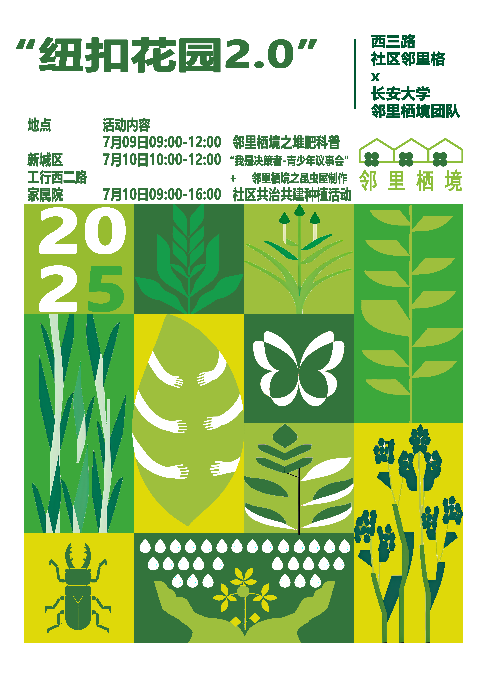
Public Participation: Over 30 teachers and students (including students from the experimental group) directly participated. Pre- and post-test data confirmed a significant improvement in students' ecological cognition and behavior. Students voluntarily promoted waste sorting and water conservation messages to their peers, expanding the reach of environmental education. At the community level:In the ICBC residential compound on West 3rd Road, 68 households (approximately 120 residents) participated in the community garden creation. The team engaged deeply with community members through a model of "co-discussing needs, co-building spaces, and co-governing the environment," transforming idle old flower beds into a shared garden. This initiative not only significantly enhanced the quality of community public spaces but also practically improved residents' living environment, earning widespread recognition from the community.In the Provincial Foreign Trade residential compound, 90 households (approximately 150 residents) participated in a series of community garden activities. Through activities such as signage system design, site cleaning, insect hotel construction, and smart garden design, the team proposed renovation plans for the old residential community garden and has been steadily advancing their implementation.
Cross-Sector Collaboration:A normalized collaboration mechanism has been established between the university's School of Architecture and the Logistics Management Department. Meanwhile, social organizations such as the Shaanxi Puhui Youth Social Development Center have been engaged to extend these practices to the communities. This has created a synergistic innovation model characterized by "University Think Tanks + Social Organizations + Community Self-Governance."
Industry Demonstration and Regional Leadership:The project outcomes were presented at the 2026 Academic Symposium on Nature Education. The West 3rd Road Community in Xi'an has designated this practice site as a demonstration point for community micro-governance. This model can be further expanded to communities, urban villages, and other contexts, forming a complete promotion chain of "Campus First, Community Follow-up, Urban-Rural Linkage." It serves as a replicable and scalable practical template for the 2026 "Beautiful China · Green Space Users Action" initiative.
成果影响力
四、成果影响力
(一)生态环境效益
减废与资源化: 课程通过“沃土循环”核心环节,将校园厨余垃圾(餐前/餐后厨余、咖啡渣)和绿化废弃物(落叶、草屑)转化为花园土壤改良资源,累计减少校园废弃物约50公斤(依据堆肥日志记录,统计周期2026年3月-5月)。手作步道利用破碎旧砖瓦,实现“零废弃”理念落地。社区推广中,指导居民将小区落叶、菜叶集中堆肥,将旧砖、旧轮胎、旧木板改造为花池、座椅和装饰件,推动社区废弃物资源化利用。
(二)社会影响效果
公众参与: 直接参与师生30余人(包含实验组学生),通过前后测数据验证了课程对学生生态认知和行为的显著提升。学生自发向身边同学宣传垃圾分类与节约用水,扩大环境教育覆盖面。社区层面:西三路工行家属院68户约120人参与了社区花园营造,团队与社区居民深度联动,通过“共商需求、共建空间、共治环境”的模式,将社区内闲置老旧的花坛改造为共享花园,不仅让社区公共空间品质显著提升,更切实改善了居民的人居环境,赢得了社区上下的广泛认可;省外贸家属院90户约150人参与了社区花园系列活动,团队通过标识系统设计、场地清洁、昆虫屋制作与花园智能设计系列活动,提出老旧小区花园更新方案,并逐步推进实施。
跨部门协同: 形成高校建筑学院与后勤管理处的常态化合作机制,并联合陕西普辉青年社会发展中心等社会组织向社区推广,实现“高校智库+社会组织+社区自治”的协同创新。
行业示范与区域带动: 课程成果在2026年自然教育学术研讨会上进行汇报,西安市西三路社区将该实践点列为社区微治理示范点,该模式可进一步推广至社区、城中村等场景,形成“校园先行、社区跟进、城乡联动”的完整推广链条,为2026年“美丽中国·绿色空间使用者行动”提供可复制、可推广的实践范本。
Reviews & Honors
1. Evaluation Feedback
The course validated significant effectiveness through pre- and post-test questionnaires (N=19 experimental group): students' comprehensive score of nature education increased by +0.35, campus nature cognition/nature-approaching behavior increased by +0.63, and ecological ethics and caregiving responsibility remained stable.
Student qualitative feedback was highly positive, with many commonly expressing sentiments such as: "I went from 'I can't do this' to 'I made this,'" "For the first time, I intuitively experienced that life has a cycle," and "After chatting with Logistics Worker Master Ji, I only then learned that they start working at 5 AM every day."
Logistics Worker Wang Yonghui commented: "The students not only learned how to plant flowers and vegetables, but also learned to respect labor."
The head of the community self-management group reported: "The students brought in professional methods, and now we residents can maintain the garden well by ourselves."
2. Media/Industry RecognitionThe course outcomes were presented as a special topic at the 2026 Academic Symposium on Nature Education, receiving praise from attending experts for "providing a replicable template for the integration of aesthetic education and nature education in universities." The community engagement activities were featured on University Student Times and University Student Cloud News.
3. Awards and Honors
The course has been approved as a Key Teaching Reform Project of Chang'an University in 2025 (Project No.: BZ202534) and has received support from the Ministry of Ecology and Environment's Ecological Civilization Education Research Project in 2026.
Meanwhile, the community building initiative has won the following awards,The "On-site Deep Engagement Award" in the [Community Garden Track] of the National College Students' Garden Design and Construction Competition;The Social Responsibility Award in the 5th National Community Garden Design, Construction, and Community Participation Action;The First Prize in the 1st Artificial Intelligence Innovation Competition of Chang'an University;The University-level Bronze Award in the Chang'an University "Challenge Cup" College Students' Entrepreneurship Plan Competition;And the University-level Silver Award in the China International College Students' Innovation Competition.
评价与荣誉
1. 评价反馈
课程通过前后测问卷(N=19实验组)验证了显著成效:学生自然教育综合得分提升+0.35,校园自然认知/亲近行为提升+0.63,生态伦理与照护责任保持稳定。学生质性反馈积极,普遍表示“从‘我不会’到‘这是我做的’”,“第一次直观感受到生命是可以循环的”,“和后勤工人季师傅聊天,才知他们每天凌晨五点就开始工作”。后勤工人王永辉评价:“学生们不仅学会了种花种菜,更学会了尊重劳动。”社区自管小组组长反馈:“学生带来了专业方法,我们居民自己也能维护好花园。”
2. 媒体/行业认可
课程成果已在2026年自然教育学术研讨会上进行专题汇报,获得与会专家“为高校美育与自然教育融合提供了可复制范本”的评价。社区营造活动刊登在大学生时代网、大学生云报等媒体。
3. 奖项荣誉
课程已获得2025年长安大学教改重点项目(BZ202534)立项,并获2026年生态环境部生态文明教育研究课题支持。同时社区营造获得全国大学生花园设计建造竞赛【社区花园赛道】 在地深耕奖;第五届全国社区花园设计营造与社区参与行动 社会责任奖;长安大学首届人工智能创新大赛一等奖;长安大学“挑战杯”大学生创业计划竞赛校级铜奖;中国国际大学生创新大赛校级银奖。

近零碳社区的美育升级---- 长寿苑社区 “低碳实践 + 影像科普” 共建项目
4天前 · 来源:成都市武侯区火车南站街道长寿苑社区居民委员会 · 作者:成都市武侯区火车南站街道长寿苑社区居民委员会

以绿色金融之力推动中国新质生产力!
4天前 · 来源:国泰海通证券研究所ESG及美丽中国研究组 · 作者:国泰海通证券研究所ESG及美丽中国研究组
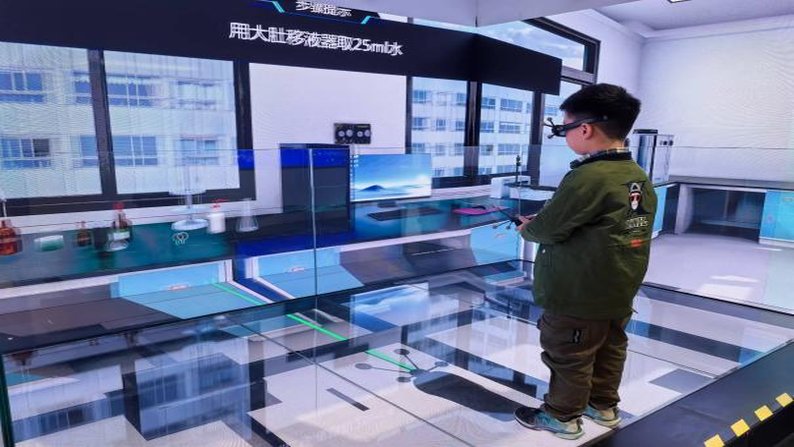
不择知行细流,蕴蓄蓝绿成深:雄安新区生态环境共享中心科普宣传空间营造雄安新区生态环境共享中心VR虚拟实验室(数字化仿真替代实体化学实验,实现科普零危废、低能耗)
6天前 · 来源:雄安新区生态环境监控中心 · 作者:雄安新区生态环境监控中心
