

Company/Organization Profile
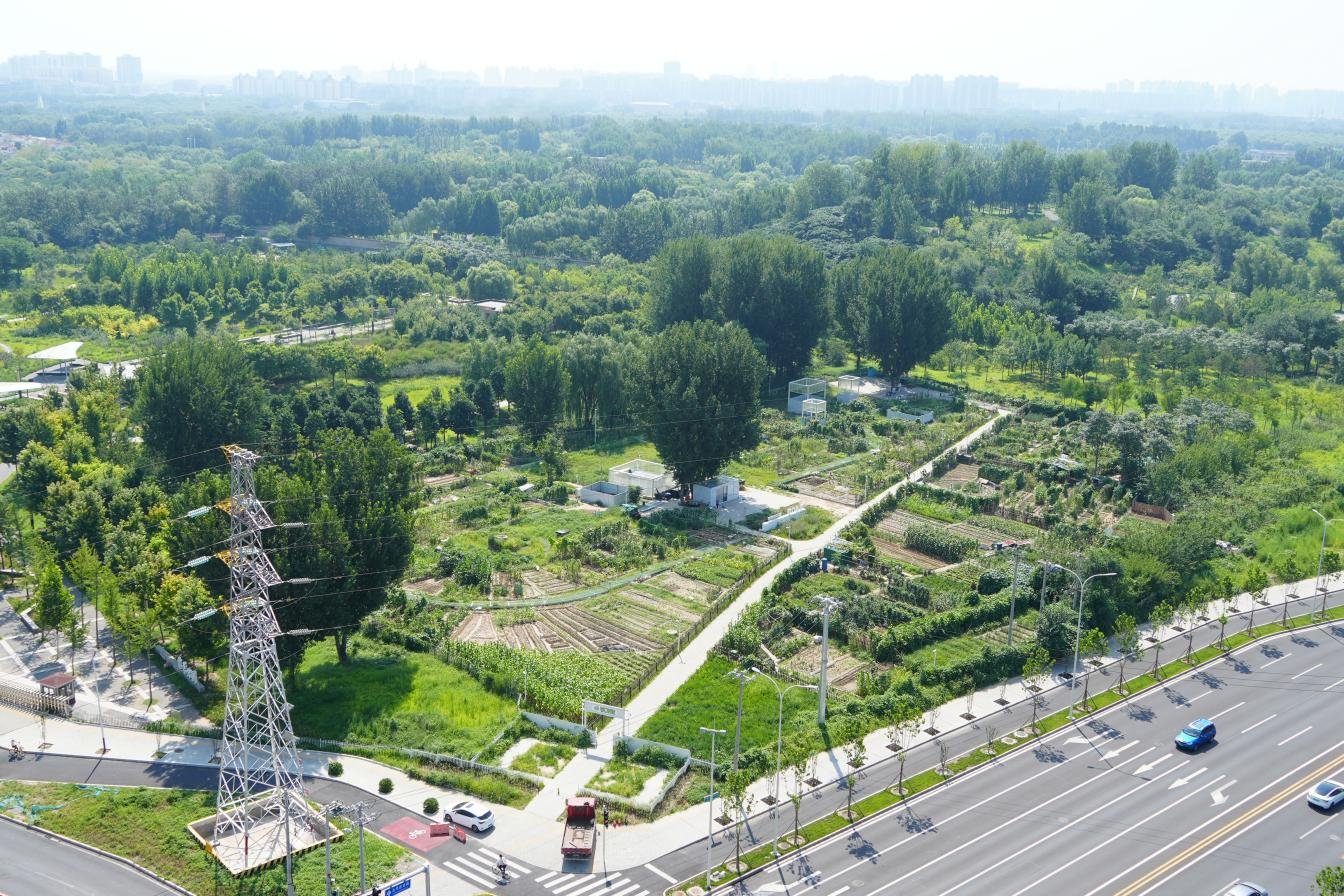
Located in the heart of the Huitian area—one of Asia's largest residential agglomerations—Huojiaying is a typical village-to-community transition neighborhood. Since 2023, guided by the "Zero-Waste 5R" philosophy, the community has revitalized nearly 12,000 m² of idle urban corner land. Partnering with the Ta Shan Shi Social Work Service Center and the Beijing Public Service Development Promotion Association, it has successively built the Happy Farm and the Yingmen Shiye Garden Farm, creating a co-governance hub that integrates resource recycling, nature education and neighborhood cohesion. The farms' self-developed enzyme-based health products have been repeatedly invited to exhibitions and promotion events. Land that was once ecologically inefficient and idle has been transformed into a carbon-sequestering "pastoral living room," where micro-scale space leverages quality and efficiency gains in low-carbon governance across the whole area, offering a replicable and scalable grassroots model for sustainable eco-city development.
机构简介
霍家营地处亚洲最大居住区之一的回天地区腹地,是由传统农村向城市社区转型形成的典型村转居社区。自2023年起,社区以“零废弃5R”理念为核心,盘活近1.2万平方米城市闲置边角地,联合它山石社会工作服务中心(以下简称“它山石”)、北京公益服务发展促进会(以下简称“公促会”),先后建成开心农场、营门拾野花园农场,打造集资源循环、自然科普、邻里融合于一体的共治阵地。农场自主研发的酵素健康产品多次受邀展出推广,昔日生态效能低下的闲置用地转化为固碳增汇的田园会客厅,以微空间撬动全域低碳治理提质增效,为生态城市可持续发展提供了可复制、可推广的基层样本。
Project Overview
Challenges: Since the village-to-community transition, the community has faced a triple predicament. Spatial: nearly 12,000 m² of vacant land has long lain idle, with frequent illegal dumping and continuing demands on manpower and funding for upkeep and clearance, resulting in low ecological efficiency. Social: the population structure is complex—migrant residents account for more than two-thirds—leaving residents with a weak sense of public identity. Ecological: kitchen waste and garden waste have long been shipped out of the community for disposal; resources "go out" but never "come back."
Cause Analysis: First, corner land left over from urban-rural transition lacked a functional position and remained a long-term "negative asset." Second, returning residents' deep attachment to the land found no outlet; the traditional mechanisms of an acquaintance society ceased to work after the transition, while new community co-governance mechanisms had yet to form. Third, residents' low-carbon behavior lacked participation scenarios and timely feedback—waste sorting and reduction became a "task" rather than a "habit," and green values could hardly translate into voluntary action.
Goal: Taking the revitalization of idle land as the breakthrough point, the community set out to embed green, low-carbon principles into spatial renewal, resource circulation and community mobilization—guiding residents from "bystanders" to "participants," helping them understand circularity and join emission reduction through farming-based science education, and building a sustainable closed loop in which behavioral awareness and ecological circulation reinforce each other.
项目背景
问题痛点:“村转居”后,社区面临三重困境——空间困境:近1.2万平方米空地长期闲置,垃圾偷倒问题频发,需投入人力财力进行维护清理,生态效能低下;社会困境:人口结构复杂,流动人口占比超三分之二,居民公共认同薄弱;生态困境:社区厨余垃圾与园林废弃物长期外运处理,资源“出得去”却“回不来”。
原因分析:一是城乡变迁进程中遗留的边角地缺乏功能定位,长期处于“负资产”状态;二是回迁居民的乡土情结无处释放,传统熟人社会运转机制在转型后失效,新的社区共治机制尚未形成;三是居民低碳行为缺少参与场景与即时反馈,分类减量沦为“任务”而非“习惯”,绿色理念难以转化为自觉行动。
改进目标:以闲置土地盘活为突破口,将绿色低碳理念融入空间改造、资源循环与社区动员,引导居民从“旁观者”转变为“参与者”,在农耕科普中理解循环、参与减排,构建行为自觉与生态循环相互赋能的可持续闭环。
Project Implementation
(I) Building the Spatial Foundation: Phased Land Revitalization to Consolidate the Physical Base.
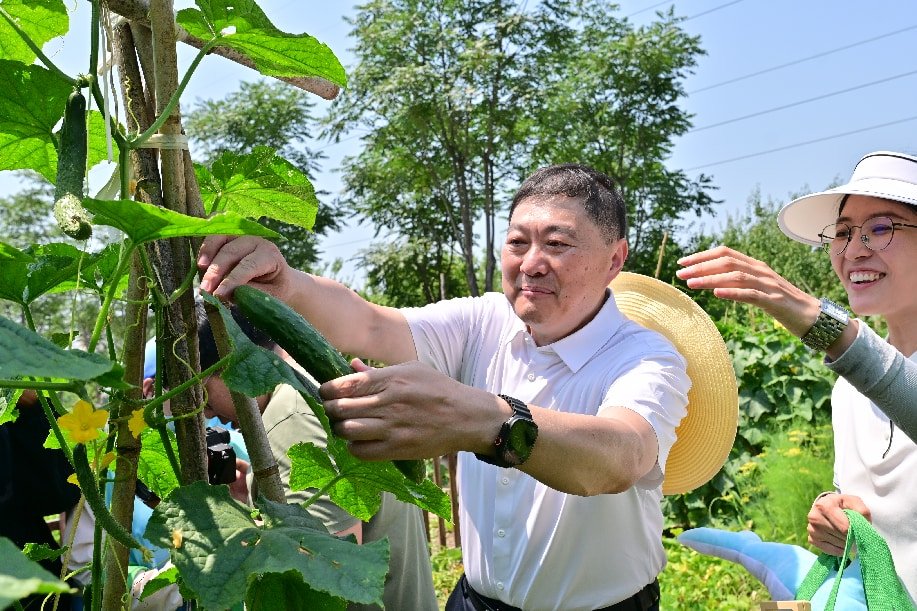
Following a "pilot-first, phased expansion" path of spatial renewal, the community introduced the professional strength of Ta Shan Shi in April 2023 to micro-renovate 600 m² of corner land into the "Happy Farm," creating 50 family adoption plots that residents could adopt free of charge and manage on their own. In the second half of 2023, it worked with North China Electric Power University (NCEPU) to designate a co-built zone, organizing faculty and students to take part in labor education and ecological practice. In September 2025, building on the pilot, it developed the 8,400 m² "Yingmen Shiye Garden Farm," bringing in the Beijing Public Service Development Promotion Association for professional, socialized operation open to adoption by the whole of society, meeting the planting needs of 207 parent-child families. By then, the two farms, together with the university co-built zone, public activity areas and other shared spaces, had revitalized about 12,000 m² of land in total. Through the classified supply of "public-interest adoption + paid leasing," corner land that was once "unmanaged" has become shared space "built and managed by everyone," providing the physical carrier for green living scenarios.
(II) Gathering People Through Co-Governance: Farming as the Medium, Weaving the Web of Connection.
Taking farming and nature education as the bond, the community built platforms for participation: the "Time Station" points mechanism quantifies volunteer service into public-interest points redeemable for daily necessities and priority access to activities, attracting wide participation from migrant tenants, young people and parent-child families. Residents who had once privately reclaimed green land were engaged as "technical advisors," turning management confrontation into joint-building synergy. Ta Shan Shi organizes farming science popularization, parent-child farming and nature classes around the "Zero-Waste 5R" philosophy, embedding green, low-carbon ideas in daily activities, while the Promotion Association links external resources and expands the community network. In spring 2026, more than 230 volunteers carried out a concentrated cleanup of newly developed plots, clearing about 8 tonnes of waste and weeds in total, and Beijing University of Agriculture provides technical support in soil improvement and pesticide-residue testing. Green space has thus become a venue where different groups interact, learn and farm together, cultivating a low-carbon lifestyle and public identity through shared labor.
(III) Closing the Ecological Loop: Circular Empowerment to Open the Path to Sustainability.
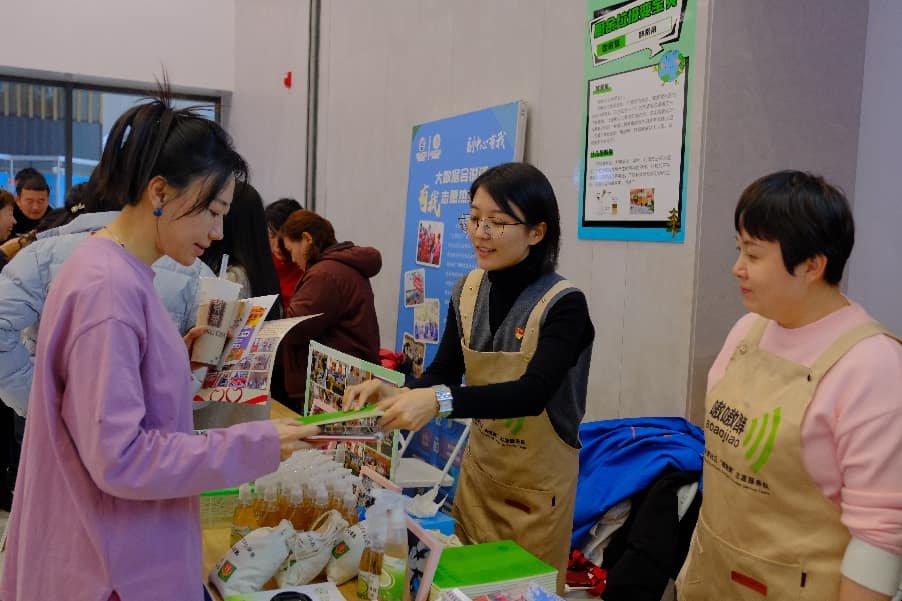
Supported by facility upgrades and operational optimization: on one front, the community integrated a smart waste-drop-off system with a points-based incentive mechanism—residents scan a code and their waste is weighed on deposit, with drop-off records automatically accruing as sorting points redeemable for daily necessities, raising participation and front-end sorting accuracy. On the other front, it works with Ta Shan Shi to organize volunteers in sandwich composting and eco-enzyme making, so that resources circulate within the community. The organic fertilizer produced returns to the fields; vegetables and fruit are donated to the community elderly station, seniors living alone and new-employment groups; enzymes fermented from kitchen waste are further developed into eco-derivatives such as handmade soap and laundry detergent, repeatedly invited to ecological-themed fairs for on-site exhibition and sale, with operating revenue fed back into community public affairs for facility maintenance and support for disadvantaged groups. Adopters have also signed the Farm Stewardship Pact, fostering an ethos of "those who benefit also maintain" and helping residents shift from "passively accepting management" to "voluntarily committing to care for the fields." A micro-renewal has activated broader governance: green, low-carbon living is settling from a "passing trend" into a "daily habit," moving green space from "built" to "sustainable" and achieving an enduring symbiosis of ecological benefits and community vitality.
项目实施
(一)空间筑基,分步盘活,夯实承载之基
社区采取“试点先行、梯次拓展”的空间改造路径:2023年4月,引入它山石专业力量,将600平方米边角地微改造为“开心农场”,设置50块家庭认养菜地,推行本社区居民免费认养、自主管护;2023年下半年,联动华北电力大学划定共建区,组织高校师生参与劳动教育与生态实践;2025年9月,在试点基础上拓展8400平方米“营门拾野花园农场”,引入公促会实行专业化、社会化运营,面向全社会开放认养,可满足207组亲子家庭的种植需求。至此,两期农场连同高校共建区、公共活动区等共享空间,整体盘活约1.2万平方米地块,通过“公益认养+有偿租地”分类供给,让“无人管”的边角地变为“大家建、大家管”的共享空间,为绿色生活场景落地提供物理承载。
(二)共治聚人,以农为媒,织密联结之网
社区以农耕和自然科普为纽带搭建参与平台:推行“时间驿站”积分机制,将志愿服务量化为可兑换生活物资和活动优先参与权的公益积分,吸引流动租户、青年群体、亲子群体广泛参与;聘请曾私垦绿地的居民为“技术顾问”,变管理对立为共建合力;它山石围绕“零废弃5R”理念组织农事科普、亲子农耕、自然课堂,将绿色低碳理念融入日常活动;公促会链接外部资源、拓展社群网络;2026年春,组织230余名志愿者对新地块开展集中清理,累计清理垃圾杂草等约8吨;同时联动北京农学院提供土壤改良、农残检测等技术支撑。由此,绿色空间成为不同人群交流交往、共学共耕的载体,在共同劳作中培育低碳生活方式与公共认同。
(三)生态闭环,循环赋能,打通永续之路
社区以设施更新与运营优化为支撑:一方面集成智慧垃圾投放系统,配套积分激励机制,居民刷码称重,投放记录自动累计为分类积分并可兑换生活物资,提升居民参与度与前端分类精准度;另一方面联动它山石组织志愿者开展三明治堆肥、环保酵素制作,让资源在社区内循环转化;产出有机肥回用于种植,果蔬捐赠给社区老年驿站、独居老人、新业态群体等;厨余发酵制成的环保酵素进一步开发为手工皂、洗衣液等生态衍生品,多次受邀参加生态主题展会现场展销,运营收益回馈社区公共事务,用于设施维护与困难群体帮扶。同时,组织认养人签署《农场养护公约》,倡导“谁受益、谁维护”的共同守望意识,助力居民从“被动接受管理”转向“主动立约护田”。以微更新激活大治理,绿色低碳生活从“一时新风”沉淀为“日常习惯”,推动绿色空间从“建起来”走向“可持续”,实现生态效益与社区活力的永续共生。

Project Outcome
(I) Wasteland Renewed, Neighbors Gathered.
The 12,000 m² of idle corner land has been transformed into a shared green space, and residents' waste-sorting participation rate has risen from an initial 3% to nearly 100%. "Field news" on the farm's WeChat group—posting harvests and giving away vegetables—has become the new normal of neighborly exchange. Residents once at odds with the community have become volunteer backbones, voluntarily taking on maintenance of public areas and planting guidance, while more than 50 parent-child families have spontaneously formed a "steward team," becoming an endogenous new driving force for community governance.
(II) Innovation-Driven Empowerment, Multi-Party Co-Governance.
1. Mechanism innovation: dual-track supply with public-interest feedback. The "Happy Farm" meets local residents' needs free of charge on a public-interest basis, while "Yingmen Shiye" opens paid adoption to the whole of society. Eco-products from the farm are sold for public benefit, with all proceeds fed back into community public affairs, achieving self-sustaining operation and cracking the grassroots governance bottleneck of "scattered people, tight money and idle resources."
2. Collaborative innovation: family-school-community-enterprise linkage for deeper empowerment. A governance community of "professional organizations setting the stage, universities empowering with technology, and multiple stakeholders participating" has taken shape: Ta Shan Shi and the Promotion Association handle operations and resource integration, NCEPU has established a labor-education practice base, and Beijing University of Agriculture provides soil improvement and pesticide-residue testing—closing the last mile of "industry-academia-research-application."
3. Model innovation: micro-renewal activating the grand ecological cycle. Using idle-space micro-renewal as the fulcrum, the community built an ecological closed loop of "waste sorting—ecological composting—farm planting—food on the table—kitchen waste," advancing environmental improvement and residents' self-governance in tandem, so that one plot of corner land delivers the combined benefits of ecological empowerment and science education.
(III) Closing the Loop for Long-Term Operation.
The project has formed a self-driven operating mechanism in which "ecological circulation, behavioral cultivation and institutional drive" work as an integrated whole and reinforce one another. Its standardized spatial-renewal process, resource-circulation model and all-resident mobilization mechanism are replicable and scalable.
成果亮点
(一)荒地焕新,田园聚邻
1.2万平方米闲置边角地蝶变为绿色共享空间,居民垃圾分类参与率从最初的3%提升至近100%,农场微信群中晒收成、送蔬菜的“田间消息”成为邻里交流新常态。曾与社区对立的居民变身为志愿骨干,主动承担公共区域管护与种植指导;50余组亲子家庭自发化身“管家团”,成为社区治理的内生新动力。
(二)创新赋能,多元共治
1. 机制创新。双轨供给与公益反哺。“开心农场”公益免费满足本社区居民需求,“营门拾野”有偿认养面向社会开放,农场产出的生态产品进行公益售卖,收益全额反哺社区公共事务,实现自我造血,破解了“人散、钱紧、物荒”的基层治理瓶颈。
2. 协同创新。家校社企联动深化赋能。构建“专业组织搭台、院校技术赋能、多元主体参与”的治理共同体。它山石与公促会负责运营与资源整合,华北电力大学设立劳动教育实践基地,北京农学院提供土壤改良与农残检测技术支撑,打通“产学研用”最后一公里。
3. 模式创新。微更新撬动生态大循环。以闲置空间微更新为支点,构建“垃圾分类—生态堆肥—农场种植—餐桌食物—厨余垃圾”生态闭环,将环境整治与居民自治统筹推进,让一方边角地释放出生态赋能、科普育人的复合效能。
(三)闭环固本,长效运行
项目已形成可自我驱动的运行机制,“生态循环、行为养成、制度驱动”三位一体,相互赋能,标准化的空间改造流程、资源循环模式与全员参与的动员机制,均具备可复制性与可推广性。
Project Highlights
Ecological Benefits: Since the base began operating in April 2023, it has cumulatively digested 7,619 kg of kitchen and garden organic waste, harvested about 2,000 kg of naturally grown green vegetables, and produced about 1,000 kg of ecological compost and about 1,600 kg of eco-enzyme stock solution and derivatives, achieving a cumulative carbon reduction of about 3.72 tonnes of CO₂ equivalent (calculated by the methane-emission-reduction coefficient of composting organic waste in place of landfill disposal).
Social Impact: The project has united multiple stakeholders around green space, holding more than 100 ecological science-education activities covering over 3,000 person-times, and incubating two public-interest volunteer teams—"Suishou Gongyi" and "Aoao Jiao"—with 843 registered volunteers, of whom young tenants account for 25%. In June 2026, the "Red Ploughing Pastoral · Community Secretaries' Studio" showcase event of Changping District was held at the Yingmen Shiye Garden Farm, where 13 community secretaries' studios and their partner organizations—more than 200 people in total—gathered in the fields to present green-governance innovations, providing frontline practical experience and a referable action model for urban communities addressing the integration of ecology and governance.
成果影响力
生态环境效益:基地自2023年4月运营以来,累计消纳厨余及园林有机废弃物7619千克,收获原生态绿色蔬菜约2000千克,产出生态堆肥约1000千克、环保酵素原液及衍生品约1600千克,累计实现减碳约3.72吨二氧化碳当量。
社会影响力:项目以绿色空间凝聚多元主体,累计开展生态科普活动100余场、覆盖超3000人次,已孵化“随手公益”、“嗷嗷酵”两支公益志愿队伍,注册志愿者达843人,其中青年租客占比达25%;2026年6月,昌平区“红耕田园·社区书记工作室”风采荟活动在营门拾野花园农场举行,全区13个社区书记工作室及共建单位等200余人齐聚田间,集中展示绿色治理创新成果,为城市社区破解生态与治理融合难题提供了一线实践经验与可参照的行动样本。
(减碳核算标准:参照有机废弃物堆肥化处理替代填埋的甲烷减排系数折算)
Reviews & Honors
Feedback & Recognition: The project has held 19 special experience-sharing sessions and received 28 study-visit exchanges from institutions at various levels. In 2023, it was officially admitted as a Practice Partner of the Community Composting Platform (CCCP), and it has since won recognition from international and industry stakeholders. Experts from Brazil's "Zero Waste" Institute and the Basel Convention Regional Centre for Asia and the Pacific made a special trip to the community to study its "zero-waste community" practices, commending the closed-loop model of on-site kitchen-waste resource recovery as a low-cost, replicable operational paradigm for organic-waste management in urban communities of developing countries. The Yingmen Shiye Garden Farm has been featured in a bilingual introduction on mooool, an international landscape platform.
Policy Support: A key pilot site for national urban-rural fringe community governance, and a node along the Huitian urban-renewal initiative and the Aobei Ten-Parks ecological layout.
Media Coverage: The project's practices have been reported by mainstream media including China Youth Daily and Beijing Radio & Television Station (BRTV), with more than 50 media features at all levels in total.
Awards & Honors: Recipient of honors including "National Most Beautiful Volunteer Service Community," "Changping District Advanced Science Popularization Base" and "Beijing Outstanding Environmental Public-Welfare Organization," with 15 national-, municipal- and district-level ecological and public-welfare honors in total.
评价与荣誉
评价反馈:项目累计开展经验专题分享19场次,接待各级单位调研交流28场次,于2023年正式入选社区厨余堆肥平台(CCCP)实践伙伴,并获国际与行业多方认可。巴西“无废”研究所及巴塞尔公约亚太区域中心专家专程赴社区调研“无废社区”实践,认为厨余就地资源化闭环模式为发展中国家城市社区有机废弃物管理提供了低成本、可复制的操作样本;营门拾野花园农场获国际景观平台mooool双语推介。
政策支持:全国城乡结合部社区治理试点重点建设点位,回天地区城市更新与奥北十园生态布局沿线点位。
媒体认可:项目实践成果被中国青年报、北京广播电视台等主流媒体报道,累计获各级媒体报道50余次。
奖项荣誉:荣获“全国最美志愿服务社区”、“昌平区科普工作先进基地”、“北京市优秀环保公益组织”等多项荣誉称号,累计获国家级、市级、区级生态公益类荣誉15项。

近零碳社区的美育升级---- 长寿苑社区 “低碳实践 + 影像科普” 共建项目
4天前 · 来源:成都市武侯区火车南站街道长寿苑社区居民委员会 · 作者:成都市武侯区火车南站街道长寿苑社区居民委员会

以绿色金融之力推动中国新质生产力!
4天前 · 来源:国泰海通证券研究所ESG及美丽中国研究组 · 作者:国泰海通证券研究所ESG及美丽中国研究组
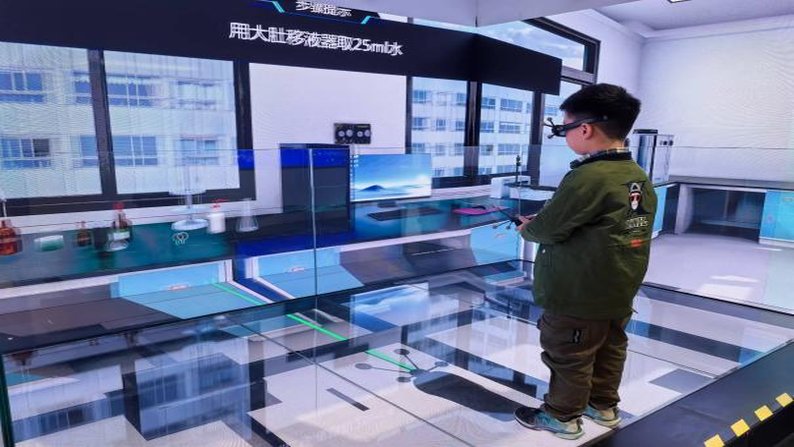
不择知行细流,蕴蓄蓝绿成深:雄安新区生态环境共享中心科普宣传空间营造雄安新区生态环境共享中心VR虚拟实验室(数字化仿真替代实体化学实验,实现科普零危废、低能耗)
6天前 · 来源:雄安新区生态环境监控中心 · 作者:雄安新区生态环境监控中心
