

Company/Organization Profile
As a wholly state-owned enterprise, Nanjing Lishui Sanitation Service Co., Ltd. serves as the core entity driving comprehensive urban-rural environmental governance and green operations across Lishui District. The company's business portfolio encompasses large-scale urban and rural sanitation cleaning, operation and maintenance of sanitation facilities, and full-process classified waste collection and transportation. It is also entrusted with the operation of the district's food waste treatment plant and bulky waste sorting center. Supported by six specialized and project branch companies, a workforce of over 1,200 employees, and a modern sanitation fleet, the company adheres to its mission of "cleaning roads for the people and making the city cleaner." By building recognized sanitation service brands and prioritizing low-carbon cleaning alongside organic waste valorization, the company actively contributes to the development of a beautiful and green Lishui.
Lishui Institute of Ecology and Environment, Nanjing University is an independent legal entity public institution co-established by the Lishui District People's Government and Nanjing University. Deeply engaged in the eco-environmental field, the Institute integrates scientific research, technology transfer, and high-end talent development. It hosts several provincial- and municipal-level research platforms, including the Organic Solid Waste Resource Recovery Branch of the National Engineering Research Center for Solid Waste Resource Recovery and the Nanjing Key Laboratory for Biomass Targeted Conversion. In fields such as organic solid waste valorization and watershed ecological governance, multiple core technologies developed by the Institute have been selected for national, provincial, and municipal advanced applicable technology catalogs for "Waste-Free Cities" and recognized as green, low-carbon model cases. The Institute has led the issuance of 3 association standards, with 12 authorized Chinese invention patents and 6 authorized PCT international patents, providing robust scientific and technological support for regional green and low-carbon transition and ecological civilization development.
机构简介
南京溧水环卫服务有限公司作为国有独资企业,是溧水区城乡环境综合治理与绿色运营的核心主体。公司业务涵盖大面积城乡保洁、环卫设施运维、垃圾全过程分类收运,并受托运营区餐厨废弃物处理厂及大件垃圾分拣中心。依托下设的6家专业/项目分公司、1200余名员工及现代化作业车队,公司践行“为人民扫好路,让城市更干净”的初心,积极打响环卫服务品牌,以低碳保洁和有机废弃物资源化利用为抓手,全面助力美丽绿色溧水建设。
南京大学(溧水)生态环境研究院为溧水区人民政府与南京大学共建的独立法人事业单位。研究院深耕生态环境领域,集科学研究、成果转化与高端人才培养于一体,建有固体废弃物资源化国家工程研究中心有机固废资源化分中心、南京市生物质定向转化重点实验室等多个省市级科研平台。研究院在有机固废资源化利用、流域生态治理等领域多项核心技术入选国家、省、市“无废城市”建设先进适用技术目录与绿色低碳典型案例;主导发布团体标准3项,累计国内发明专利授权12项,PCT专利授权6项,为区域绿色低碳转型与生态文明建设提供了强有力的科技支撑。
Project Overview
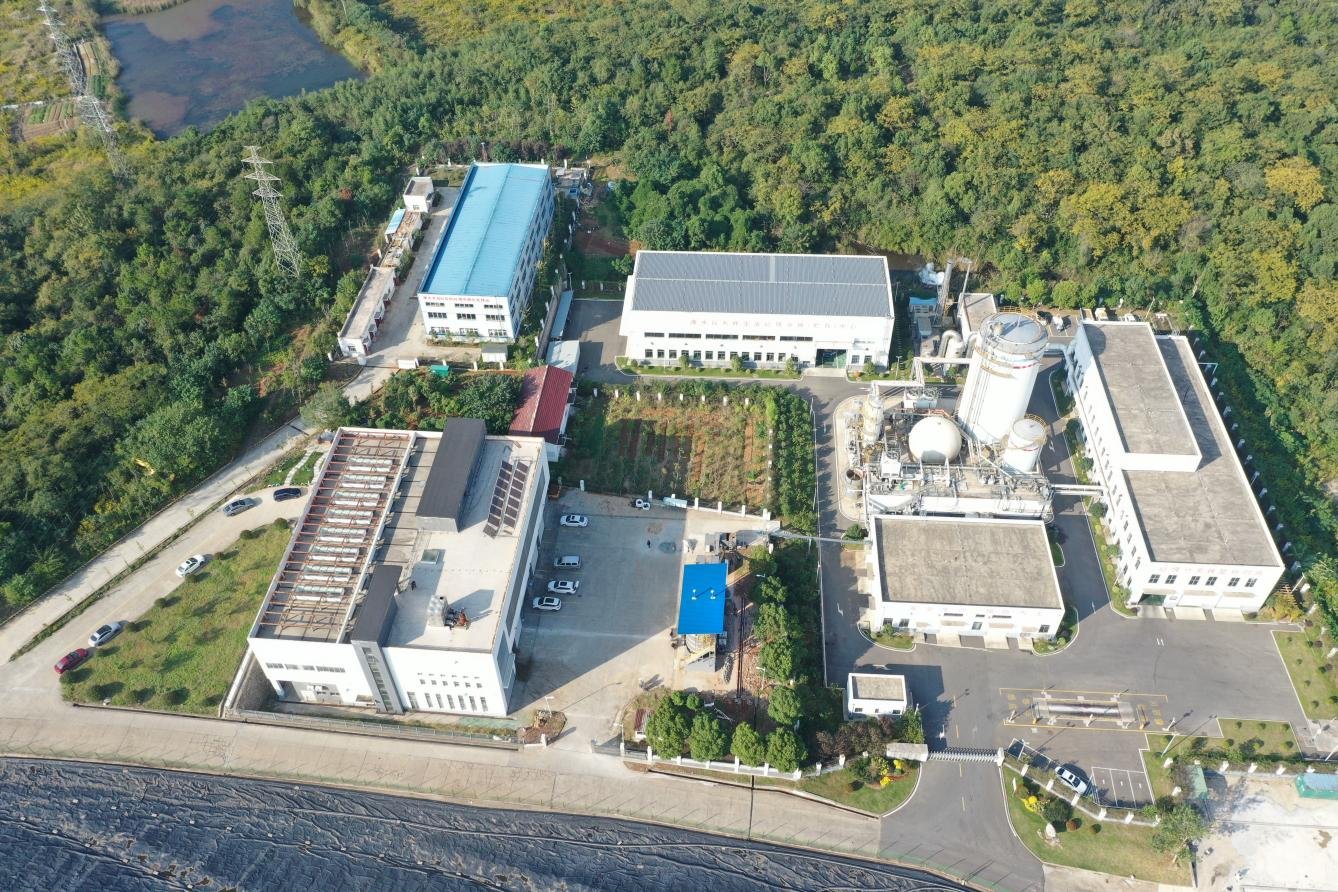
Located at Meiren Mountain in Shahe Village, Lishui District, Nanjing, the Lishui District Kitchen Waste Treatment Plant officially commenced operations in June 2020 with a designed capacity of 50 tons per day, serving local catering businesses and urban-rural residents. On this basis, Lishui District has achieved a closed-loop system for kitchen waste, covering everything from collection and transportation to final treatment within the district.
The facility utilizes anaerobic digestion technology, where food waste undergoes a standardized process of "pretreatment (impurity removal + crushing and pulping + heating + three-phase separation) + anaerobic fermentation + wastewater treatment," ultimately yielding biogas, grease, and minor residues to fundamentally achieve end-of-pipe harmless disposal and volume reduction. However, the comprehensive resource utilization rate remains relatively low. Furthermore, restricted disposal outlets for the daily volume of high-moisture digestate have led to a long-term reliance on costly outsourced transportation and treatment, posing a substantial economic and environmental burden.
In active response to national policies, to upgrade waste treatment standards and continuously advance waste resource recovery, the Lishui District Urban Management Bureau, in partnership with the operator Nanjing Lishui Sanitation Service Co., Ltd., launched a technological transformation and upgrading project. Aiming at 'capacity expansion, efficiency enhancement, and high-value conversion,' the project leverages cutting-edge biological synergistic technologies to resolve digestate disposal bottlenecks and elevate overall resource utilization, establishing a demonstration benchmark for organic solid waste valorization under the 'Waste-Free City' and 'Dual Carbon' strategies.
项目背景
溧水区餐厨废弃物处理厂坐落于南京市溧水区沙河村美人山,于2020年6月正式开始运行,设计规模为50吨/天,服务于全区餐饮商户及城乡居民。在此基础上,溧水区已经实现了餐厨废弃物在区内从收运到处理的闭环。
处理厂厂采用厌氧技术,所有餐厨废弃物经过“预处理(除杂+破碎制浆+加热+三相分离)+厌氧发酵+污水处理”的程序,最终产生沼气和油脂,及少量残渣,基本实现了餐厨废弃物的无害化和减量化的末端处置功能。然而,综合资源化利用率较低,且每日伴生的大量高湿沼渣处置渠道受限,长期依赖高成本外运处置,构成沉重经济与环境负担。
为了积极响应国家政策,提高垃圾处理水平并持续推动垃圾资源化利用,溧水区城管局联合运营单位南京市溧水区环卫服务有限公司启动技改提升项目。以 “扩能增效、高值转化” 为目标,依托前沿生物协同技术破解沼渣处置瓶颈并提升整体资源化水平,打造“无废城市”与“双碳”战略下的有机固废资源化示范标杆。
Project Implementation
In 2024, the "Lishui District Kitchen Waste Treatment Plant Technological Upgrading — Kitchen Waste Bio-Synergistic High-Value Utilization Demonstration Project" was officially approved and launched. Targeting the bottlenecks of conventional anaerobic digestion processes, the project leverages institutional innovation, technological breakthroughs, and intensive construction to efficiently establish a comprehensive, high-value valorization system for multi-source organic waste.
Mechanism Construction: Tripartite Synergy of Government-Enterprise-University to Overcome Implementation Barriers
The project designated the Lishui District Urban Management Bureau as the competent administrative authority, in charge of overall planning and resource coordination; Nanjing Lishui Sanitation Service Co., Ltd. as the operational and implementation entity, responsible for project execution, equipment procurement, on-site commissioning, and market integration; and the Nanjing University (Lishui) Institute of Eco-Environmental Studies as the technical support institution, providing process development, parameter optimization, experimental validation, and performance evaluation. The three parties established a tripartite collaborative mechanism characterized by "policy guidance, enterprise execution, and university empowerment," leveraging complementary strengths to provide robust assurance for technological innovation and sustainable project operations.
2. Process Innovation: Three-Line Coupling Overcomes Digestate Bottlenecks and Low Value-Added Challenges
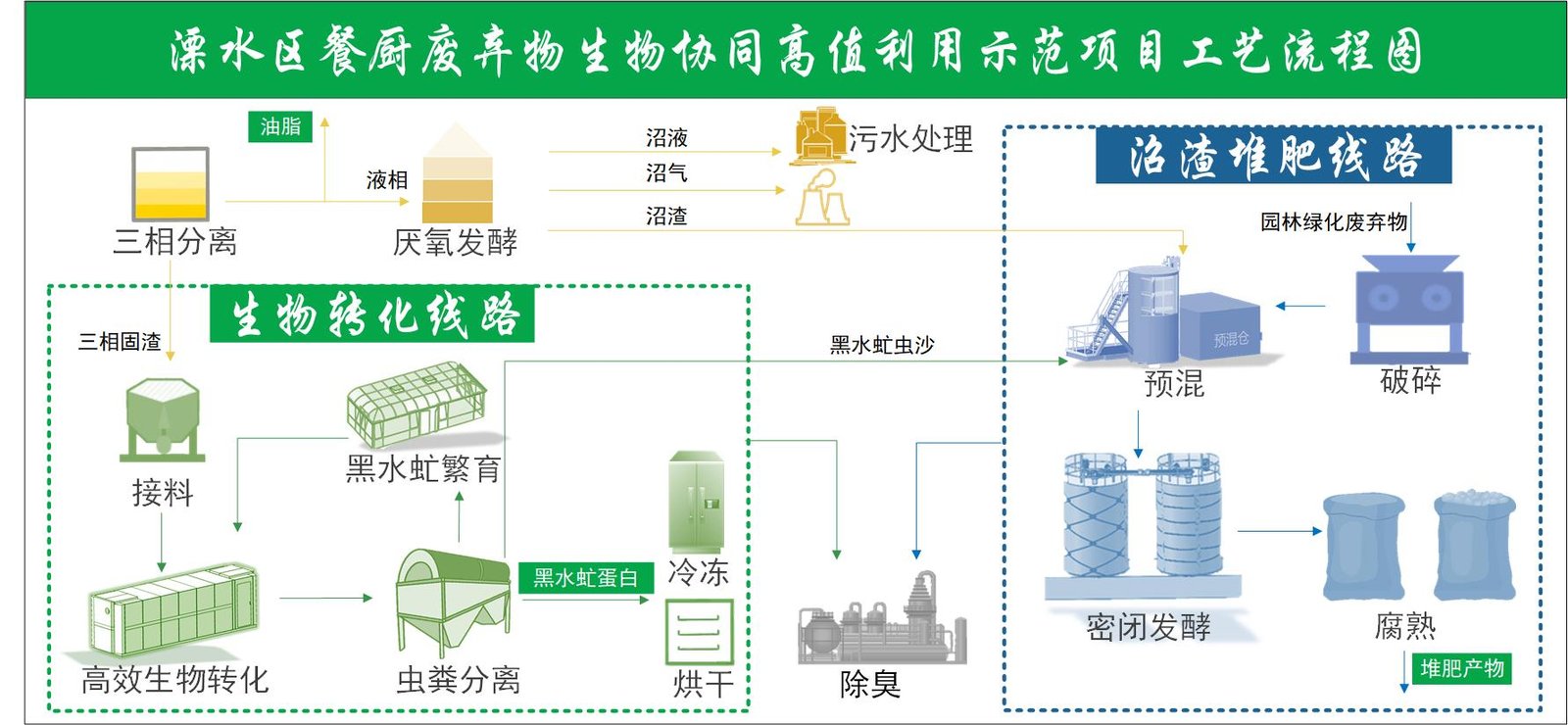
The facility's original process adopted a workflow of "pretreatment (impurity removal, shredding and pulping, thermal conditioning, and three-phase separation) + anaerobic digestion + wastewater treatment." This setup yielded limited product value-added potential and generated high volumes of digestate that posed substantial on-site disposal difficulties, off-site secondary pollution risks, and cost pressures. Following three-phase separation and oil extraction, the solid and liquid phases were recombined into the anaerobic digestion system, failing to achieve high-value valorization.
Addressing these process characteristics, two dedicated valorization lines were integrated: Line 1 utilizes black soldier fly (BSF) bioconversion for the three-phase solid residue, while Line 2 employs aerobic composting to convert digestate into organic fertilizer. By deeply coupling and integrating the three mainstream organic waste treatment technologies—anaerobic digestion, insect bioconversion, and aerobic composting—the facility achieved a paradigm shift from "single-stream disposal" to "three-line synergistic valorization," substantially increasing the overall food waste processing capacity.
3. Spatial Intensification: Revitalizing Existing Assets to Overcome Land-Use Constraints
Addressing severe land-use zoning restrictions around the plant and the inability to acquire additional construction land, the project adopted an intensive construction model by revitalizing existing idle facilities. The District Urban Management Bureau coordinated the adaptive reuse of a decommissioned waste transfer station's footprint, while Lishui Sanitation and the Institute jointly optimized the spatial layout. Implementing a "modular, vertical, and highly integrated" design, the project deployed complete packaged equipment, including black soldier fly bioconversion chambers and vertical enclosed aerobic fermentation vessels. By sharing and retrofitting pipelines and infrastructure with the existing pretreatment and wastewater systems, the facility completed both capacity expansion and environmental upgrading without adding a single square meter of new construction land.
4. Synergistic Co-Disposal: Multi-Source Solid Waste Ratio Optimization Resolves Material Imbalance
Anaerobic digestate suffers from high moisture content and an imbalanced carbon-to-nitrogen (C/N) ratio, making single-feedstock processing insufficient to meet the technical requirements of aerobic composting. Leveraging Lishui Sanitation’s district-wide cleaning network, a collaborative "municipal green waste–food waste treatment plant" operational mechanism was established, while the Institute developed a scientifically tailored compounding formulation. Lishui Sanitation systematically transports street-swept leaves and landscape pruning waste directly to the plant. Following shredding and pretreatment, this green waste serves as a conditioning carbon source to be scientifically blended with anaerobic digestate and black soldier fly frass. This integration not only overcomes composting fermentation bottlenecks but also establishes a synergistic co-disposal pathway for multi-source organic solid wastes, yielding premium bio-organic nutrient soil.
项目实施
2024年,“溧水区餐厨垃圾处理厂技改提升—餐厨废弃物生物协同高值利用示范项目”正式立项实施。项目聚焦传统厌氧工艺短板,通过机制创新、技术突破与集约建设,高效构建多源有机废弃物全量高值转化体系。
1、机制构建:政-企-校三元协同破除落地壁垒
项目由溧水区城市管理局作为主管单位,负责统筹规划与资源协调;南京溧水环卫服务有限公司作为运营实施主体,负责项目落地、设备采购、现场运营调试、市场对接;南京大学(溧水)生态环境研究院作为技术支撑单位,提供工艺方案研发、参数优化、试验验证、成效评估。三方形成 “政策引导-企业落地-高校赋能” 的三元协同机制,三方优势互补,为项目技术创新与可持续运营提供坚实保障。
2、工艺革新:三线耦合突破沼渣处理难题与低附加值瓶颈
厂区原有处理工艺采用“预处理(除杂、破碎制浆、加热调质、三相分离)+厌氧发酵+污水处理” 流程,产品附加值有限,副产物沼渣产量大且就地处置困难,外运存在二次污染风险与成本压力。三相分离后的油脂提取后,固液再次混合进入厌氧发酵系统,未能实现高值资源化转化。
基于此工艺特征,新增2条资源化处理线,线1为黑水虻生物转化餐厨三相固渣工艺,线2为沼渣好氧堆肥生产有机肥工艺。将有机废弃物三大主流处理技术-厌氧发酵、黑水虻生物转化、好氧堆肥深度耦合、高效集成,餐厨厂实现从 “单一处置” 到 “三线协同” 的范式革新,餐厨废弃物整体处理规模提升。
3、空间集约:盘活存量设施破解用地指标制约
针对厂区周边土地规划受限,场地无法新增建设用地的困难,项目采取存量闲置用地盘活的集约建设模式。由区城管局协调停运的垃圾中转站闲置用地,溧水环卫与研究院联合开展集约化布局优化。采用“模块化、立体化、高集成”设计,配置黑水虻生物转化仓、立式密闭好氧发酵罐等成套集成设备,依托原厂区预处理、污水系统实施管线与设施共用改造。在“不新增一寸建设用地”的前提下完成扩建与环保升级。
4、协同处置:多源固废配比解决物料失衡难题
厌氧沼渣含水率高、碳氮比失衡,单一物料难以满足好氧堆肥工艺要求。依托溧水环卫全域环卫清扫网络,建立“市政绿化废弃物—餐厨处理厂”联动机制;研究院制定科学配伍方案。环卫公司将道路清扫落叶及园林修剪枝条定向清运进厂,经粉碎预处理后作为调质碳源,与沼渣、黑水虻虫沙科学复配,不仅攻克了堆肥发酵技术难题,更打通了多源有机废弃物协同处置路径,产出高品质生物有机营养土。
Project Outcome
(1) Establishing an Innovative Paradigm for High-Value Organic Waste Valorization
Rather than a superficial superposition of technologies, the project transforms the single-stream anaerobic digestion route into a "three-line synergistic" comprehensive valorization system. It fundamentally restructures the logic of food waste processing: the treatment destination has been upgraded from auxiliary landfilling and incineration to 100% high-value conversion, yielding green products such as animal protein and organic soil conditioner, thereby offering a brand-new direction for industrial technological integration.
(2) Extending the Green Industrial Chain to Energize Regional Development
The project establishes dual closed-loop ecological chains: "Urban Organic Waste–Insect Protein–Ecological Aquaculture–Green Agri-Products" and "Organic Solid Waste–Organic Soil Conditioner –Soil Remediation." The annual yield of bioprotein empowers local crab aquaculture in Lishui District with higher quality and efficiency, while the organic soil conditioner visibly enhances urban greening and the cityscape. By deeply integrating with Lishui's signature sectors—including eco-agriculture, health and wellness, tourism, and environmental education—the initiative delivers an exemplary demonstration of win-win economic and social benefits.
(3) Creating a Benchmark Showcase for "Waste-Free Lishui"
Centered on food waste treatment, the project has successfully expanded operational boundaries to evolve into a comprehensive regional organic waste processing platform. In synergy with the plant's on-site bulky waste sorting center, community regenerative composting garden, the Economic Development Zone's food waste composting station, and the Lishui Municipal Solid Waste Landfill restored in 2026 under the leadership of the Urban Management Bureau, this site has become a tangible embodiment of the philosophy that "Lucid waters and lush mountains are invaluable assets" in Lishui District.
成果亮点
(1)构建有机废弃物高值资源化处理创新范式
项目并非简单技术叠加,而是将厌氧发酵“单一处置”线路变革为“三线协同”的全量资源化技术体系。彻底重构餐厨废弃物处理逻辑:处理终点从“填埋/ 焚烧辅助”升级为“100%高值转化”,产出动物蛋白与有机改良土等绿色产品,为行业技术融合提供全新方向。
(2)绿色产业链条延伸,激活区域发展动能
通过构建 “城市有机废弃物—昆虫蛋白—生态养殖—绿色农产品”与“有机废弃物—有机改良土—土壤修复” 的闭环生态产业链。年产出的生物蛋白助力溧水区螃蟹养殖业提质增效,有机改良土改善城市绿化与市容环境。项目与溧水生态农业、康养、旅游、教育等特色产业深度融合,形成经济与社会效益双优的示范样板。
(3)打造“无废溧水”样本示范窗口
项目以餐厨垃圾处理为核心,成功拓展处理边界,升级为区域性有机废弃物综合处理平台。结合餐厨厂内设的居民大件垃圾分拣中心、社区堆肥再生花园以及开发区厨余垃圾堆肥处理站、城管局2026年主导修复完成的溧水区生活垃圾填埋场,该地块已经成为溧水区“绿水青山就是金山银山”理念的具象实践。
Project Highlights
The project delivers prominent comprehensive benefits, establishing a benchmark for a "Waste-Free, Low-Carbon, and Healthy Lishui."
Ecological, Environmental & Economic Benefits: Food waste treatment capacity surged from 50 tons/day to 70 tons/day, achieving 100% on-site high-value valorization of 25,550 tons of food waste annually, alongside the co-disposal of over 100 tons/year of landscaping green waste. Completely eliminating off-site digestate haulage avoids secondary environmental risks. The overall process transitioned from a conventional carbon source to a carbon sink, delivering an annual net climate benefit of 308 tons of CO2 equivalent (tCO2e) calculated via carbon mitigation models. On-site composting avoids digestate outsourcing costs of 600 RMB/ton; combined with revenues from insect bioprotein and organic soil conditioner, annual cost savings and value generation exceed 3 million RMB.
Social & Demonstration Impact: The initiative creates a replicable technical paradigm for multi-source organic waste co-treatment, offering an industry benchmark for upgrading similar facilities nationwide. Transformed into an ecological study and educational base, the site hosts over 2,000 public and cross-sector visits annually, driving collaborative green and low-carbon community governance.
成果影响力
本项目综合效益显著,打造了“无废、低碳、健康溧水”示范样板。
生态环境与经济效益:餐厨处理能力由50吨/天跃升至70吨/天,年实现25550吨餐厨废弃物100%就地高值资源化,年协同消纳园林绿化废弃物≥100吨。完全杜绝沼渣外运,彻底消除次生污染;全流程由传统“碳源”转变为“碳汇”,经碳减排模型核算实现年净气候效益308t CO₂。沼渣堆肥免除外运处置成本600元/吨,叠加生物蛋白与有机土收益,年综合降本增收超300万元。
社会示范效应:形成可复制的有机废弃物协同处置技术范式,为国内同类型设施改造提供行业示范。厂区打造为生态研学示范基地,年接待公众与跨部门参访逾2000人次,有力推动全社会绿色低碳共治。
Reviews & Honors
1. Evaluation & Feedback: Overcoming the digestate bottleneck and achieving capacity expansion alongside efficiency gains, the project has transformed organic waste from an environmental "liability" into a green economic "asset." Serving as a core demonstration and validation site, the project robustly supported the National Key R&D Program project "Targeted Biological Conversion and Pollution Control Technologies for Food and Kitchen Waste" in successfully passing its national mid-term inspection and on-site expert review. It has earned high commendation from municipal administrative and environmental protection authorities as a benchmark project aligned with the "Waste-Free City" and "Dual Carbon" national strategies.
2. Media & Industry Recognition: The project's advanced practices have been featured in dedicated reports across authoritative official platforms, including the Lishui District Government official portal and Nanjing Sanitation media channels. It is acclaimed within the industry as an exemplary paradigm of "Government–Enterprise–University" industry-academia-research synergy. In collaboration with urban management and ecological environment departments, the facility regularly conducts public eco-science outreach, serving as a real-world window for regional ecological civilization education.
3. Awards & Demonstration Incubation: The project is being actively cultivated as a key demonstration project for "Waste-Free Lishui" in Nanjing and has been officially incorporated into the Nanjing Municipal Key Demonstration Project Repository for Classified Municipal Solid Waste Sorting and Resource Valorization, establishing a solid foundation for future applications for national green, low-carbon, and circular economy demonstration honors.
评价与荣誉
评价反馈:项目攻克沼渣瓶颈并实现扩能增效,使有机废弃物从环境“负债”蜕变为绿色“资产”。作为核心示范验证工程,项目有力支撑国家重点研发计划“厨余及餐厨垃圾定向生物转化与污染控制技术”顺利通过国家级中期检查与专家组现场评审;获得主管及环保部门高度肯定,评价其为契合“无废城市”与“双碳”战略的标杆工程。
媒体与行业认可:项目先进经验获溧水区政府官网政务专栏、南京环卫等官方平台专题报道,被业内誉为“政-企-校”产学研协同的典型范式。厂区联动城管、生态环境部门常态化开展公众科普研学,成为区域生态文明宣教的实景窗口。
奖项与示范培育:项目已作为南京市“无废溧水”重点示范工程进行培育,并正式列入南京市生活垃圾分类与资源化处置重点示范项目库,为国家级绿色低碳与循环经济示范创建奠定了坚实基础。

近零碳社区的美育升级---- 长寿苑社区 “低碳实践 + 影像科普” 共建项目
4天前 · 来源:成都市武侯区火车南站街道长寿苑社区居民委员会 · 作者:成都市武侯区火车南站街道长寿苑社区居民委员会
以绿色金融之力推动中国新质生产力!
4天前 · 来源:国泰海通证券研究所ESG及美丽中国研究组 · 作者:国泰海通证券研究所ESG及美丽中国研究组
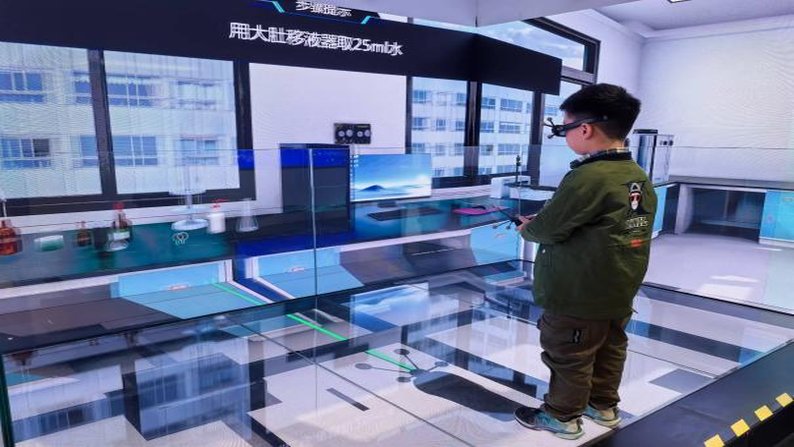
不择知行细流,蕴蓄蓝绿成深:雄安新区生态环境共享中心科普宣传空间营造雄安新区生态环境共享中心VR虚拟实验室(数字化仿真替代实体化学实验,实现科普零危废、低能耗)
6天前 · 来源:雄安新区生态环境监控中心 · 作者:雄安新区生态环境监控中心
