

Company/Organization Profile
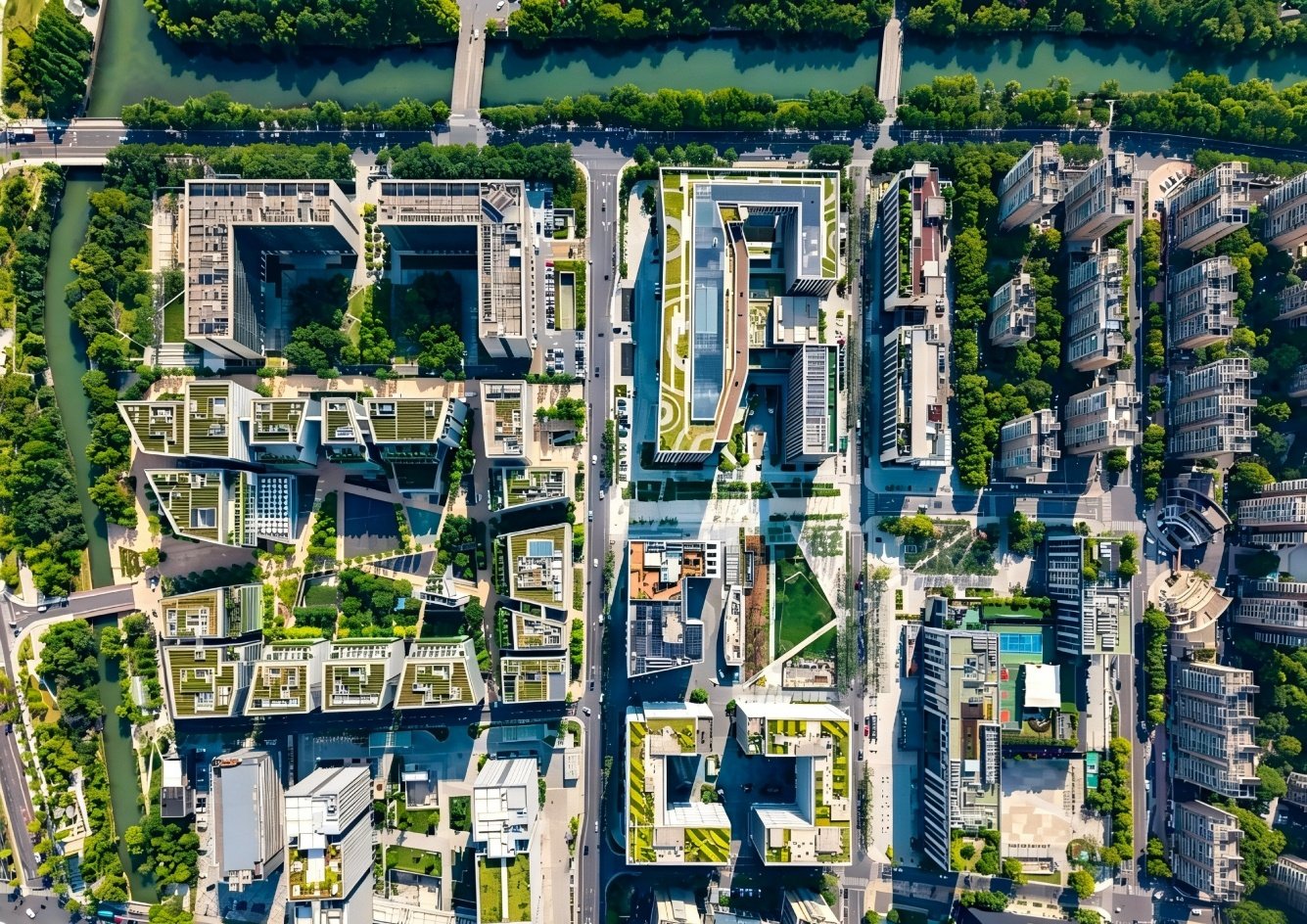
Guided by the spirit of "renewing ancient charm and gathering talent," Gudang Sub-district is located in the central part of Xihu District, Hangzhou. It is a distinctive area where a millennium-old waterside cultural heritage meets exemplary modern urban renewal. The sub-district administers ten communities, including Jialvyuan and Huaxing, and has a permanent population of approximately 89,000. To its south lies the West Lake World Cultural Landscape Heritage site; to its north is the Xixi Wetlands of International Importance. Gudang is therefore a key area for Hangzhou's "Twin-West Synergy" strategy.Since being selected as a pilot area for Zhejiang's Future Community initiative, Gudang has continuously explored renewal and reuse of existing spaces. Taking the Tianmuli International Block - one of Zhejiang's first representative urban-renewal cases - as a renewal engine, it has extended Tianmuli's "opening walls to greenery" approach from the commercial district into communities and waterside corridors. This has created a systematic practice of breaking boundaries across commercial, residential and water-system spaces. In the adjacent Huaxing and Jialvyuan communities, the sub-district has jointly built and shared connected green spaces, making the value of premier ecological resources tangible and accessible within a 15-minute living circle.
机构简介
“古韵承新、聚才呈荡”,是为古荡,古荡街道坐落于杭州市西湖区中部,是兼具千年水乡文脉与现代城市更新典范的特色片区,下辖嘉绿苑、华星等10个社区,常住人口约8.9万人。古荡街道南承西湖世界文化景观遗产、北接西溪国际重要湿地,是杭州“双西合璧”战略的关键承载区域。自入选浙江省未来社区建设试点以来,古荡街道不断探索存量空间更新利用,以天目里国际街区(浙江省首批城市更新典型案例)为更新引擎,将天目里国际街区的“拆墙透绿”更新理念向社区和水系廊道系统传导,形成从商业到居住到水系的系统性“破壁”实践,在华星、嘉绿苑两个相邻社区实践连片绿色空间共建共享,让顶级生态资源价值在15分钟生活圈内可感可及。
Project Overview
The Huaxing-Jialvyuan area of Gudang Sub-district lies along Hangzhou's "Twin-West Synergy" ecological corridor. With an almost 6-kilometre continuous water system comprising the Lianhuagang River, Fengjia River and Yile River, it serves about 20,000 nearby residents and is a core area for integrating ecological resources into the community living circle.
Before the renewal, the area faced three major challenges. First, green spaces were fragmented: community fences, unauthorized waterfront structures, ageing park facilities and ecological degradation had left green areas isolated. Public green-service coverage was below 30%, and ecological resources could not readily be converted into places for residents' leisure. Second, everyday mobility and leisure were carbon-intensive. Residents relied excessively on commercial complexes for leisure, motorised travel had a high share, and less than 40% of existing community green spaces were used, leaving landscape resources unable to support low-carbon living. Third, green maintenance was one-directional, with landscaping and river patrols led mainly by government and limited resident participation. At the core, existing green spaces had not formed a connected network or developed a close link with residents' daily needs and habits.
In response, Gudang Sub-district adopted "opening walls to greenery and weaving together connected spaces" as its central measure. By breaking down the three boundaries between communities, commercial areas and water systems, it activated existing spaces and created a fully connected green living circle. First, it wove greenery into a convenient network by turning "isolated idle corners" into a "connected, vibrant green network": themed parks and leisure facilities for all ages transformed fragmented unused spaces and activated their ecological and recreational value. Second, it embedded greenery to reduce carbon emissions by integrating green spaces into daily journeys, adding walking, cycling and low-carbon rest facilities, and encouraging nearby access to nature and low-carbon travel instead of high-carbon leisure trips to commercial complexes. Third, it brought people together for shared governance by involving residents of all ages in the management and operation of spaces, upgrading one-way governance into shared stewardship and raising the value of green spaces from standalone landscapes to platforms for low-carbon living and public co-creation.
项目背景
古荡街道华星-嘉绿苑片区依托杭州“双西合璧”生态廊道,有莲花港河-冯家河-益乐河近6公里连贯水系,服务周边约2万名居民,是生态资源融入社区生活圈的核心区域。
改造前,片区主要存在三大问题:一是绿色空间碎片化,社区围栏阻隔、滨水违建侵占、多处公园设施老旧、生态退化,绿地呈孤岛式分布,公共绿地服务覆盖率不足30%,生态资源难以转化为居民休闲场景。二是生活出行高碳化,居民休闲过度依赖商业综合体,机动车出行占比高,社区存量绿地使用率不足40%,景观资源未能赋能低碳生活。三是绿色维护单向化,绿化管护、河道巡护以政府单向主导,居民参与度较低。究其核心,存量绿色空间未形成网络化贯通体系,也未与居民日常生活需求、行为习惯建立深度联结。
对此,古荡街道以“拆墙透绿、连片织补”为核心举措,打破社区、商业、水系三重边界,盘活存量空间,打造全域贯通的绿色生活圈。一是织绿成网便民,推动 “闲置边角孤岛” 向 “连片活力绿网” 转变,打造不同主题的公园,增设全龄休闲设施,将碎片化闲置空间改造为连片活力绿网,激活生态休闲价值。二是嵌绿降碳惠民,将绿色空间融入居民日常出行,配套慢行、低碳休憩设施,引导居民就近享绿、低碳慢行,扭转依赖商业综合体高碳出行休闲模式。三是聚力共治睦民,吸纳全龄居民参与空间管护运营,推动单向治理向全民共享升级,从单一生态景观向低碳生活载体、全民共建阵地的综合价值提升。
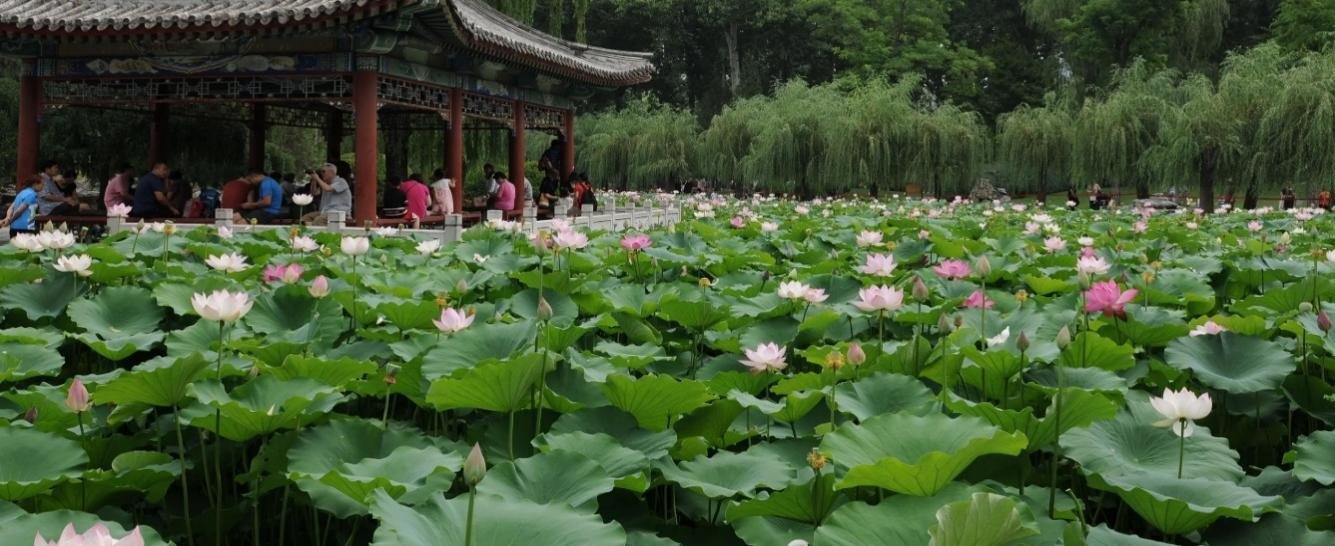
嘉绿苑公园水生植物净化系统
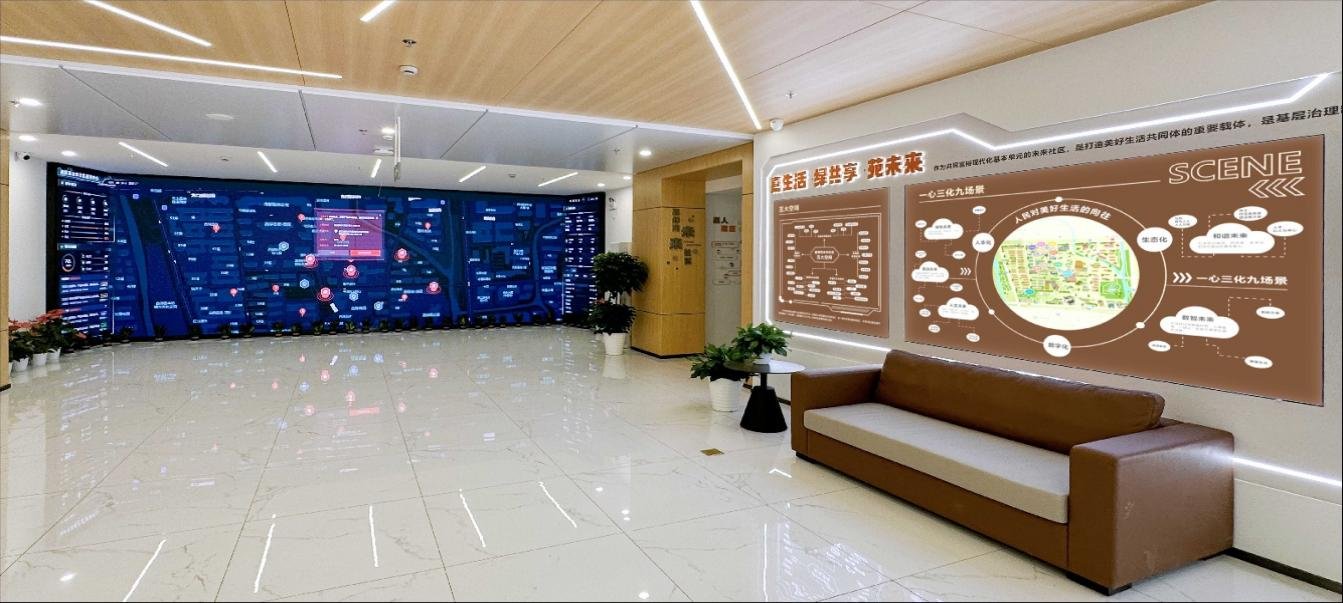
低碳化智慧平台管理
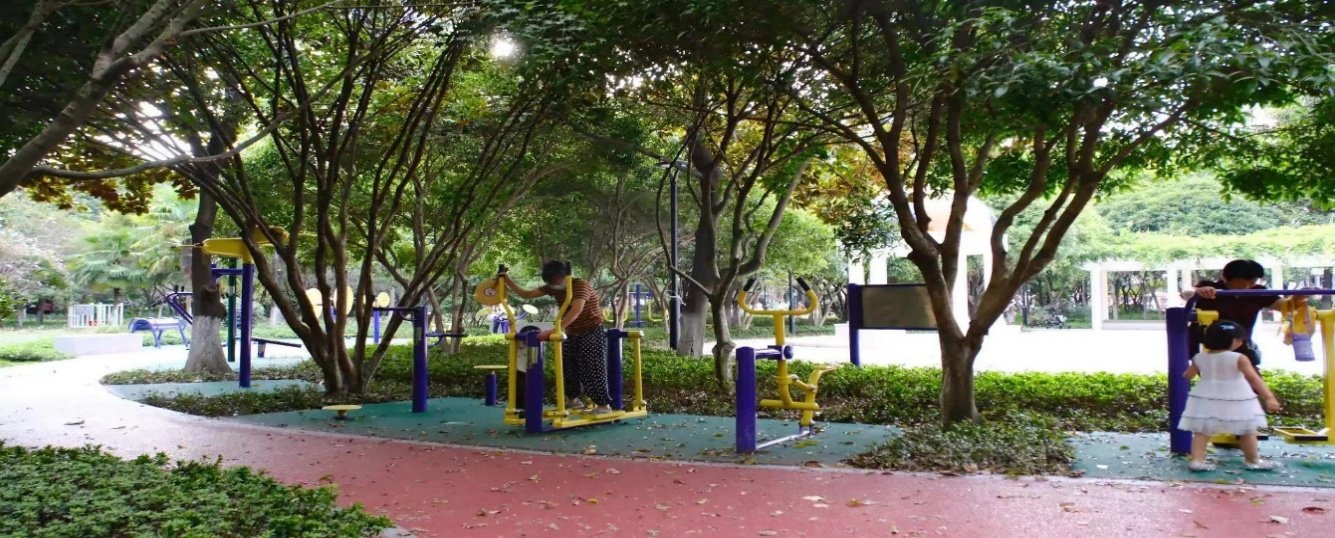
生态价值与居民生活的无界绿融
Project Implementation
The project uses "One River Linking Three Parks, Green Corridors Connecting the Twin Wests" as its spatial framework and a three-tier cascade of "opening walls to greenery" as its core methodology. It carried out systematic green regeneration across four existing sites - Fengtan Urban Cultural Park, Jialvyuan Park, Sanyou Park and the riverside green space along the Lianhuagang River - to address three major challenges: fragmented space, carbon-intensive behaviour and maintain unidirectionality.
(I) Addressing fragmented space: implementing a three-tier cascade of "opening walls to greenery" to build a connected green-space network.
At the first level, the conceptual prototype: Tianmuli International Block, one of Zhejiang's first representative urban-renewal cases, removed walls in ten commercial parks and freed nearly 200 ground-level parking spaces to create the South Bank Park lawn. The number of street trees increased to 2,909, forming a 350-mu (about 23.3-hectare) "borderless district" model. At the second level, community application: Huaxing Community has moderately opened up the fences of formerly gated residential compounds. Meanwhile, Jialvyuan Community has developed a "1+7+N" integrated space framework. With the community (neighborhood) center as its core, the system is backed by seven standard functional spaces — including a growth center and health complex — to revitalize idle small and micro spaces like underused corners and leftover venues. Public-service coverage in the area increased from 30% to 85%. At the third level, water-system application: unauthorized structures along the Lianhuagang River were cleared and closed waterfront sections reopened, creating a continuous 6-kilometre greenway along the water system. The sub-district completed zero-direct-discharge wastewater upgrades in 28 residential compounds and established records and closed-loop management for 152 drainage outlets along local watercourses. These three levels created a green-penetration chain of "borderless district - borderless community - borderless water system." Gudang Sub-district provided overall coordination; Huaxing and Jialvyuan Communities organised delivery; and Xihu Environmental Group provided technical support for water treatment.
(II) Addressing carbon-intensive behaviour: regenerating green spaces for multiple uses and guiding low-carbon behaviour through themed settings.
The four existing sites were assigned differentiated themes, allowing residents to experience diverse green settings within a 15-minute walk and reducing carbon-intensive travel and indoor commercial consumption. Fengtan Urban Cultural Park was transformed from idle woodland and incorporated the "Baishan Pillars" culture-of-goodness programme, becoming one of Hangzhou's first urban cultural parks and attracting residents outdoors through cultural activities. Jialvyuan Park established a water-purification system using aquatic plants such as water lilies, yellow flag irises and pickerelweed, supported by internal water circulation and quartz-sand filtration. Nature-based solutions (NbS) enable long-term self-purification of the waterbody. Sanyou Park converted an abandoned courtyard plaza into a blue-and-white castle-themed, child-friendly playground, encouraging family outdoor leisure. The riverside green space restored previously closed riverbanks to create linear water-and-green infrastructure; the Lianhuagang River was successfully designated a provincial-level Beautiful River and Lake. All four sites improved the quality of existing land without adding new construction land.
(III) Addressing superficial participation: Public discussion and joint construction, with a trinity of 'professional patrol + volunteer patrol + digital patrol'.
At the level of spatial co-construction, the "government + building owners + merchants" collaborative model implemented in Tianmu Li has been extended to residential communities. Huaxing Community leverages its red property management committee to facilitate the opening of fences and the micro-renovation of spaces, while Jialüyuan Community utilizes its residents' council to finalize renovation plans for underutilized spaces, thereby transitioning residents from mere recipients of opinion solicitation to key decision-makers in the renovation process. At the level of process co-governance, a comprehensive three-pronged water protection system has been established, integrating "professional patrols, volunteer patrols, and digital patrols." Professional teams from river maintenance and park management conduct standardized patrols of park water bodies and waterfront areas; the "Five Elders" river protection team in Huaxing Community and the volunteer river patrol force in Jialüyuan Community extend patrol coverage to park trails and waterfront spots, acting as grassroots "mobile sensors"; utilizing the digital river chief platform of Gudang Subdistrict, digital patrols incorporating "aerial surveillance, front-end sensing, and platform-based closed-loop management" are implemented to address regulatory gaps during nighttime, adverse weather conditions, and in areas that are challenging for personnel to access.
项目实施
项目以“一河串三园、双西通绿脉”为空间骨架,以“拆墙透绿”三级传导为核心方法论,在丰潭城市文化公园、嘉绿苑公园、三优公园、莲花港河滨河绿地四个存量空间实施系统性绿色再生,重点解决空间碎片化、行为高碳化和维护单向化三大问题。
(一)针对空间碎片化问题——实施 “拆墙透绿”三级传导,构建连片绿色空间网络
第一级,理念原型:天目里国际街区(浙江省首批城市更新典型案例)推动10 个商业园区拆除围墙,腾退近200个地面车位打造南岸公园草坪,街区乔木增至2909棵,形成350亩“无界街区”样板。第二级,社区传导:华星社区推动小区封闭围栏适度开放,嘉绿苑社区构建“1+7+N”嵌合式空间体系,即以民生综合体(邻里中心)为总核心,配套成长中心、健康综合体等7个标准功能空间,盘活闲置边角地等存量小微场地,片区公共服务覆盖率由30%提升至85%。第三级,水系传导:清理莲花港河滨河违建、打通封闭岸线,实现6公里水系绿道全线贯通;街道完成28个小区污水零直排改造,辖区152处河道排水口建立台账闭环管控。三级传导搭建起“街区无界—社区无界—水系无界” 绿色渗透链条。项目由古荡街道统筹,华星、嘉绿苑社区组织实施,西湖环境集团提供水体治理技术支撑。
(二)针对行为高碳化问题——实施绿色空间的复合再生,以主题场景引导低碳使用行为
四大存量空间差异化布局主题功能,居民15分钟步行圈内可体验多元绿色场景,减少高碳出行与室内商业消费。丰潭城市文化公园依托原有闲置林地改造,植入 “百善柱”善文化体系,打造杭州首批城市文化公园,以文化场景吸引居民户外休闲。嘉绿苑公园搭建睡莲、黄菖蒲、梭鱼草等水生植物净化系统,配套配水内循环与石英砂过滤装置,运用基于自然的解决方案(NbS)实现水体长效自净。三优公园由废弃楼间广场改造为蓝白城堡风格儿童友好乐园,引导亲子户外休闲。滨河绿地修复封闭河道岸线,打造水绿一体线性基础设施,莲花港河成功创建省级美丽河湖。四大空间均依托存量用地提质,不新增建设用地。
(三)针对参与表层化问题——全民议事共建,“专业巡护+志愿巡护+数字巡护”三位一体
空间共建层面,天目里“政府+楼宇业主+商户”共建模式向居住社区延伸。华星社区依托红色业委会推进围栏开放与空间微更新,嘉绿苑社区借助居民议事厅敲定闲置空间改造方案,推动居民从意见征询对象转变为改造决策主体。过程共治层面,构建 “专业巡护+志愿巡护+数字巡护”三位一体护水体系。由河道养护、公园物业专业队伍落实公园水体、滨水岸线标准化巡护;发挥华星社区“五老”护河队、嘉绿苑巡河志愿力量,将巡护覆盖至公园游步道、滨水点位,当好基层 “移动探头”;依托古荡街道数字河长智慧平台,实施 “空中巡航+前端感知+平台闭环” 数字巡护,补齐夜间、恶劣天气及人员难达区域的监管短板。
Project Outcome
Highlight 1 - Model innovation: three-tier linkage for opening walls to greenery, connecting green space across the area.
The Huaxing-Jialvyuan renewal is a systematic practice of breaking boundaries across parks, districts and residential communities. Using Tianmuli as its conceptual prototype and quality benchmark, it builds on the district's ecological framework and delivers livelihood-oriented community settings, creating a complete "borderless green integration" model for urban renewal in Hangzhou. Centred on the Yanhuo Bafang community-livelihood complex, Jialvyuan Community has created a "1+7+N" integrated space system, with a one-stop neighbourhood centre, seven types of distinctive convenience facilities, and linkages to 21 existing service points, thereby strengthening the 15-minute neighbourhood service circle. By activating idle spaces and linking fragmented resources, public-service coverage rose from 30% to 85%; after six roads and public spaces were renewed, utilisation exceeded 90%, transforming small micro-spaces into an area-wide service network.
Highlight 2 - Collaborative innovation: creating distinctive green spaces by zone and upgrading ecological quality.
The Huaxing-Jialvyuan area coordinates Fengtan Park, Jialvyuan Park, Sanyou Park and waterfront green spaces to form a multi-functional green living circle with "distinct themes, complementary functions and continuous space." Within a 15-minute walk, residents can reach four types of distinctive green spaces that meet diverse ecological, cultural, family and exercise needs. The project innovates a "Green Space Plus" regeneration model. It avoids the homogeneity of conventional upgrades to ageing communities - where one park is expected to serve every need and every park looks alike - and moves beyond standard configurations of plants, fitness equipment and pavilions. Each of the four green spaces has its own thematic identity, creating a connected ecological system with differentiated and complementary functions.
Highlight 3 - Mechanism innovation: smart water management strengthens stewardship and public participation protects ecology.
The Huaxing-Jialvyuan area integrates smart tools with green development to enable ecological stewardship across the area. The sub-district has established a multi-layered smart water-management system, with on-water water-quality monitors continuously collecting river data and two drones conducting automated patrols across the area. They can reach risk locations within five minutes and enable intelligent identification of riverbanks, discharge outlets and floating debris, followed by closed-loop response to identified risks. The Chinese source text attributes this point to Qianjiang Evening News. Huaxing and Jialvyuan Communities also regularly organise offline ecological study activities and water-protection literacy sessions.River-stewardship teams and community river chiefs conduct ongoing patrols, spreading low-carbon awareness through volunteer practice. Smart monitoring and digital patrols strengthen the ecological foundation, while offline education and volunteer participation create a lasting governance mechanism in which "technology manages water and everyone protects greenery."
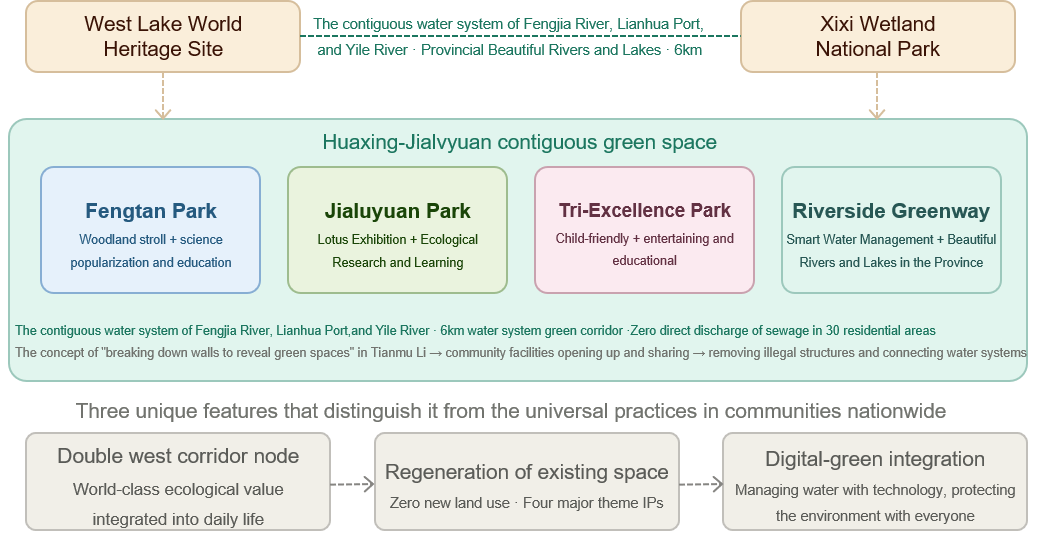
成果亮点
亮点一 模式创新:拆墙透绿三级联动,全域空间打通融绿
华星-嘉绿苑片区更新是覆盖园区、街区、住区的系统性 “破壁” 实践,以天目里为理念原型与品质标杆,依托街区生态骨架,落地社区民生场景,构建杭州城市更新 “无界绿融”完整范式。嘉绿苑社区以 “烟火八坊” 民生综合体为核心,打造 “1+7+N”嵌合式空间体系,布局一站式邻里中心、7类特色便民设施,联动 21 个存量服务节点,织密15分钟邻里服务圈。通过盘活闲置空间、串联碎片资源,片区公共服务覆盖率从30%提升至 85%,6条道路与公共空间焕新后利用率超90%,实现小微空间向全域服务网的质变。
亮点二 协同创新:分片打造特色绿地,实施生态提质升级
华星-嘉绿苑片区统筹丰潭、嘉绿苑、三优公园及滨水绿地,构建 “主题分工、功能互补、空间连续”的复合型绿色生活圈,居民步行15分钟可达四类特色绿色空间,覆盖生态、文化、亲子、运动多元需求。项目创新 “绿色空间 +”复合再生模式,打破老旧小区改造“单园全包、千园一面” 的同质化通病,摒弃绿植、健身器材、凉亭的标准化单一配置,四大绿地各设专属主题 IP,形成差异化互补的连片生态体系。
亮点三 机制创新:数字治水强管护,全民参与护生态
华星-嘉绿苑片区深耕智慧与绿色融合,以数字化手段赋能全域生态管护。街道搭建立体智慧治水体系,部署水上水质检测仪常态化采集河道数据,配备双无人机开展全域自动巡河,5分钟快速抵达隐患点位,实现岸线、排口、漂浮物智能识别闭环处置钱江晚报。依托华星、嘉绿苑社区阵地常态化开展线下生态研学、护水科普课堂,组织护河队、民间河长常态化巡护,以志愿实践传递低碳理念。通过智慧监测、数字巡查夯实生态基底,线下科普、志愿参与,形成 “科技管水、全民护绿” 的长效治理机制。
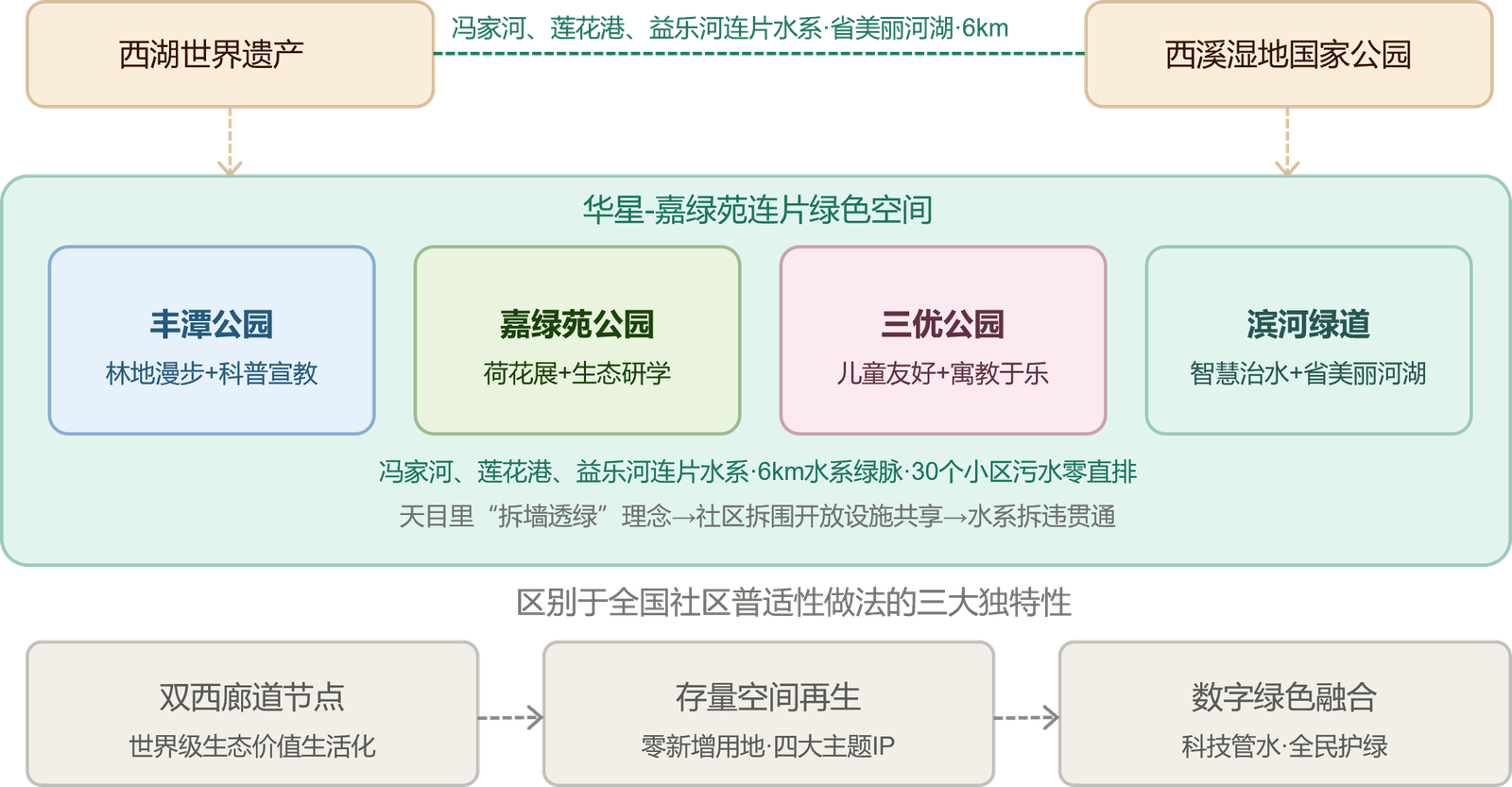
Project Highlights
Ecological and environmental benefits: the four green spaces in the Huaxing-Jialvyuan area cover more than 80,000 square metres in total and were renewed from existing spaces without adding new construction land. The waterfront water system was successfully designated a provincial-level Beautiful River and Lake. At Jialvyuan Park, a pond uses communities of aquatic plants and an internal water-circulation system to achieve long-term self-purification. Across the sub-district, zero-direct-discharge wastewater upgrades were completed in 28 residential compounds, and 152 drainage outlets along local watercourses were registered and managed under a unified system. Preliminary estimates put the annual carbon benefits at 210 tCO2 from natural carbon sinks (vegetation and waterbody carbon sequestration), about 750 tCO2 from low-carbon living, and about 190 tCO2 from improved ecological engineering. This is equivalent to the annual carbon emissions of 250 household sedans and represents substantial combined ecological value.
Social and economic benefits: Jialvyuan Community has been recognised as a Zhejiang Leading Future Community and as an Outstanding Case of Digital Future Community Development in Zhejiang, and has created provincially recognised service settings for both older adults and children. At the Hangzhou main event for National Low Carbon Day in 2026, Gudang Sub-district shared its experience as a representative model. The project extends Tianmuli's "opening walls to greenery" renewal approach from commercial districts to residential communities, creating a regional demonstration effect and a replicable "borderless green integration" model for green regeneration of existing spaces in central urban areas across China.
成果影响力
生态环境效益:华星-嘉绿苑片区四大绿色空间总面积超8万平方米,依托存量空间更新改造,零新增建设用地。滨河水系成功创建省级美丽河湖;嘉绿苑公园池塘依托水生植物群落与水体内循环系统实现长效自净。街道全域完成28个小区污水零直排改造,片区152个河道排水口统一建档管控。经初步估算年碳汇效益,自然碳汇(植被+水体固碳)210tCO2,低碳生活碳减排约750tCO2,生态工程提质约190tCO2,相当于250辆家用轿车一年的碳排放量,形成显著综合生态价值。
社会经济效益:嘉绿苑社区获评浙江省引领型未来社区、省未来社区数字化建设优秀案例,打造省级认可的 “一老一小” 特色服务场景。在 2026 年全国低碳日杭州主场活动中,古荡街道作为典型样板分享实践经验。项目推动天目里 “拆墙透绿” 更新理念由商业街区向居住社区传导,形成区域示范效应,为国内中心城区存量空间绿色再生打造可复制的 “无界绿融” 范式。
Reviews & Honors
Gudang Sub-district has worked extensively in urban renewal and has continuously put sustainable green-space use into practice, producing substantial development outcomes. Jialvyuan Community and Huaxing Community in Gudang Sub-district were respectively recognised in Zhejiang's fourth batch of Leading Future Communities and seventh batch of Inclusive Future Communities. Jialvyuan Community's low-carbon practice was selected as an Outstanding Case of Digital Future Community Development in Zhejiang. The connected water systems of the Fengjia River, Lianhuagang River and Yile River (the Wenxin area water system in Xihu District) were selected as Zhejiang "Beautiful River and Lake" sites for two consecutive years, in 2020 and 2021, and were promoted by the Zhejiang Provincial Office for Water Management as a typical "Beautiful River and Lake" case. In 2025, the Tianmuli International Block urban-renewal project in Gudang Sub-district was selected as one of Zhejiang's first representative urban-renewal cases. Its practices were reported by mainstream media including Xinhua News Agency's website and Zhejiang Daily.
Awards and honours:
Zhejiang Leading Future Community (Jialvyuan Community, Gudang Sub-district; Zhejiang Provincial Development and Reform Commission; 2023)
Outstanding Case of Digital Future Community Development in Zhejiang (Jialvyuan Community, Gudang Sub-district; Zhejiang Provincial Development and Reform Commission; 2023)
Zhejiang Beautiful River and Lake (Wenxin area water system, Xihu District; Zhejiang Provincial Office for Water Management; 2020 and 2021)
Hangzhou Municipal Pilot for Embedded Service Community Development (Huaxing Community, Gudang Sub-district; Hangzhou Municipal Development and Reform Commission; 2024)
Zhejiang's First Batch of Representative Urban-Renewal Cases (Tianmuli International Block Urban-Renewal Project; Zhejiang Provincial Office for Urban Renewal Enhancement; 2025)
评价与荣誉
古荡街道深耕城市更新领域,以可持续发展的理念持续践行绿色空间使用,取得丰硕建设成果:古荡街道嘉绿苑社区与华星社区先后获得浙江省第四批引领型未来社区、浙江省第七批普惠型未来社区,嘉绿苑社区低碳实践入选浙江省未来社区数字化建设优秀案例。冯家河、莲花港、益乐河连片水系(西湖区文新片区水系)2020、2021连续两年入选浙江省“美丽河湖”,被浙江省治水办作为“美丽河湖”典型案例推广。2025年,古荡街道天目里国际街区城市更新项目获得浙江省首批城市更新典型案例,相关经验做法被新华网、浙江日报等主流媒体报道。
奖项荣誉:
浙江省引领型未来社区(古荡街道嘉绿苑社区,浙江省发改委,2023年)
浙江省未来社区数字化建设优秀案例(古荡街道嘉绿苑社区,浙江省发改委,2023年)
浙江省美丽河湖(西湖区文新片区水系,浙江省治水办,2020、2021年)
杭州市级嵌入式服务社区建设试点(古荡街道华星社区,杭州市发改委,2024年)
浙江省第一批城市更新典型案例(天目里国际街区城市更新项目,浙提升办,2025年)
近零碳社区的美育升级---- 长寿苑社区 “低碳实践 + 影像科普” 共建项目
4天前 · 来源:成都市武侯区火车南站街道长寿苑社区居民委员会 · 作者:成都市武侯区火车南站街道长寿苑社区居民委员会

以绿色金融之力推动中国新质生产力!
4天前 · 来源:国泰海通证券研究所ESG及美丽中国研究组 · 作者:国泰海通证券研究所ESG及美丽中国研究组
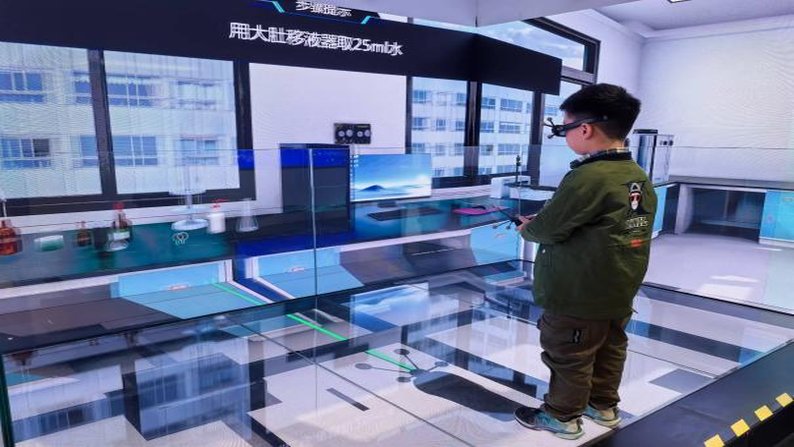
不择知行细流,蕴蓄蓝绿成深:雄安新区生态环境共享中心科普宣传空间营造雄安新区生态环境共享中心VR虚拟实验室(数字化仿真替代实体化学实验,实现科普零危废、低能耗)
6天前 · 来源:雄安新区生态环境监控中心 · 作者:雄安新区生态环境监控中心
