

Company/Organization Profile
Cuiyuan Subdistrict was established in 1986. It is bounded by Jiaogong Road to the east, Tianmushan Road to the south, Gucui Road (Fengjia River) to the west, and Yuhangtang River to the north. It is a model subdistrict of quality, integrating profound cultural heritage, a harmonious development environment, innovative service platforms, and a thriving commercial economy. The subdistrict covers an area of 3.9 square kilometers, with a permanent population of over 110,000 (including nearly 30,000 migrants). It has jurisdiction over 12 residential communities—including Cuiyuan Yiqu—and 4 joint-stock economic cooperatives, including Gudangwan.
In recent years, under the correct leadership of the Xihu District Party Committee and District Government, Cuiyuan Subdistrict has focused on the strategic goal of building a "model district that achieves all-around moderate prosperity, comprehensive beauty, and universal happiness." Making full use of its locational, resource, and industrial advantages, the subdistrict has prioritized the development of modern service industries, vigorously advanced urban organic renewal, comprehensively improved the urban ecological environment, and continuously promoted various social undertakings. The entire subdistrict now presents a favorable picture characterized by political stability, social harmony, economic growth, thriving public services, and the peaceful and contented lives of its residents. The Hangzhou Municipal Bureau of Ecology and Environment, Xihu District Branch is responsible for the supervision and management of ecological environment protection in Xihu District. Its main responsibilities include enforcing environmental policies, laws, and regulations; monitoring pollutant discharges; approving environmental impact assessment documents for construction projects; investigating and punishing environmental violations; implementing the pollutant discharge permit system; and coordinating overall ecological conservation efforts.
机构简介

翠苑街道简介:翠苑街道成立于1986年,东起教工路,南邻天目山路,西以古翠路(冯家河)为界,北与余杭塘河接壤,是一个集深厚人文底蕴、和谐发展环境、创新服务平台、繁盛商贸经济的品质示范街道。辖区面积3.9平方公里,常住人口11万余人(外来人口近3万人)。辖有翠苑一区等12个社区以及古荡湾等4个股份经济合作社。
近年来,翠苑街道在区委、区政府的正确领导下,围绕“全面小康全域美丽全民幸福的首善之区”的战略目标,充分利用区位优势资源优势、产业优势,重点发展现代服务业,大力推进城市有机更新,全面提升城区生态环境,不断推进各项社会事业,全街道呈现出政治安定社会稳定、经济发展、事业兴旺、人民群众安居乐业的良好局面。
杭州市生态环境局西湖分局简介:负责西湖区生态环境保护监督管理工作,主要职责涵盖执行环保政策法规、监督污染物排放、审批建设项目环境影响评价文件、查处环境违法行为、实施排污许可证制度以及统筹协调生态保护工作。
Project Overview
This project is located at the former Hongfeng Park in Cuiyuan Subdistrict, adjacent to Wenyi Street Primary School, serving nearby residents, teachers, and students. The park, initially planned as a garden space, was later fenced and locked for a long time, resulting in idle and wasted public green space. After reopening, various problems emerged: pavilions and wooden boardwalks are aged and damaged; the lake lacks guardrails, posing significant safety hazards; rest and sanitation facilities are scarce; the north wall blocks the greenway connection, and the narrow entrances make it inconvenient for the elderly and strollers; moreover, there is a lack of lowcarbon and zerowaste publicity, and no maintenance mechanism for the lake water.
The reasons are: longterm closure led to neglect of maintenance, and facilities deteriorated without timely repair; the initial planning only met basic greening needs and did not integrate daily leisure and passage requirements; physical barriers reduced spatial connectivity; and the park was not designed in line with green, lowcarbon, and zerowaste city requirements to establish ecological operation and publicity systems.
The improvement goals are: to demolish part of the north wall, widen and add entrance passages, and connect the public greenway; to renovate pavilions and boardwalks, and add lakeside guardrails to eliminate hazards; to install solarpowered fountains in the lake, add floating islands, and supplement rest and sanitation facilities; to adhere to the zerowaste concept by recycling demolition materials; to optimize the water ecosystem with ecological floating islands for water purification and solar fountains for water circulation; and to build diverse publicity scenarios, creating a green, lowcarbon, ecologically recycling, and peoplefriendly park.
项目背景
本项目位于翠苑街道原弘丰公园,毗邻文一街小学,服务周边居民及师生。公园早期规划后增设围墙并长期锁闭,公共绿地闲置浪费。开放后问题凸显:亭廊、木栈道老化破损,湖边无防护围栏,安全隐患突出;休憩、环卫设施稀缺;北侧围墙阻隔绿道,入口狭窄,老人婴儿车通行不便;缺乏低碳环保宣传,湖水运维机制缺失。
原因在于长期封闭管护缺位,设施风化未及时修缮;前期规划仅满足基础绿化,未配套休闲通行需求;物理隔断致公共空间连通性不足;未结合绿色低碳、无废城市要求构建生态运维与宣传体系。
改进目标:拆除部分北侧围墙,拓宽入园通道,打通绿道;修缮亭廊、木栈道,增设湖边围栏,消除隐患;增补休憩、环卫设施,完善便民配套;秉持无废理念循环利用拆除建材;优化水体生态,增设生态浮岛净化水质,配置太阳能喷泉,实现水体循环活化;搭建多元宣传场景,打造绿色低碳、生态循环的便民公园。
Project Implementation
Green Eco-Cycle Park, renovated from the former Hongfeng Park, is Zhejiang Province’s first practice park for zerowaste culture and circular economy. The project cycle covers four stages: scheme design, onsite renovation, exhibition installation, and park opening and operation. Led by the subdistrict office, it brings together the design institute Hangzhou Jinshi Weikai Culture Media Co., Ltd., construction contractors, merchants from the local digital district, and community residents. Financial resources are coordinated from government funds, while construction waste, electronic scrap from the district, and donated household items are repurposed to complete landscape works, the zerowaste exhibition hall, water treatment of Jian Shan Lake, and science education scenes.
The project tackles four major challenges one by one:
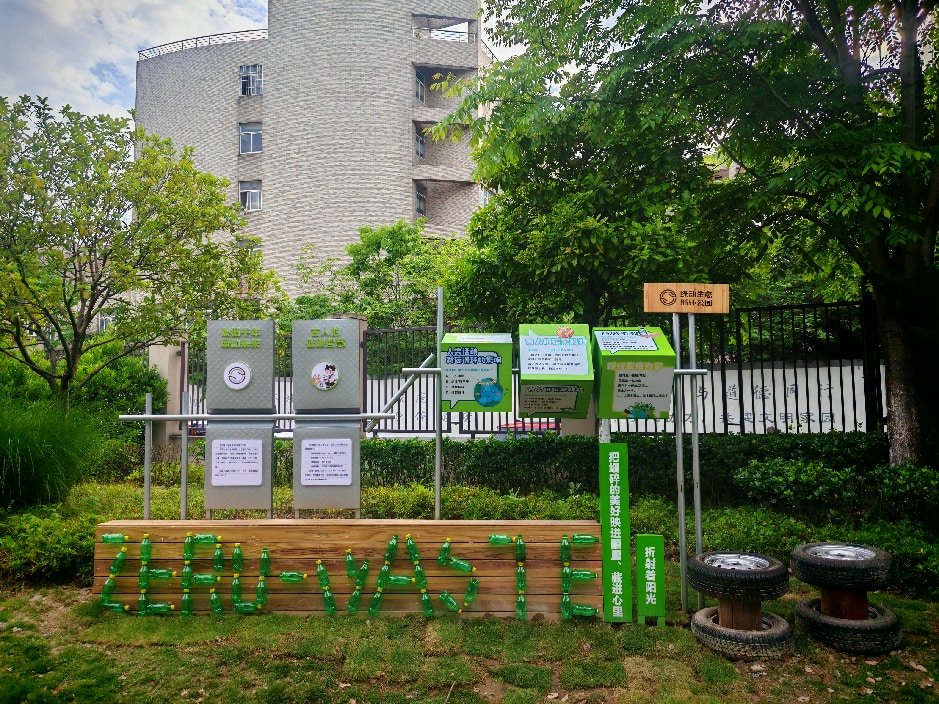
1. Spatial fragmentation caused by walls and difficult disposal of construction waste. More than 50 metres of walls were demolished, and the debris was reused on site rather than simply hauled away. The subdistrict office coordinated the work, the contractor carried it out, and the design team provided artistic solutions. Stones, railings, and pavement slabs were sorted; intact components were converted into treeseats, cubeshaped display devices, and aggregate for bench fillers, while damaged materials were safely absorbed within the park. This approach of “removing walls, not materials” cuts transport and gives old materials new life.
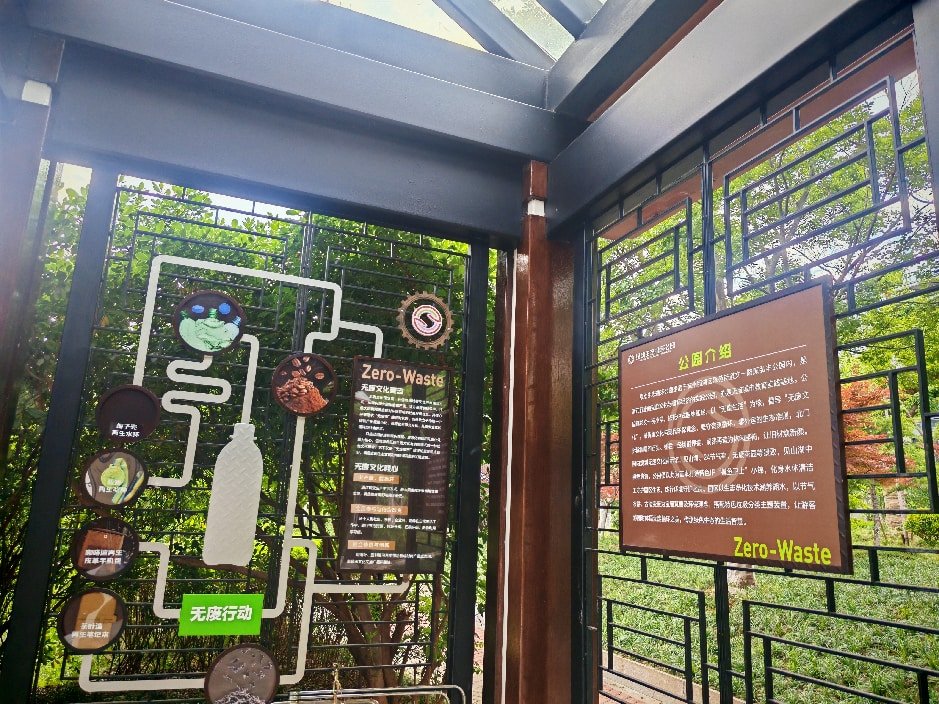
2. Insufficient raw materials for zerowaste landscapes and difficulty in expressing local character. Targeted recycling within the district was adopted to integrate local elements. The subdistrict and community connected with merchants and designers. Obsolete motherboards, keyboards, mice, and other ewaste were collected from local businesses, while household discards such as milk powder cans, bottle caps, coffee grounds, and fallen leaves were gathered from residents. Designers transformed these materials into the “Guardian Fish Xiaojin” IP sculpture, wayfinding signs, culturalcreative exhibits, and a heartshaped fallenleaf installation, blending the digital district’s features and the traditional 24 solar terms into the landscape, thus enriching the zerowaste scenes.
3. Deteriorating water quality in Jian Shan Lake and high energy consumption of conventional treatment. A threedimensional zerocarbon water treatment system was established. The contractor, together with a waterenvironment service provider, carried out dredging, installed ecological floating islands with aquatic plants to absorb pollutants, added solarpowered oxygenating fountains, and applied regular scientific silt removal. Relying on solar energy for zerocarbon operation, the system cuts internal pollution sources, balances ecology and energy saving, and improves the lake’s water environment.
4. Overemphasis on construction and neglect of operation in science education sites, coupled with low public participation. A dynamic renewal mechanism for the exhibition hall and diversified activity platforms were put in place. The subdistrict, community, and the hall’s operator jointly implemented this. A system for regularly updating exhibits was established, continuously inviting citizens to contribute upcycled creative works and refreshing the displays. Meanwhile, the Green Lawn and the 24SolarTerm Pavilion host regular zerowaste fairs, solarterm science activities, municipallevel wastesorting study summer camps, and handson workshops with scrap materials. By linking merchants, designers, and residents in both development and operation, a closed loop of “construction – collection – activity – feedback” has been formed, with public participation running through the entire project cycle.
After the renovation, a multiparty collaborative operation and maintenance mechanism was set up, clearly defining the roles of the subdistrict, community, and thirdparty operators to ensure longterm care of landscape facilities, the exhibition hall, and the water system, achieving a smooth transition from project construction to regular scienceeducation operation. The project has successfully pioneered a replicable model of “microrenewal of old parks + onsite waste absorption + embedding of science education scenes.” Since its opening, it has attracted many visitors, immersively spreading zerowaste and lowcarbon values, with notable social benefits.
项目实施
绿动生态循环公园由原弘丰公园改造而成,是浙江首座无废文化与循环经济实践公园。项目周期涵盖方案设计、现场改造、布展落地、开园运维四个阶段。街道牵头,联合设计单位杭州金石为开文化传媒有限公司、施工单位、街道内数字街区商户、社区居民多方参与;统筹财政资金,盘活拆改废料、辖区电子废弃物及市民捐赠的生活旧物,完成景观工程、无废展馆、见山湖水体治理、科普场景等建设。
项目直面四大问题,逐项破解:
围墙割裂空间,建筑垃圾处置难。拆除50余米围墙,废料就地资源化,不简单外运。由街道统筹,施工单位实施,设计单位提供艺术方案。分拣石材、栏杆、步道板,完好构件改造为树椅、魔方宣传装置、座椅骨料,破损物料合规内消,实现“拆墙不拆材”,减少外运,赋予旧材新用。
无废景观原材料不足,地域特色难体现。采取辖区定向回收,融入本土元素。街道社区对接,联合商户与设计师。集中回收旧主板、键盘、鼠标等电子废弃物,征集奶粉罐、瓶盖、咖啡渣、落叶等生活旧物;设计师艺术加工,打造“摸鱼卫士小锦”IP雕塑、导视标识、文创展品、心形落叶装置,将数字街区特色与二十四节气文化融入景观,丰富无废场景。
见山湖水质退化,传统治理能耗高。构建零碳水体治理体系。施工单位联合水环境服务商,开展湖底清淤,布设生态浮岛吸附污染物,加装太阳能增氧喷泉,搭配定期科学清淤。依靠太阳能实现零碳运行,削减内源污染,兼顾生态与节能,改善水环境。
科普阵地重建设轻运营,公众参与度低。完善展馆动态更新机制,搭建多元活动平台。街道社区与运营方共同实施。建立展品动态更新制度,持续征集市民变废为宝作品,迭代展陈内容;依托绿动草坪、24节气亭,将常态化举办无废市集、节气科普、市级垃圾分类研学夏令营及废旧手工实践。联动商户、设计师、居民参与建设与运营,形成“建设—征集—活动—反馈”闭环,公众参与贯穿全程。
改造完成后,建立多方协同运维机制,明确街道、社区、第三方单位分工,保障景观、展馆、水体系统长效管护,实现从工程建设向常态化科普运营平稳过渡。项目成功探索了“老旧公园微更新+固废就地消纳+科普场景植入”的可复制模式,开园后吸引大量市民打卡,沉浸式传播无废低碳理念,社会成效显著。
Project Outcome
Green Eco-Cycle Park is Zhejiang Province’s first practice park for zero-waste culture and circular economy, upgraded from the former Hongfeng Park. The project adheres to the principle of “zero offsite disposal and full reuse,” transforming an aging park into a zerowaste themed science education park. Before renovation, the park had limited functions, with walls blocking interaction between people and nature, a lack of environmental education facilities, and any upgrades generating large amounts of construction waste. During renovation, the approach of “removing walls, not materials” was implemented. Waste from demolished walls, railings, and path slabs was reused on site, achieving complete internal absorption of construction debris, reducing transport and disposal costs. After completion, the park now offers science displays, interactive experiences, and cultural leisure activities, becoming a public space that integrates sightseeing, zerowaste education, and cultural heritage. Spatial openness and visitor experience have been markedly improved.
The project features distinctive innovations. In terms of model innovation, it promotes the full regeneration of various waste materials, collecting discarded electronic components from Yihao Street, as well as household waste like milk powder cans, bottle caps, and coffee grounds, to create landscape installations such as the “Guardian Fish Xiaojin” IP and heartshaped fallenleaf art pieces, embedding circular principles into landscape details. In technical innovation, a threedimensional water treatment system has been established, combining ecological floating islands, solarpowered oxygenenhancing fountains, and scientific dredging techniques to purify the water of Jian Shan Lake in a zerocarbon manner. In collaborative innovation, the project works with merchants, designers, and citizens to explore the characteristics of the digital district, solicit creative ideas, and integrate traditional 24solarterm culture with modern zerowaste concepts.
The project is highly sustainable and replicable. The exhibition hall features a dynamic renewal mechanism, continuously collecting citizens’ upcycled creations. Regular zerowaste fairs and solarterm educational activities are held on the Green Lawn, establishing a longterm operation and maintenance system. The “microrenewal of old parks + onsite waste absorption + embedding of science education scenes” model requires few new building materials, fits the upgrade of existing urban parks, and is easy for neighborhoods and communities to adopt and promote. Since opening, the park has attracted numerous visitors, immersively spreading zerowaste and lowcarbon values, and achieving strong social impact.
成果亮点
绿动生态循环公园是浙江首座无废文化与循环经济实践公园,由弘丰公园改造升级而成。项目秉持“零外运、再利用”原则,推动老旧公园向无废主题科普公园转型。改造前,园区功能单一,围墙阻隔互动,缺少环保科普载体,设施更新会产生大量建筑垃圾。改造中落实“拆墙不拆材”,围墙、栏杆、步道板等废料就地资源化利用,实现建筑垃圾园内消纳,减少外运处置,降低固废成本。改造后,公园兼具科普展示、互动体验与文化休闲功能,成为集观光游览、无废教育、文化传承于一体的公共空间,空间通透度与游园体验显著提升。
项目创新特色鲜明。模式上,推动废旧物资全域再生,回收颐高街区电子元器件及奶粉罐、瓶盖、咖啡渣等生活废弃物,打造“摸鱼卫士小锦”IP、心形落叶艺术装置等景观,将循环理念融入细节。技术上,搭建立体化水体治理体系,组合生态浮岛、太阳能增氧喷泉与科学清淤工艺,以零碳方式净化见山湖水环境。协同上,联动商户、设计师与市民,挖掘数字街区特色,征集创意,将二十四节气传统文化与现代无废理念有机融合。
项目可持续、可复制性强。展馆建立展品动态更新机制,持续征集市民变废为宝作品;依托绿动草坪常态化举办无废市集、节气科普等活动,构建长效运维机制。“老旧公园微更新+固废就地消纳+科普场景植入”模式,无需大量新增建材,适配城市存量公园升级,便于街道、社区借鉴推广。开园后吸引大批市民打卡体验,沉浸式传播无废低碳理念,取得良好社会成效。
Project Highlights
The statistical period of this project covers the park’s reconstructionconstruction phase to its postopening operation. Solidwaste accounting follows the criteria for construction waste recycling of urban parks, with the bulk density of mixed construction waste set at 1.5 t/m³. In terms of ecological benefits, over 50 meters of enclosures were dismantled. Railings, wall stones and pavement slabs were reused onsite, cutting outbound constructionwaste transportation by 60 tons (equivalent to 3 fewer truckloads). Waste electronic components recycled from Yigao Digital Block were made into park guidesign art installations. Sediment dredging was conducted at Jianshan Lake, and a zerocarbon waterbody treatment system with solarpowered fountains was established. Reuse of waste materials saved approximately 100,000 CNY in construction costs.
Socially, the park has become a popular venue for sketching, camping and researchstudy activities. In August 2025, the municipallevel summer researchstudy camp on waste classification was held here, organizing teenagers to carry out zerowaste handicraft practices. Serving as a replicable model for zerowaste renovation of existing parks, the project delivers multiparty collaborative demonstration effects and effectively disseminates lowcarbon and zerowaste concepts.
成果影响力
本项目统计时段为公园改造建设期至开园运营阶段,固废参照城市公园建筑垃圾资源化核算口径,混合建筑垃圾松散密度 1.5t/m³。生态效益上,拆除围栏 50 余米,栏杆、围墙石料、步道板就地再利用,减少建筑垃圾外运 60 吨(少外运 3 车次);回收颐高数字街区旧电子配件打造园区导视艺术装置。见山湖清淤,依托太阳能喷泉构建零碳水体治理体系,旧物复用节约建设成本约 10 万元。
社会效益方面,公园成为写生、露营、研学热门点位。2025 年 8 月,市级垃圾分类暑期研学夏令营在此落地,组织少年开展无废手工实践。项目形成存量公园无废改造可复制样板,多方协同示范,有效传播低碳无废理念。
Reviews & Honors
Evaluation & Feedback: After systematic remediation, Jianshan Lake in Cuiyuan Subdistrict has seen significant improvements in water transparency and dissolved oxygen, with water quality achieving a "qualitative leap," officially recognized as "brand new." The community’s "Fishing Guardian · Xiao Jin" eco-IP encourages resident co-governance, enhancing participation in water protection and delivering a tangible sense of livability with "clear water, green banks, and scenic harmony."
Media & Industry Recognition: The official platform "Beautiful Xihu" featured continuous special reports, highlighting it as a model case for deepening the "Five-Water Co-Governance." Positioned as a "Zero-Waste Park" with zero-carbon solar fountains, ecological floating islands, and aquatic plants, the project aligns closely with ESG and zero-carbon demonstration goals. It is also integrated into youth immersive education, gaining social recognition for its ecological concepts.
Awards & Honors: Currently, no external formal awards have been recorded. The project remains in a phase of "consolidating achievements and improving long-term management." Its systematic, ecology-first approach and "zero-waste + zero-carbon" practices demonstrate strong potential for future district-level green demonstration and ecological governance selections.
评价与荣誉
评价反馈:翠苑街道见山湖经系统性整治后,水体透明度与溶解氧显著提升,水质实现"质的飞跃",获官方"焕然一新"定性认可。社区以"摸鱼卫士·小锦"生态IP引导居民共治,居民亲水护水参与度持续提高,"水清岸绿、景美人和"的宜居获得感切实增强。
媒体/行业认可:官方平台"美丽西湖"连续刊发专题报道,将其作为深化"五水共治"的典型案例传播。项目以"无废公园"为定位,配套零碳太阳能喷泉系统驱动水体循环增氧,结合生态浮岛与水生植物净化,高度契合ESG与零碳示范方向,被纳入青少年沉浸式科普活动,生态治理理念获社会化普及认可。
奖项荣誉:目前暂无外部正式奖项。项目处于"持续夯实成效、健全长效管护"阶段,其"生态优先、标本兼治"的系统化方案及"无废+零碳"实践,已具备申报区级绿色示范与生态治理类评选的潜力基础。

近零碳社区的美育升级---- 长寿苑社区 “低碳实践 + 影像科普” 共建项目
4天前 · 来源:成都市武侯区火车南站街道长寿苑社区居民委员会 · 作者:成都市武侯区火车南站街道长寿苑社区居民委员会
以绿色金融之力推动中国新质生产力!
4天前 · 来源:国泰海通证券研究所ESG及美丽中国研究组 · 作者:国泰海通证券研究所ESG及美丽中国研究组
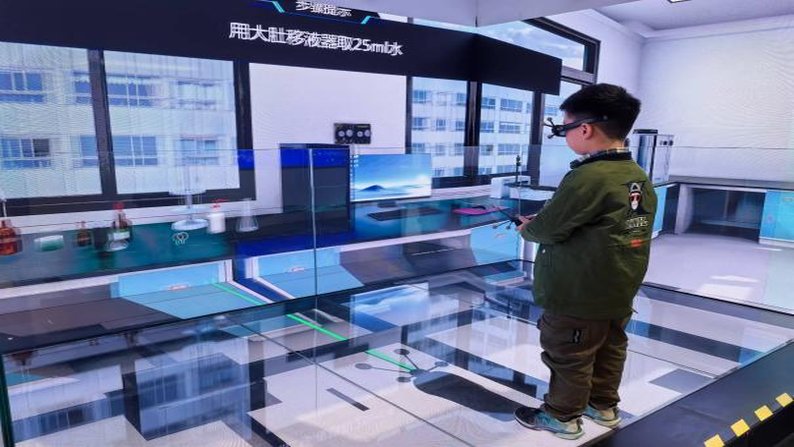
不择知行细流,蕴蓄蓝绿成深:雄安新区生态环境共享中心科普宣传空间营造雄安新区生态环境共享中心VR虚拟实验室(数字化仿真替代实体化学实验,实现科普零危废、低能耗)
6天前 · 来源:雄安新区生态环境监控中心 · 作者:雄安新区生态环境监控中心
