

Company/Organization Profile
Qingdao Energy Thermal Power Group No. 3 Heating Co., Ltd. is the project investor, construction owner and operating entity. As part of Qingdao Energy Thermal Power Group, it provides urban heating services while expanding clean, low-carbon integrated energy services.
Qingdao Lixinda Energy Service Co., Ltd., the joint applicant, is responsible for the engineering implementation and system integration of the smart PEDF (photovoltaics, energy storage, direct current and flexibility) DC microgrid. Using Zhongtianheng Building as a real-world office and commercial setting, the two parties jointly deployed high-efficiency mechanical and electrical systems, distributed PV, electrical and thermal storage, DC distribution, flexible energy use and intelligent operation, establishing a collaborative model between the space operator and the low-carbon technology implementer.
机构简介
青岛能源热电集团第三热力有限公司是本项目投资建设与运营主体,隶属青岛能源热电集团,长期承担城市供热保障并积极拓展清洁低碳综合能源服务。
青岛立信达能源服务有限公司作为联合申报单位,负责“光储直柔”智能直流微网的工程实施与系统集成。双方以中天恒大厦真实办公商业空间为载体,协同推进高效机电、分布式光伏、储能蓄冷、直流配电、柔性用能和智慧运维落地,形成“空间运营方+低碳技术实施方”协同实践机制。

Project Overview
As renewable energy expands and China advances its new-type power system, urban buildings need to do more than passively consume energy. A key challenge for low-carbon buildings is to increase on-site use of green electricity and unlock load flexibility without compromising normal office and commercial activities or occupant comfort. Qingdao, a national carbon-peaking pilot city, has explicitly promoted smart microgrids and PEDF systems in buildings.
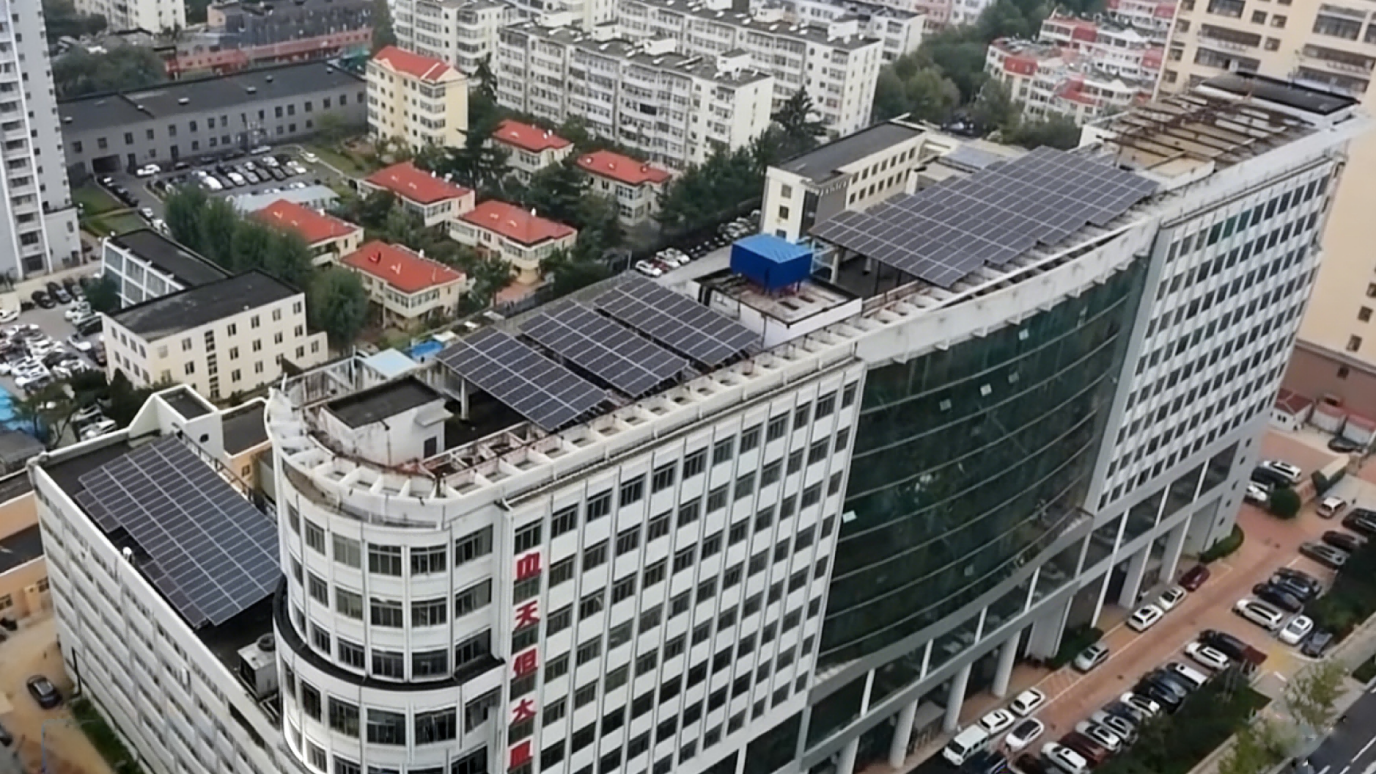
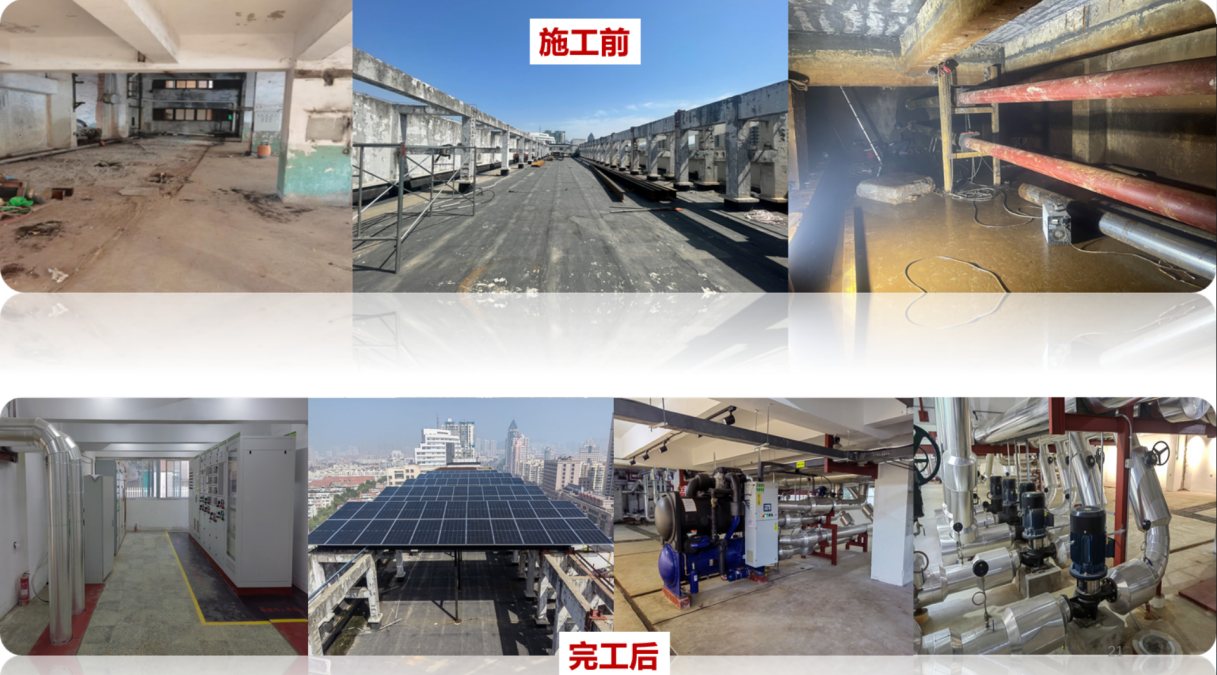
Zhongtianheng Building is an existing 12,985 m² office-commercial building; its retrofit was completed in June 2023 and the building then entered operation, serving occupants and operations staff. Before the project, cooling, power distribution, storage and building loads lacked coordinated operation, while the energy value of existing assets such as the roof and underground fire-water tank was underused.
The project therefore adopted a “minimal demolition, priority reuse of existing assets” approach, integrating PV, storage, DC distribution, flexible loads and intelligent control to transform the building from a passive energy consumer into a flexible energy unit capable of generation, storage, adjustment and interaction.
项目背景
随着可再生能源加快发展和新型电力系统建设推进,城市建筑已不应只是能源消费终端。如何在保障正常办公、商业使用和舒适需求的同时,提高绿电消纳能力、释放负荷调节潜力,成为建筑绿色低碳转型需要回答的新课题。青岛作为国家碳达峰试点城市,已明确推动智能微电网、“光储直柔”等技术在建筑领域应用。中天恒大厦为既有办公商业建筑,建筑面积12985平方米,项目于2023年6月完成改造并进入运行,服务楼内办公商业使用者及运行管理人员。
改造前,建筑供冷、配电、储能及用能负荷协同不足,屋顶、地下消防水池等既有资源的能源价值尚未充分释放。项目因此以“不大拆大建、优先盘活既有资源”为原则,通过光伏、储能、直流配电、柔性负荷和智慧控制系统集成,探索建筑由单纯用能终端向可发、可储、可调、可互动的柔性能源单元转变。
Project Implementation
The retrofit was invested in by Qingdao Energy Thermal Power Group No. 3 Heating Co., Ltd. Professor Wei Qingpeng’s team at Tsinghua University provided top-level planning and the technical route, while Qingdao Lixinda Energy Service Co., Ltd. carried out engineering implementation.
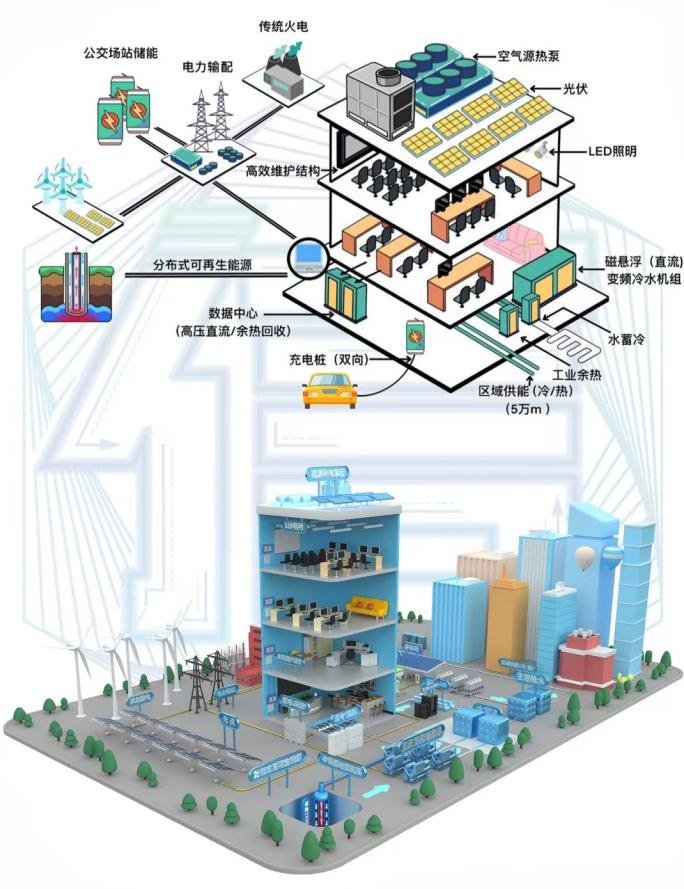
The project followed a layered approach: use less energy, use greener energy, store it, flexibly adjust it, and manage it intelligently.
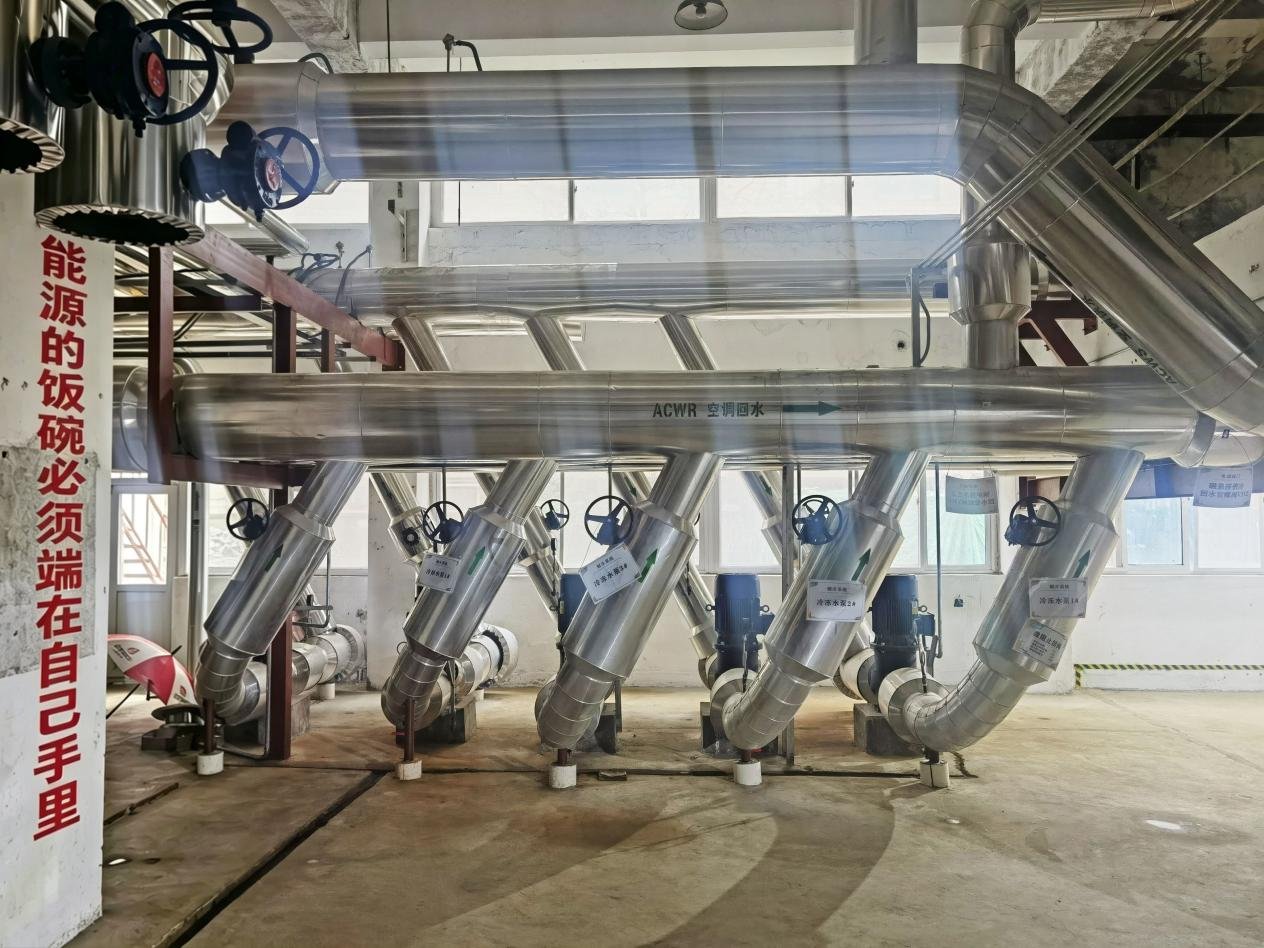
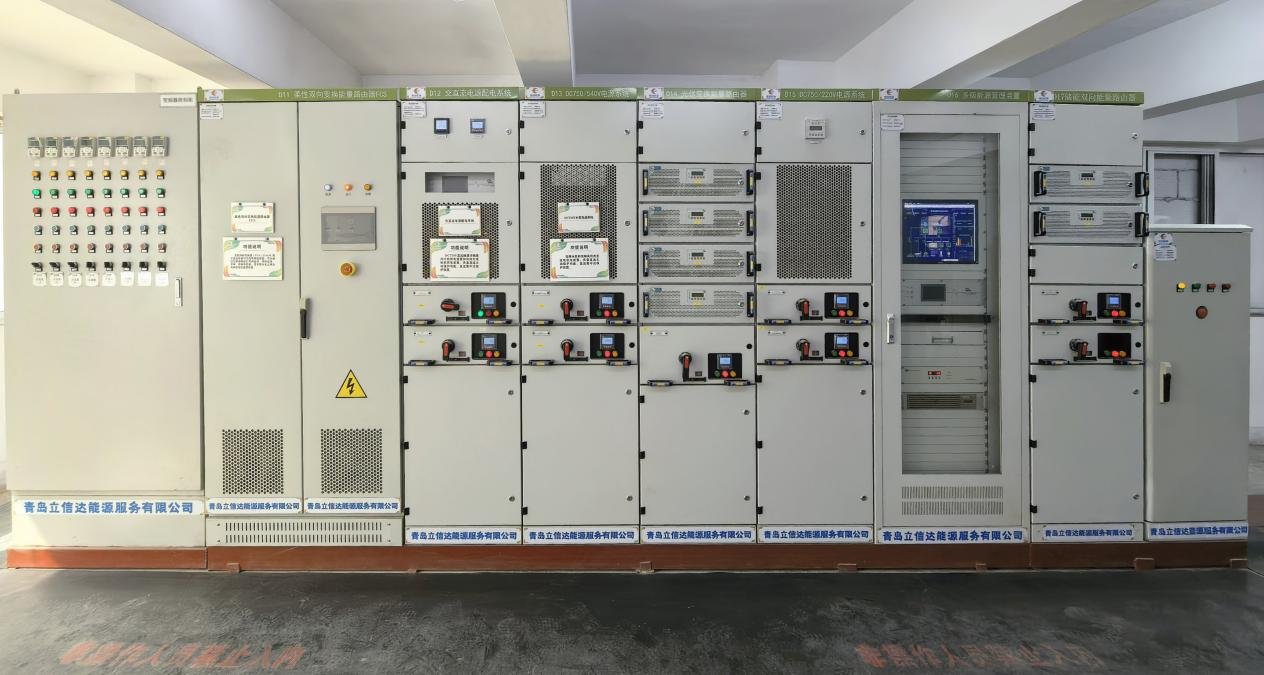
First, improve end-use efficiency. Cooling is centered on a 750 V DC-direct-drive magnetic-bearing variable-frequency centrifugal chiller with a rated COP of 5.9. Chilled-water pumps, cooling-water pumps and cooling-tower fans use variable-frequency drives and connect directly to the DC bus. BIM-based load simulation, multidisciplinary coordination and pipework optimization improved the MEP system without changing the main building structure.
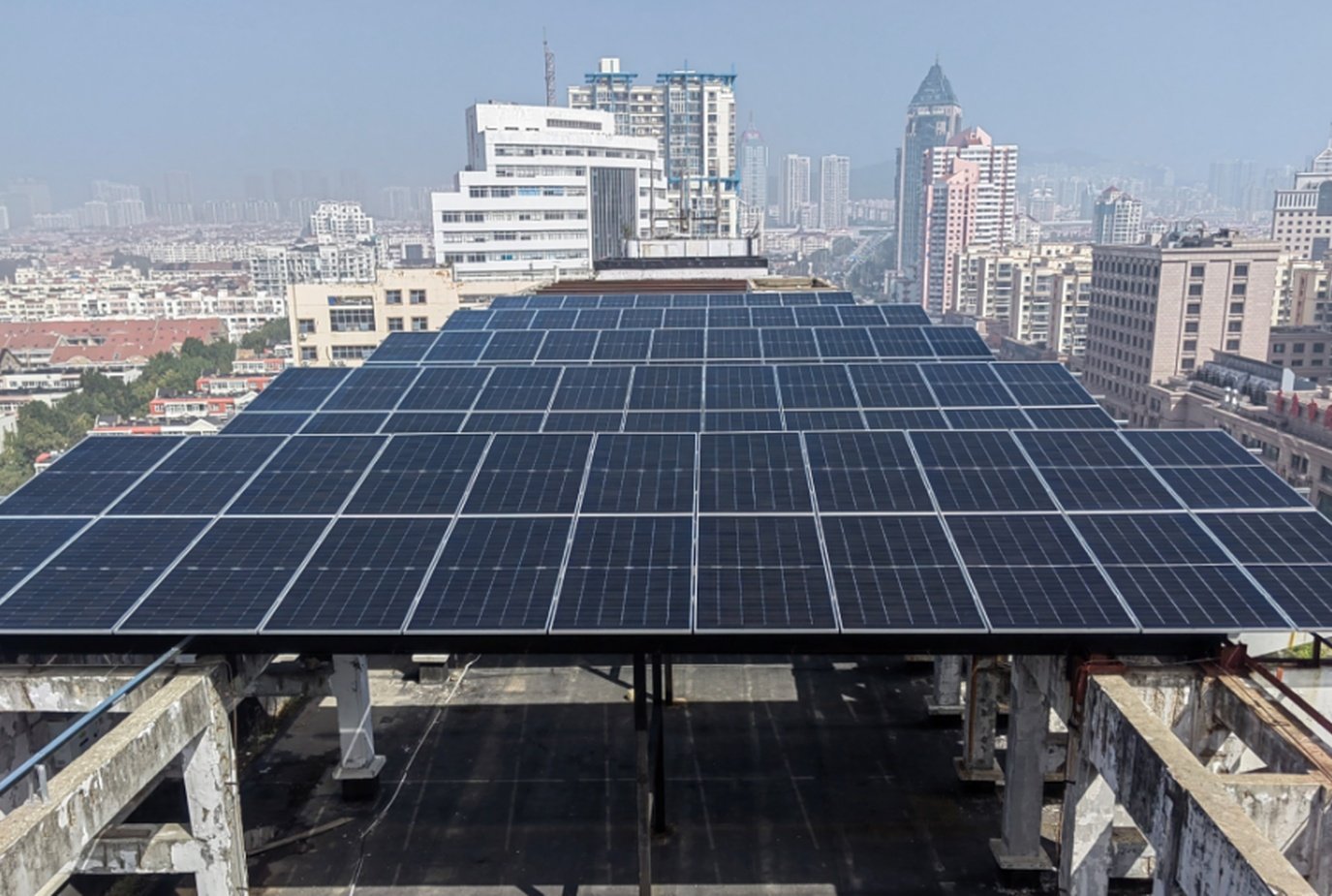
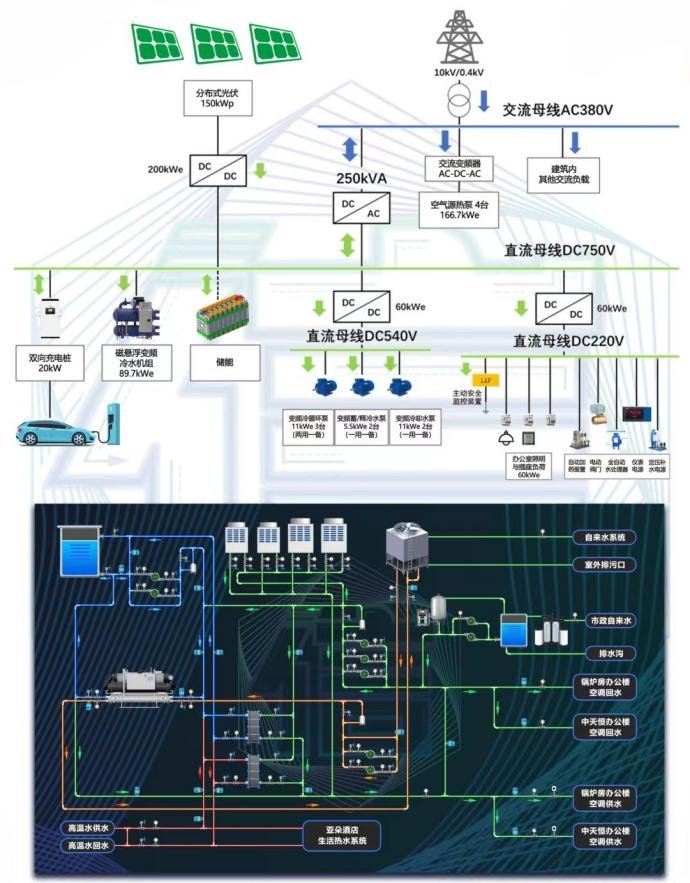
Second, increase on-site use of green electricity. A 150 kWp rooftop PV system and 51.24 kWh lithium iron phosphate battery were installed. A three-level 750/540/220 V DC distribution network integrates PV, storage, chillers, pumps and office lighting loads, reducing unnecessary AC/DC conversion. A 250 kVA flexible bidirectional converter regulates energy exchange with the grid according to system conditions.
Third, activate existing spatial assets. An approximately 270 m³ idle underground fire-water tank was converted into a chilled-water storage system with a 7°°C temperature differential, providing about 1,698 kWhc of cooling-storage capacity. It stores cooling during off-peak periods or when PV output is abundant and releases it during peak demand or low-PV periods, enhancing peak shaving without constructing a new large storage structure.
Fourth, expand flexibility. A bidirectional DC V2G charging facility was deployed and a 16.11 kW reverse-discharge test was completed, allowing parked EVs to act as mobile storage for building-side energy adjustment. PV, battery storage, chilled-water storage, flexible HVAC loads and EVs therefore operate as a coordinated resource portfolio.
Fifth, establish intelligent operations.
The PEDF building energy management platform monitors temperature, flow and power, combines weather, load, PV-output and time-of-use price forecasts, and applies model predictive control (MPC) for day-ahead scheduling and real-time optimization. It automatically switches among five modes—direct supply, charging thermal storage, discharging thermal storage, simultaneous supply and storage, and simultaneous supply and discharge—keeping PV curtailment below 3% and reducing overall operating costs by about 30% compared with the pre-retrofit conventional system.
Sixth, connect low-carbon operation with everyday users. Cooling is metered by floor and charged according to actual consumption, making energy use measurable, visible and demand-based. Complex optimization is handled mainly by the platform and operations staff in the background, embedding low-carbon operation into daily building use while meeting normal office and commercial needs.
项目实施
项目由青岛能源热电集团第三热力有限公司投资改造,清华大学魏庆芃团队提供顶层规划与技术路线,青岛立信达能源服务有限公司负责工程实施,围绕“用得更少、用得更绿、储得起来、调得灵活、管得智能”分层推进。
一是提高用能效率。供冷核心采用750V直流直驱磁悬浮变频离心式冷水机组,额定COP5.9;冷冻水泵、冷却水泵和冷却塔等采用变频驱动并直连直流母线。设计阶段利用BIM开展负荷模拟、多专业协同和管路优化,在不改变主体结构的条件下提升机电系统效率。
二是提高绿电就地利用。利用既有屋顶建设150kWp分布式光伏,配置51.24kWh磷酸铁锂储能,构建750V/540V/220V三级直流配电网络,将光伏、储能、冷机、水泵及办公照明等负荷统一接入,减少不必要的交直流转换;250kVA柔性双向变换器根据系统状态调节与电网的能量交换。
三是盘活存量空间。将地下约270立方米闲置消防水池改造为7℃温差水蓄冷系统,形成约1698kWhc蓄冷能力。低谷电或光伏富余时蓄冷,用电高峰或光伏不足时释冷,在不另建大型蓄冷构筑物的情况下增强削峰填谷能力。
四是拓展柔性调节。配置V2G双向直流充电设施并完成16.11kW反向放电实测,使停放的电动汽车可作为移动储能参与建筑侧调节。光伏、电储能、水蓄冷、空调柔性负荷和电动汽车由此形成多元协同。
五是建立智慧运维机制。“光储直柔建筑能源管理平台”布设温度、流量、功率等监测点,融合气象、负荷、光伏出力和分时电价预测,采用MPC模型预测控制开展日前调度与实时优化,可在“直供、蓄冷、释冷、同供同蓄、同供同释”五种模式间自动切换,弃光率低于3%,整体运行费用较改造前常规系统降低约30%。
六是让低碳与使用者日常相连。项目实行分层用冷计量、按实际用冷量计费,使能源消费可计量、可感知、按需使用;复杂优化主要由平台和运行人员在后台完成,在保障正常办公商业使用需求的同时,把绿色低碳融入日常空间运营。
Project Outcome
The project goes beyond simply adding PV, storage and energy-efficient equipment. By restructuring the building energy system, it delivers three fundamental shifts in the role of the building, the use of existing resources and the way the building is operated.
First, from passive consumption to coordinated generation, consumption, storage and adjustment. Rooftop PV produces green electricity, batteries and chilled-water storage provide energy storage, HVAC loads offer flexible adjustment, and V2G brings EVs into the building energy system. The building is therefore evolving into a flexible energy unit that can generate, store, consume and adjust energy.
Second, from adding new facilities to activating existing assets. Without altering the main structure, the project uses the existing roof for PV and converts an approximately 270 m³ idle fire-water tank into a roughly 1,698 kWhc “cooling battery,” allowing the roof, water tank, vehicles and MEP equipment to participate jointly in energy optimization.
Third, from stand-alone equipment and experience-based adjustment to predictive coordination. The platform automatically optimizes operation based on weather, load, PV output and electricity prices. Continuous 12-month measurements from July 2023 to June 2024 show an operational carbon-emission intensity of 23.0 kgCO₂e/(m²·a), a renewable-energy substitution rate of 33%, and a non-heating public-building energy-use intensity of 87.61 kWh/(m²·a). PV curtailment is below 3%, while operating costs are about 30% lower than the pre-retrofit conventional system. The project has thus established a durable operating model linking efficient equipment, green-electricity supply, multi-form storage, flexible adjustment and intelligent operations, providing an engineering example for urban public buildings to evolve from passive energy consumers into coordinated green-energy units.
成果亮点
项目不是简单叠加光伏、储能和节能设备,而是通过能源系统重构,实现建筑角色、资源利用和运行方式的三重转变。
一是从“被动用能”向“产消储调”转变。屋顶光伏生产绿电,电池与水蓄冷承担储能,空调等负荷具备柔性调节能力,V2G把电动汽车纳入建筑能源系统,使建筑逐步形成可发、可储、可用、可调的柔性能源单元。
二是从“新增设施”向“盘活存量”转变。在不改变主体结构的条件下利用既有屋顶建设光伏,将约270立方米闲置消防水池转化为约1698kWhc“冷量电池”,让屋顶、水池、车辆和机电设备等原本分散的资源共同参与能源优化。
三是从“设备独立、经验调节”向“预测协同”转变。平台根据天气、负荷、光伏和电价变化自动优化运行。2023年7月至2024年6月连续12个月实测核算显示,建筑运行碳排放指标为23.0kgCO₂e/(㎡·a),可再生能源替代率33%,公共建筑非供暖能耗指标87.61kWh/(㎡·a);弃光率低于3%,运行费用较改造前常规系统降低约30%。项目由此形成“高效设备—绿电供给—多元储能—柔性调节—智慧运营”的长期运行模式,为城市公共建筑由能源消费终端向绿色能源协同单元转变提供工程样本。
Project Highlights
Environmentally, the project uses continuous energy bills and monitoring data from July 2023 to June 2024 as the basis for performance assessment. The renewable-energy substitution rate reaches 33%, operational carbon-emission intensity is 23.0 kgCO₂e/(m²·a), and non-heating public-building energy-use intensity is 87.61 kWh/(m²·a). Publicly released operational data also indicate savings of about 55 tonnes of standard coal and approximately 136 tonnes of CO₂.
Socially, the project demonstrates in a real office-commercial building that PV, battery storage, chilled-water storage, flexible loads and EVs can be coordinated. It provides practical evidence for Qingdao’s national carbon-peaking pilot to explore flexible building-side energy use, and offers a reference pathway for low-carbon transformation of existing office, commercial and other public buildings across China, enabling ordinary urban spaces to become active participants in the green-energy transition.
成果影响力
生态环境方面,项目以2023年7月至2024年6月连续12个月能源账单和监测数据为核算基础,可再生能源替代率达到33%,建筑运行碳排放指标为23.0kgCO₂e/(㎡·a),公共建筑非供暖能耗指标为87.61kWh/(㎡·a);公开运行资料显示,可节约标准煤约55吨、减少二氧化碳排放约136吨。
社会影响方面,项目以真实办公商业建筑验证光伏、电储能、水蓄冷、柔性负荷和电动汽车协同运行,为青岛国家碳达峰试点探索建筑侧柔性用能提供实证,也为全国既有办公、商业等公共建筑绿色低碳转型提供可借鉴路径,让城市中普通的用能空间逐步成为绿色能源转型的参与者。
Reviews & Honors
The project has developed a mutually reinforcing evidence chain of operational data, professional review, government recognition and mainstream media coverage. In 2025, after multiple rounds of technical review, final presentation and operational-data verification by the National Technology Innovation Center for Green and Low-Carbon Building, it was selected as one of 15 annual demonstration projects nationwide.
It was also selected as a “New Energy + Energy Storage” Excellent Case by the APEC Sustainable Energy Center, an Energy Green and Low-Carbon Transition Typical Case by the Shandong Provincial Energy Administration, and a Shandong Provincial Construction Science and Technology Demonstration Project.
At the municipal level, it was included in Qingdao’s 2024 Typical Cases of Energy Conservation and Carbon Reduction and the Qingdao Key Energy-Saving and Low-Carbon Technology Promotion Catalogue (Fifth Batch).
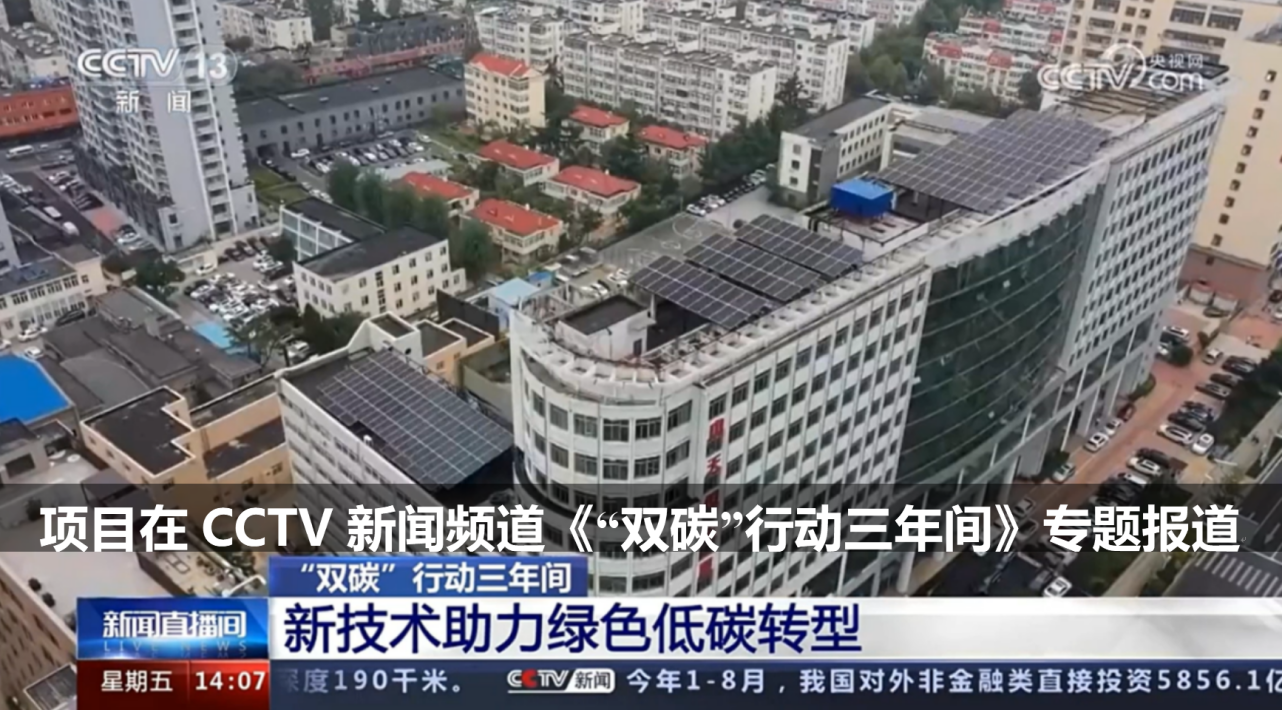
The project was also featured by CCTV News Channel in the special program “Three Years of Dual-Carbon Action.” These independent recognitions demonstrate its practical value in green building energy use, flexible energy management and broader replication.
评价与荣誉
项目已形成“运行数据—专业评审—政府认可—主流传播”相互印证的评价链。2025年,项目经国家建筑绿色低碳技术创新中心多轮技术审查、终审答辩及运行数据核查,入选全国15项年度示范工程。
项目还入选APEC可持续能源中心“新能源+储能”优秀案例成果、山东省能源局“能源绿色低碳转型典型案例”、山东省住房和城乡建设厅建设科技示范工程创建项目,以及青岛市发展改革委2024年度“节能降碳”典型案例和“青岛市节能低碳重点技术推广目录(第五批)”。
央视新闻频道《“双碳”行动三年间》曾对项目进行专题报道。多层级第三方认可从专业评审、工程运行和社会传播等维度体现了项目在建筑绿色用能、柔性调节和推广应用方面的实践价值。

近零碳社区的美育升级---- 长寿苑社区 “低碳实践 + 影像科普” 共建项目
4天前 · 来源:成都市武侯区火车南站街道长寿苑社区居民委员会 · 作者:成都市武侯区火车南站街道长寿苑社区居民委员会

以绿色金融之力推动中国新质生产力!
4天前 · 来源:国泰海通证券研究所ESG及美丽中国研究组 · 作者:国泰海通证券研究所ESG及美丽中国研究组
不择知行细流,蕴蓄蓝绿成深:雄安新区生态环境共享中心科普宣传空间营造雄安新区生态环境共享中心VR虚拟实验室(数字化仿真替代实体化学实验,实现科普零危废、低能耗)
6天前 · 来源:雄安新区生态环境监控中心 · 作者:雄安新区生态环境监控中心
