

Company/Organization Profile
Yuexiu Park's core management team (including the Park Director and the Landscape and Greening Department) has endorsed a green development strategy aligned with China's carbon peaking and carbon neutrality goals, and has established an effective zero-waste management system for green waste. Building on its Carbon Neutrality Park, Yuexiu Park delivers ongoing public education on climate change and low-carbon development while providing an open space for ecological awareness and environmental engagement. Through the adoption of clean energy, energy-efficiency upgrades, the development of circular low-carbon products, and the promotion of green commuting among staff, the park integrates low-carbon practices into its daily operations. It also actively engages communities, families, and schools in promoting sustainable lifestyles, and showcases its green initiatives and practical achievements through its official website and third-party communication platforms.
机构简介
越秀公园核心管理团队已审议通过支持国家“双碳”战略的绿色发展目标与行动路径,并有效运行覆盖园林垃圾零废弃管理体系。园内依托碳中和主题园,持续开展“双碳”与气候变化科普,打造生态文化展示空间。通过推进清洁能源替代、实施节能降碳技术改造、推出循环再生低碳产品、推行员工绿色通勤方案,全方位践行低碳运营。同时,积极面向社区、家庭和校园传播绿色理念,并通过官网及第三方平台展示绿色实践与行动案例。
Project Overview
As one of Guangzhou's major urban public parks, Yuexiu Park serves large numbers of residents, visitors, and surrounding communities. As expectations for sustainable urban development continue to grow, opportunities remain to further strengthen both park operations and environmental education.
One challenge lies in the management of green waste generated through routine landscape maintenance, including tree branches, leaves, and other plant materials. Conventional practices—primarily natural decomposition and off-site disposal—require long processing times, increase transportation-related costs and carbon emissions, and do not fully realize the resource value of these materials.
At the same time, important issues such as climate change, biodiversity conservation, and circular resource use are often insufficiently connected to people's everyday experiences. Traditional environmental education approaches have had limited impact in encouraging public participation and supporting the transition to more sustainable lifestyles. These challenges highlight the need for closer integration between ecological resource management and public education within urban parks, while further unlocking the educational value of circular resource management.
In response, Yuexiu Park has adopted a green and low-carbon development approach by establishing a zero-waste management system for green waste. Through on-site treatment and resource recovery, the park improves resource circularity while reducing carbon emissions associated with waste management. Building on its existing public spaces, the park has also developed the Carbon World Playground and the Eco Low-Carbon Trail, integrating themes of ecological conservation, climate change, and sustainable living into visitors' everyday park experiences. Together, these initiatives have created a public demonstration space that combines low-carbon practices with environmental education.
项目背景
越秀公园作为城市公共生活空间,长期服务市民游客及周边社区居民。随着绿色低碳发展要求提升,公园运营管理和生态教育仍存在优化空间。
一方面,公园绿化养护过程中产生大量树枝、落叶等园林废弃物,传统处理方式以自然堆肥和外运为主,存在降解时间长、环境污染、运输处理成本与碳排放提高及资源利用效率不足等问题。
另一方面,气候变化、生物多样性保护、资源循环利用等生态议题与公众日常生活连接不足,现有科普方式难以推动绿色转型和全员行动。上述问题主要源于城市公园生态资源管理与教育功能融合不足,园林资源循环利用和生态价值传播仍有提升空间。
为此,越秀公园以绿色低碳理念为核心,探索园林垃圾零废弃管理模式,推动园林垃圾就地处理资源化利用,提升资源循环效率并降低碳排放。同时,依托既有公共空间建设碳世界乐园和生态低碳径,将生态环境、气候变化与低碳生活主题融入游客日常游览场景,打造低碳实践与公众教育融合的绿色公共示范空间。
Project Implementation
1. Establishing a zero-waste green waste management system
To address the limitations of conventional green waste management, Yuexiu Park developed an innovative zero-waste management model known as the "Yuexiu Triple-All Approach", featuring whole-process monitoring, whole-park coverage, and whole-chain participation. The model manages green waste throughout its entire lifecycle—from generation, collection, and sorting to treatment and reuse.
Led by the park management team and implemented in partnership with Climate Action (Guangdong) Environmental Technology Co., Ltd., the project introduced dedicated green waste treatment facilities and optimized operational processes. Using high-temperature aerobic composting technology, the project established an integrated resource recovery chain covering source separation, mechanical shredding, rapid decomposition, and resource recovery. Tree branches, leaves, and other plant materials are converted into organic compost for landscaping and vegetation maintenance within the park, enabling a closed-loop system in which green waste is fully treated on site.
Following process optimization, the treatment cycle was reduced to approximately one day. The project now achieves 100% reduction treatment of green waste, a resource recovery rate exceeding 95%, and an estimated annual reduction of 232 tonnes of CO₂ emissions, significantly improving resource circularity and operational efficiency.
2. Transforming waste treatment facilities into public demonstration spaces
Following the introduction of professional treatment equipment, the space previously occupied by stockpiled green waste was released for new uses. In collaboration with Climate Action (Guangdong) Environmental Technology Co., Ltd., Yuexiu Park transformed the area into a green waste resource recovery station and circular economy demonstration space. As the treatment process operates without unpleasant odours or adverse environmental impacts, the site became suitable for public access and educational activities.
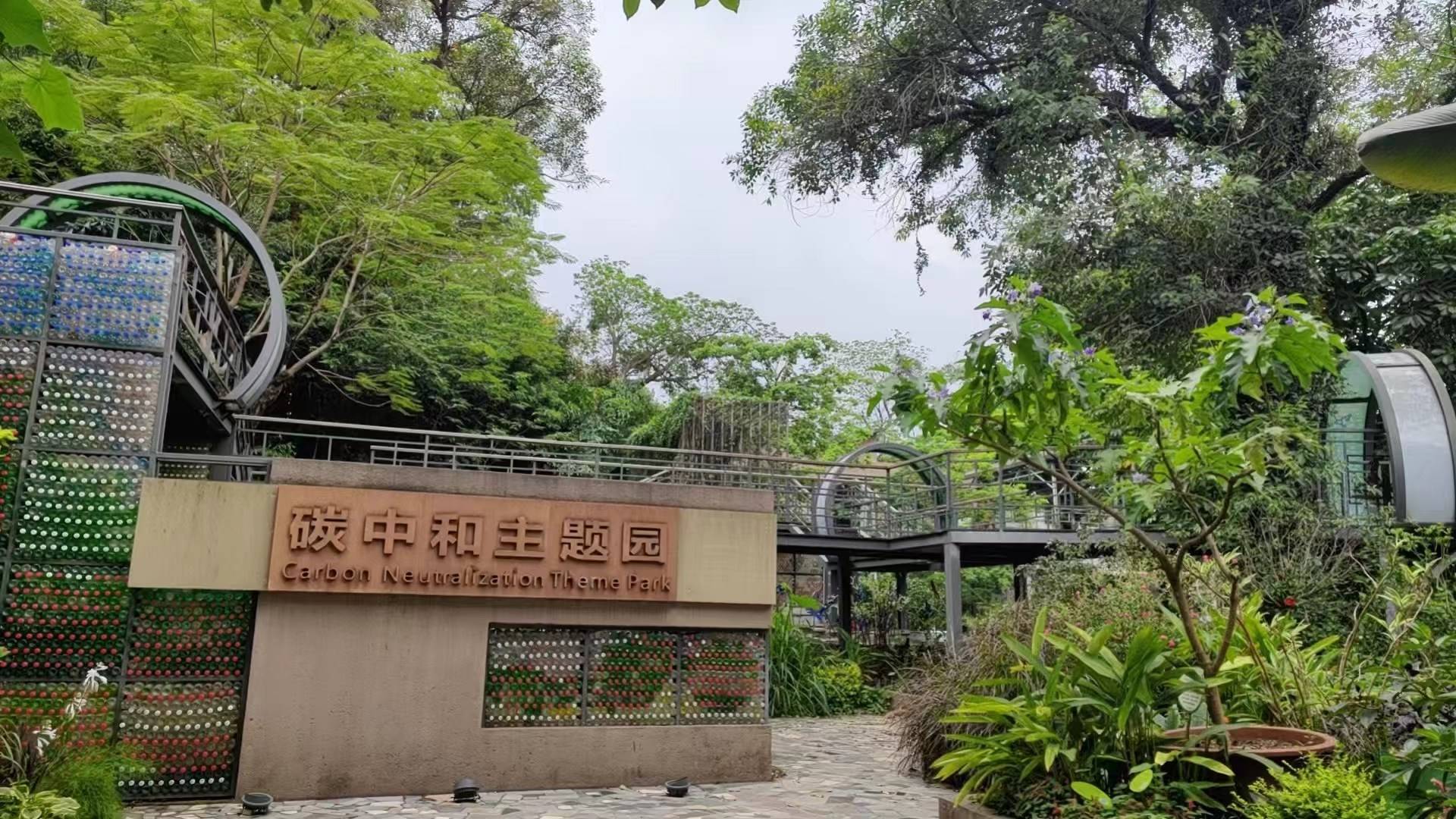
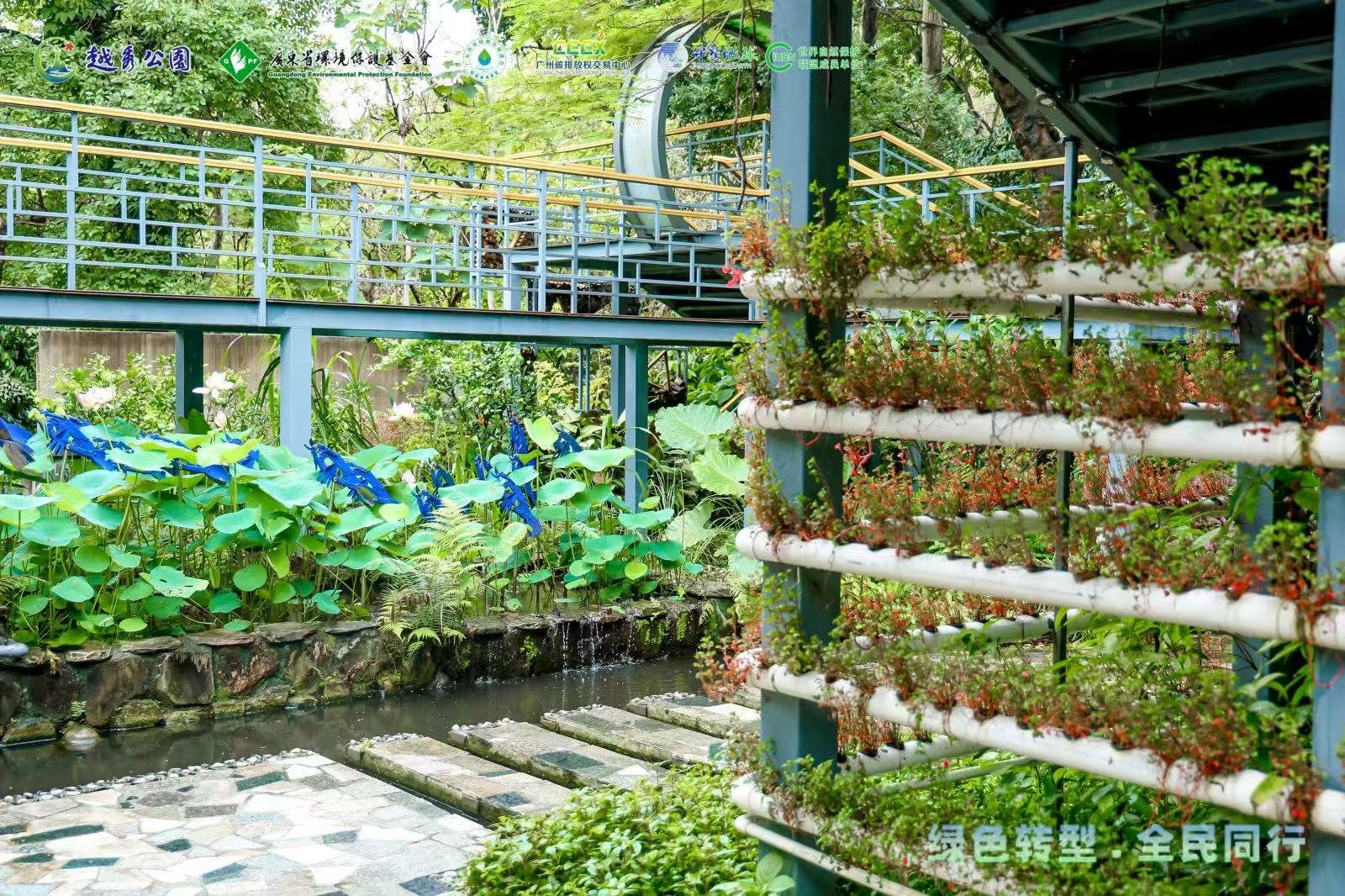
Building on this foundation, the park established the Phase I Carbon Neutrality Theme Park, guided by China's carbon peaking and carbon neutrality goals. The project integrates low-carbon technologies, ecological restoration, and public education through real-world demonstrations, including water reuse systems, photovoltaic energy generation, green waste resource recovery, and climate-smart agricultural technologies. These facilities enable visitors to experience carbon neutrality concepts through everyday park activities.
The park was constructed using a wide range of recycled and environmentally friendly materials, while its landscape design combines ecological conservation, sustainable production, community recreation, and environmental education within a single public space.
3. Expanding low-carbon education and circular economy practices
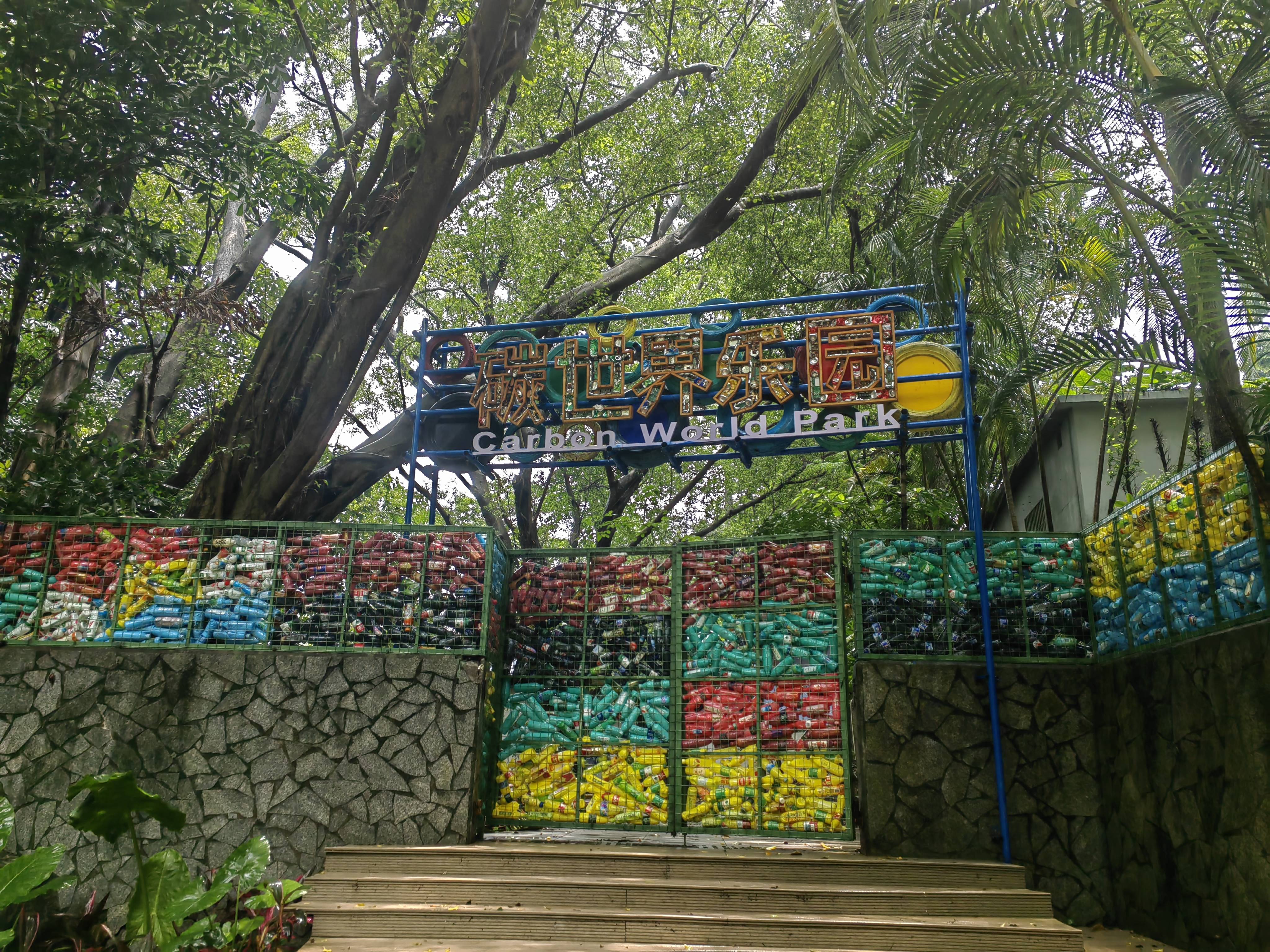
The project was subsequently expanded by Climate Action (Guangdong) Environmental Technology Co., Ltd., extending the Carbon Neutrality Theme Park into Phases II and III and creating the Carbon World Playground, a comprehensive destination integrating recreation, low-carbon experiences, and environmental education.
New facilities include a digital exhibition hall for youth climate change and carbon neutrality education, a low-carbon restaurant, and the Climate Avenue. Materials recovered through green waste recycling are further transformed into wooden handicrafts and handmade paper for educational programmes and public exhibitions, demonstrating higher-value applications of circular resource use.
4. Strengthening environmental education through multi-stakeholder collaboration
To strengthen the educational role of the park, the project partnered with the Guangdong Environmental Education Promotion Association to establish a Nature School within Yuexiu Park, creating an "open-air classroom" that combines nature education, ecological civilisation education, and hands-on learning.
The project also works closely with communities and schools to organise family-oriented environmental activities and nature education programmes, establishing a collaborative education model that connects families, schools, communities, and the park. This approach shifts public engagement from passive awareness-raising to active participation in low-carbon lifestyles.
5. Integrating biodiversity and climate education into everyday visitor experiences
To improve public understanding of ecological conservation, Yuexiu Park developed the Eco Low-Carbon Trail along its existing visitor routes. Interpretive signage and educational displays introduce topics including low-carbon plants, wildlife, habitats, and biodiversity conservation, allowing visitors to learn about the ecological value of urban green spaces during their park experience.
By embedding environmental education into routine recreational activities, the project encourages greater awareness of harmonious coexistence between people and nature while promoting sustainable lifestyles.
项目实施
针对公园园林垃圾传统处理方式产生的各种问题,越秀公园开展园林垃圾零废弃管理模式创新,构建“越秀三全”本土特色模式,即全流程监控、全领域覆盖、全链条参与,实现园林垃圾从产生、收运、分类、处理到再利用的全过程管理。项目由公园运营管理团队牵头,联合气候行动(广东)环境科技有限公司开展设施建设与运营优化,通过配置园林垃圾处理设备,采用高温好氧发酵技术,打通“源头分类→机械破碎→快速降解→资源化利用”链条,将树枝、落叶等废弃物转化为有机质回用于园区种植和绿化管养,实现“垃圾不出园”。经过流程优化,园林垃圾处理周期缩短至约1天,实现100%绿化垃圾减量化处理,资源化利用率超过95%,年减少CO₂排放232吨,有效提升资源循环效率。
引入专业的园林垃圾处理设备后,原本园林垃圾堆放占用的空间被释放了出来,越秀公园联合气候行动(广东)环境科技有限公司对既有空间进行功能优化。由于垃圾处理过程无异味和环境影响,后将其改造为园林垃圾处理资源化站点和资源循环利用展示空间。该区域进一步升级,以“双碳”政策为导向创建了碳中和主题园一期。该项目巧妙融合了低碳技术、生态修复与公众教育,通过建设水资源再利用系统、绿色光伏能源、园林垃圾处理资源化利用模式以及引入低碳农林业科研产品进行实景展示,让市民游客在游憩中直观感知“碳中和”。主题园一期在建设中采用了大量环保和再生材料,并运用低碳艺术手法进行设计,把生态、生产、生活及科教有机结合。
后续气候行动(广东)环境科技有限公司进一步推动碳中和主题园升级,从一期扩展至二、三期,形成集休闲游憩、低碳体验、科普研学于一体的“碳世界乐园”。二、三期项目建设青少年气候变化与“双碳”实践基地数字化展厅、低碳餐厅、气候大道等设施,并将园林垃圾资源化产生的材料进一步开发成木工艺品制作和植物造纸,应用于研学课程及公众展示,拓展资源循环利用的实践价值。
针对教育功能融合不足的问题,项目联合广东省环境教育促进会,依托越秀公园共建自然学校,打造“没有围墙的教室”,将自然教育、生态文明教育与实践体验结合。同时联动社区、校园开展亲子自然课堂等公益活动,构建“家校社园”协同育人模式,推动低碳理念从展示传播转向公众参与。
针对公众生态认知不足问题,越秀公园利用既有游览路线打造生态低碳径,将低碳相关的植物、动物、生境保护等知识融入观赏路径,通过科普标识、展示牌等形式,引导公众了解城市绿地生态价值,增强人与自然和谐共生意识。
Project Outcome
Since its implementation, the project has achieved 100% reduction treatment of green waste, with a resource recovery rate exceeding 95%. The treatment cycle has been reduced to approximately one day, resulting in an estimated annual reduction of 232 tonnes of CO₂ emissions. The former green waste storage area has been transformed into an integrated space for resource recovery, low-carbon demonstration, and public education, simultaneously improving resource efficiency, the quality of public space, and visitor experience.
The project's most distinctive innovation is that its educational activities are built upon real operational practices rather than purpose-built exhibition facilities. Instead of creating simulated educational settings, the project transforms the park's day-to-day green waste management and circular economy practices into learning opportunities. Through familiar materials such as fallen leaves, tree branches, and organic compost—items that visitors can easily see and experience—the project helps the public understand resource circularity, sustainable lifestyles, and climate change, creating a natural pathway from practical resource management to climate awareness.
The project has established an integrated model that combines resource circularity, low-carbon education, and sustainable park operations.
At the technical level, it has established an on-site green waste resource recovery system that improves resource efficiency while reducing waste and carbon emissions.
At the operational level, it integrates park management, ecological restoration, environmental education, experiential learning, and sustainable consumption into a unified public service model.
At the institutional level, it has explored a long-term mechanism that combines public-interest objectives with market-oriented operation. Revenue generated through green waste resource recovery, educational programmes, low-carbon catering services, and environmentally themed cultural products supports ecological maintenance, facility upgrades, and public education, creating synergies between environmental, social, and economic value. Meanwhile, long-term partnerships with schools and local communities, supported by the park's environmental education base, have established a collaborative engagement model linking families, schools, communities, and the park.
The model makes full use of existing urban park infrastructure and operational systems, demonstrating how everyday park operations can become platforms for environmental learning. By embedding education into real-world facilities, management practices, and visitor experiences, it transforms sustainability from an abstract concept into an immersive learning experience.
Because the model relies primarily on existing park spaces and operational resources rather than large-scale new infrastructure, it offers strong long-term viability and provides a replicable and scalable pathway for supporting the green transition of urban parks while strengthening public climate education.
成果亮点
项目开展以来,公园实现100%园林垃圾减量化处理,资源化利用率超过95%,处理周期缩短至约1天,年减少二氧化碳排放232吨;原园林垃圾堆放区域同步转变为资源化处理、低碳实践和公众教育空间,实现资源利用效率、空间品质和公众体验同步提升。
项目最大的创新在于,并非为了开展教育而专门建设科普场景,而是依托公园真实开展的园林垃圾资源化利用和循环经济实践,将日常运营过程转化为公众教育资源。通过落叶、树枝、有机质等公众日常可见、可接触的事物,引导公众理解资源循环、低碳生活与气候变化,实现从资源循环实践到公众气候意识培育的自然转化。
项目形成了“资源循环+低碳教育+可持续运营”三位一体的创新模式。在技术层面,构建园林垃圾就地资源化利用体系;在模式层面,将公园运营、生态修复、科普教育、研学实践与绿色消费场景有机融合;在机制层面,探索“公益导向、市场化运营”的长效机制,通过园林垃圾资源化利用、研学课程、低碳餐饮、文创产品等业态,提升公园吸引力和运营活力,以运营收益反哺公园生态维护、设施更新和公益教育,实现生态价值、社会价值与经济价值协同提升。同时,依托公园研学基地与学校、社区建立长期合作机制,形成“家校社园”协同参与的运行模式。
该模式充分依托城市公园既有空间和运营体系,践行“设备即课堂、校园即教材、实践即育人”的理念,从理论转化为沉浸式实体课堂。无需大规模新增建设投入,具有持续运行能力,可为城市公园绿色低碳转型和公众气候教育提供可复制、可推广的实践路径。
Project Highlights
Since the opening of Phase I of the Carbon Neutrality Park, the project has welcomed more than 100,000 visitors from across China. It has also received nearly 1,000 enterprises from energy-intensive and low-carbon industries, as well as more than 500 forestry and landscape management organisations nationwide for technical exchanges and study visits. The project has been featured in over 100 reports by leading national and regional media outlets, including Xinhua News Agency, People's Daily, Science and Technology Daily, Guangzhou Daily, Yangcheng Evening News, and Nanfang Daily.
The park has established a dedicated climate and carbon neutrality education programme and maintains long-term partnerships with primary and secondary schools across Guangzhou, providing environmental education for more than 30,000 young people each year.
In recent years, Yuexiu Park has further strengthened its commitment to sustainable development by launching a dedicated Carbon Peaking and Carbon Neutrality Fund in partnership with the Guangdong Environmental Protection Foundation, establishing the Guangzhou Carbon Neutrality Volunteer Service Team, and organising a wide range of public engagement initiatives, including ecological night runs and World Water Day walking events.
The park has also served as the host venue for a series of major public events, including the China (Guangzhou) Park Cultural and Creative Conference (2023–2025), World Environment Day celebrations (2022–2026), the Low-Carbon Lantern Exhibition during the Spring Festival Lantern Festival (2024–2026), and themed reading programmes at the Huacheng Book House.
Through the continuous development of an integrated programme of public events, environmental education, and community engagement, Yuexiu Park has become a leading demonstration site for the integration of green and low-carbon development, circular economy practices, and ecological culture in urban parks, serving as a reference for sustainable park management in Guangzhou and across China.
成果影响力
碳中和主题园一期建成并开园以来,已经接待了来自全国各地的广大群众超过10万人次,各类耗能企业及低碳相关行业企业近1000家,全国各地的林业及园林系统单位500多家,接受包括新华社、人民日报、科技日报、广州日报、羊城晚报、南方日报等各类媒体采访报道上百次。园区设立了专门的碳中和科普课堂,与广州市多所中小学建立常态化合作,每年惠及超过3万名青少年。
近年来,越秀公园深度践行绿色转型,先后在广东省环境保护基金会设立“双碳”专项基金,组建广州市碳中和志愿服务总队,并持续开展生态夜跑、世界水日徒步等系列公益活动。园区连续多年承接中国(广州)公园文创大会(2023-2025年连续三届主会场)、六五世界环境日(2022-2026年)、新春灯会低碳灯展(2024-2026年)及花城书房主题读书活动等重大品牌项目。通过系统化活动体系的构建,越秀公园已成为广州乃至全国公园绿色低碳发展与生态文化融合的标杆示范与核心主场。
Reviews & Honors
Since its implementation, Yuexiu Park's green waste resource recovery and public engagement initiatives have gained broad recognition from government agencies, industry organizations, the media, and the wider public. The project has become a leading example of green and low-carbon transformation in urban parks, with steadily increasing public participation and social impact.
Media and Institutional Recognition
The project has been featured by major national and regional media outlets, including Xinhua News Agency, Science and Technology Daily, Guangzhou Daily, Guangzhou Television, and the Asia-Pacific Communication Center of China International Communications Group (CICG). Media coverage has highlighted Yuexiu Park's innovative approach to transforming green waste into valuable resources through on-site treatment and circular resource management, recognizing the project as a practical model for advancing sustainable and low-carbon urban park management.
The Guangzhou Forestry and Landscaping Bureau has recognized the Carbon Neutrality Theme Park as an important platform for advancing the development of a "Zero-Carbon Park" and promoting greener urban lifestyles. In 2026, the Yuexiu Branch of the Guangzhou Municipal Ecology and Environment Bureau, together with Yuexiu Park and six partner organisations, jointly hosted the National Energy Conservation Publicity Week and the Open Day of the Youth Climate Change and Carbon Neutrality Education and Practice Base at the Carbon World Playground.
Awards and Official Designations
2022 – Designated by the Guangzhou Municipal Education Bureau as a Guangzhou Study Tour Education Base.
2023 – Selected by China's Ministry of Ecology and Environment as a National Typical Case of Green and Low-Carbon Bases, and recognized as the only public engagement base in Guangdong Province included in this national program.
2024 – Designated as a Guangdong Environmental Education Base; appointed by the Chinese Society of Parks and Landscapes as the Chair Organization of the Professional Committee on Green Waste Resource Recovery in Parks; selected as a case under the Green Belt and Road Zero-Carbon Park Initiative; and recognized as a Guangzhou Youth Carbon Reduction Volunteer Service Practice Base.
2025 – Selected as a Training Base by the People's Study Tour Network.
评价与荣誉
项目实施以来,越秀公园园林垃圾资源化利用和低碳公众参与实践获得社会各界广泛认可,成为城市公园绿色低碳转型的典型案例,公众参与度和社会影响力持续提升。
媒体及行业认可:项目获新华网、科技日报、广州日报、广州电视台、中国外文局亚太传播中心官网等主流媒体报道。媒体认为,越秀公园创新探索城市公园园林绿化废弃物资源化利用模式,实现园林垃圾“不出园、变废为宝”,为城市公园绿色低碳发展提供了实践样板。广州市林业和园林局表示,越秀公园正依托碳中和主题园推进“零碳公园”建设,打造城市绿色生活圈。广州市生态环境局越秀分局联合越秀公园等7个单位在碳世界乐园举行2026年全国节能宣传周暨青少年气候变化教育双碳实践基地开放日活动。
奖项荣誉:2022年越秀公园被广州市教育局评选为广州市研学基地。2023年越秀公园入选生态环境部公布的绿色低碳基地类典型案例,为广东省唯一入选的绿色低碳公众参与实践基地;2024年获评“广东省环境教育基地”,并被中国公园协会授予“公园绿化垃圾资源化利用专业委员会主任单位”,入选共建绿色“一带一路”零碳公园案例,入选广州青年减碳志愿服务实践基地;2025年入选人民研学网培育基地。
近零碳社区的美育升级---- 长寿苑社区 “低碳实践 + 影像科普” 共建项目
4天前 · 来源:成都市武侯区火车南站街道长寿苑社区居民委员会 · 作者:成都市武侯区火车南站街道长寿苑社区居民委员会
以绿色金融之力推动中国新质生产力!
4天前 · 来源:国泰海通证券研究所ESG及美丽中国研究组 · 作者:国泰海通证券研究所ESG及美丽中国研究组
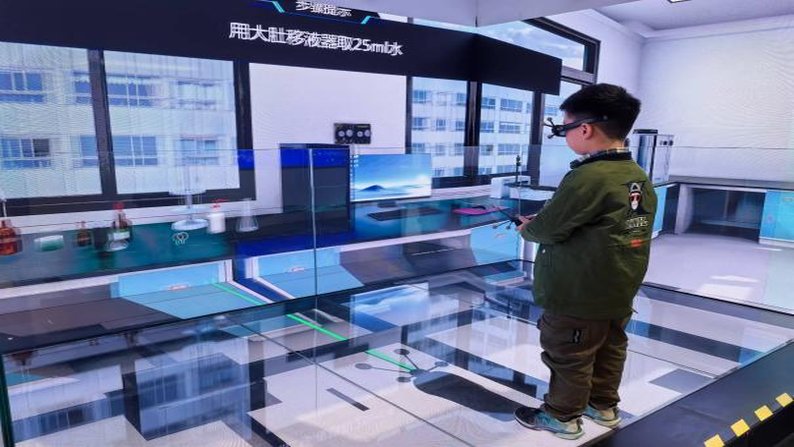
不择知行细流,蕴蓄蓝绿成深:雄安新区生态环境共享中心科普宣传空间营造雄安新区生态环境共享中心VR虚拟实验室(数字化仿真替代实体化学实验,实现科普零危废、低能耗)
6天前 · 来源:雄安新区生态环境监控中心 · 作者:雄安新区生态环境监控中心
