

Company/Organization Profile
Applicant Institution:
Water Authority of Shenzhen Longhua District was officially established in March 2019. As the district's competent authority for water affairs, it assumes overall responsibility for core functions including water resources management, water security assurance, water environment governance, water engineering construction, water conservation and protection, and smart water system development, effectively fulfilling its primary duties in water management, regulation, and development. Since its inception, the Bureau has closely aligned with regional development strategies, focusing on key priorities such as modern water network construction, systematic water pollution control, smart water infrastructure upgrades, and ecological river and lake quality improvement. It has continuously worked to address weaknesses in water infrastructure, deepen comprehensive water environment remediation, and modernize water governance systems and capabilities. Thanks to its solid achievements in water management, Longhua District has been recognized as the second batch of national model counties for deepening the reform of small reservoir management systems, the fifth batch of water-saving society construction达标 districts, and a national model county for soil and water conservation. The Shima River (Guanlan River) was successfully included in the Ministry of Water Resources' list of Happy River and Lake construction projects. With robust water affairs support, the Bureau contributes to the district's high-quality economic and social development, laying a solid ecological and water-security foundation for the construction of a "Green and Beautiful Longhua" and a "Digital and Smart Longhua."
Joint Applicant Institution:
Shenzhen Longhua Drainage Co., Ltd. was established in April 2019. It is a district‑owned wholly state‑owned professional drainage company founded by the Longhua District Committee and the Longhua District Government of Shenzhen to resolutely assume the political responsibility for water management and to place high priority on water quality improvement. The company has been granted a concession for the operation of drainage facilities across the entire district. Since its inception, the company has consistently taken as its mission the fulfillment of state‑owned enterprise social responsibilities and the safeguarding of urban operational safety, playing a vital role in emergency rescue and water pollution control in Longhua District. Its business scope covers the operation and management of water infrastructure, such as drainage pipe networks, rivers, reservoirs, pumping stations, and sluice gates; operation and maintenance of water purification plants and constructed wetlands; construction and management of urban information pipelines and integrated utility tunnels; geological disaster prevention; and wastewater treatment and recycling.
Shenzhen Longlan Ecological Technology Co., Ltd. is a wholly state-owned professional ecological technology enterprise fully owned by Shenzhen Longhua Drainage Co., Ltd. Its flagship benchmark project, the Zhangge Comprehensive Water Quality Purification Plant, is a key municipal water infrastructure project in Shenzhen’s Longhua District. It is also the first intelligent full-underground water purification plant in China whose entire process is powered by the HarmonyOS system. Located within the Zhangge Science and Technology Park, at the core of the Shenzhen-Dongguan advanced manufacturing corridor, the plant treats electronic industrial wastewater from the park to high standards, thereby reinforcing the water environment bottom line for the advanced manufacturing cluster and laying a solid ecological foundation for the high-quality development of industry-city integration in the region.
Beijing Guohuan Tsinghua Environmental Engineering Design & Research Institute Co., Ltd. is a wholly-owned environmental engineering service provider of Tsinghua University, serving as the university's main social service platform in the environmental field and the School of Environment's platform for industry-academia-research collaboration. Over more than four decades of development, the company has built a comprehensive service team covering water treatment, solid waste treatment, environmental remediation, environmental impact assessment, environmental planning, and scientific research, offering full-chain services including consulting, design, general contracting, and operations management. The company has completed dozens of research projects and engineering consulting/design projects, among which the Wuhan Jinkou Landfill Ecological Restoration Project won the 2015 C40 Cities Climate Leadership Award. It also has extensive track records in black-odorous water treatment, watershed management, sponge city development, and site remediation.
机构简介
申报机构:
深圳市龙华区水务局于2019年3月挂牌成立,作为全区水务工作主管部门,统筹承担水资源管理、水安全保障、水环境治理、水务工程建设、节水护水、智慧水务建设等核心职能,切实履行治水、管水、兴水主体责任。成立以来,紧扣区域发展战略,聚焦现代化水网建设、系统治水攻坚、智慧水务升级、生态河湖提质等重点工作,持续补齐水务基础设施短板,深化水环境综合治理,推动水务治理体系和治理能力现代化。凭借扎实的治水成效,龙华区先后获评全国第二批深化小型水库管理体制改革样板县、第五批节水型社会建设达标区、国家水土保持示范县,石马河(观澜河)成功入选水利部幸福河湖建设清单,以坚实水务保障助力全区经济社会高质量发展,为绿美龙华、数智龙华建设筑牢水生态安全根基。
联合申报机构:
深圳市龙华排水有限公司成立于2019年4月,是深圳市龙华区委、区政府为坚决扛起治水攻坚政治责任、高度重视治水提质工作而成立的区级国有独资专业排水公司,被授予全区排水设施特许经营权。公司自成立以来,始终以履行国企社会责任、保障城市运行安全为己任,在龙华区应急抢险救援和水污染治理等方面发挥了重要作用。公司业务范围涵盖排水管网、河道、水库、泵站、水闸等水务设施运营管理,水质净化厂及人工湿地运营维护,城市信息管道与综合管廊建设管理,地质灾害防治,污水处理及其再生利用等领域。
深圳市龙澜生态科技有限公司是深圳市龙华排水有限公司全资设立的国有独资专业化生态科技企业,核心标杆项目章阁综合水质净化厂,是深圳市龙华区重点民生水务基础设施,也是国内首个全流程搭载鸿蒙系统的智慧型全地下水质净化厂。项目位于章阁科技园内,地处深莞先进制造走廊核心地带,通过高标准处理园区电子工业废水,为先进制造业集群筑牢水环境底线,为片区产城融合高质量发展夯实生态基底。
北京国环清华环境工程设计研究院有限公司是清华大学全资的环境工程服务单位,是学校环境领域主要的社会服务平台和环境学院产学研转化平台。四十余年发展,公司形成覆盖水处理、固废处理、环境修复、环评、环境规划、科研等领域的综合服务团队,提供咨询、设计、工程总包、运营等全链条服务。公司完成数十项科研和工程咨询设计项目,其中武汉金口垃圾填埋场生态修复项目荣获2015年C40城市气候领袖奖。在黑臭水体治理、流域治理、海绵城市、场地修复等领域拥有丰富业绩。
Project Overview
Wastewater discharged from integrated circuit manufacturing enterprises is characterised by complex composition, a wide variety of chemical substances, and difficulty in treatment, making it unsuitable for direct processing by conventional municipal water purification plants. To facilitate investment attraction in Longhua District, ease administrative supervision, and protect the ecological environment of the Guanlan River basin, it is urgently necessary to construct dedicated treatment facilities.
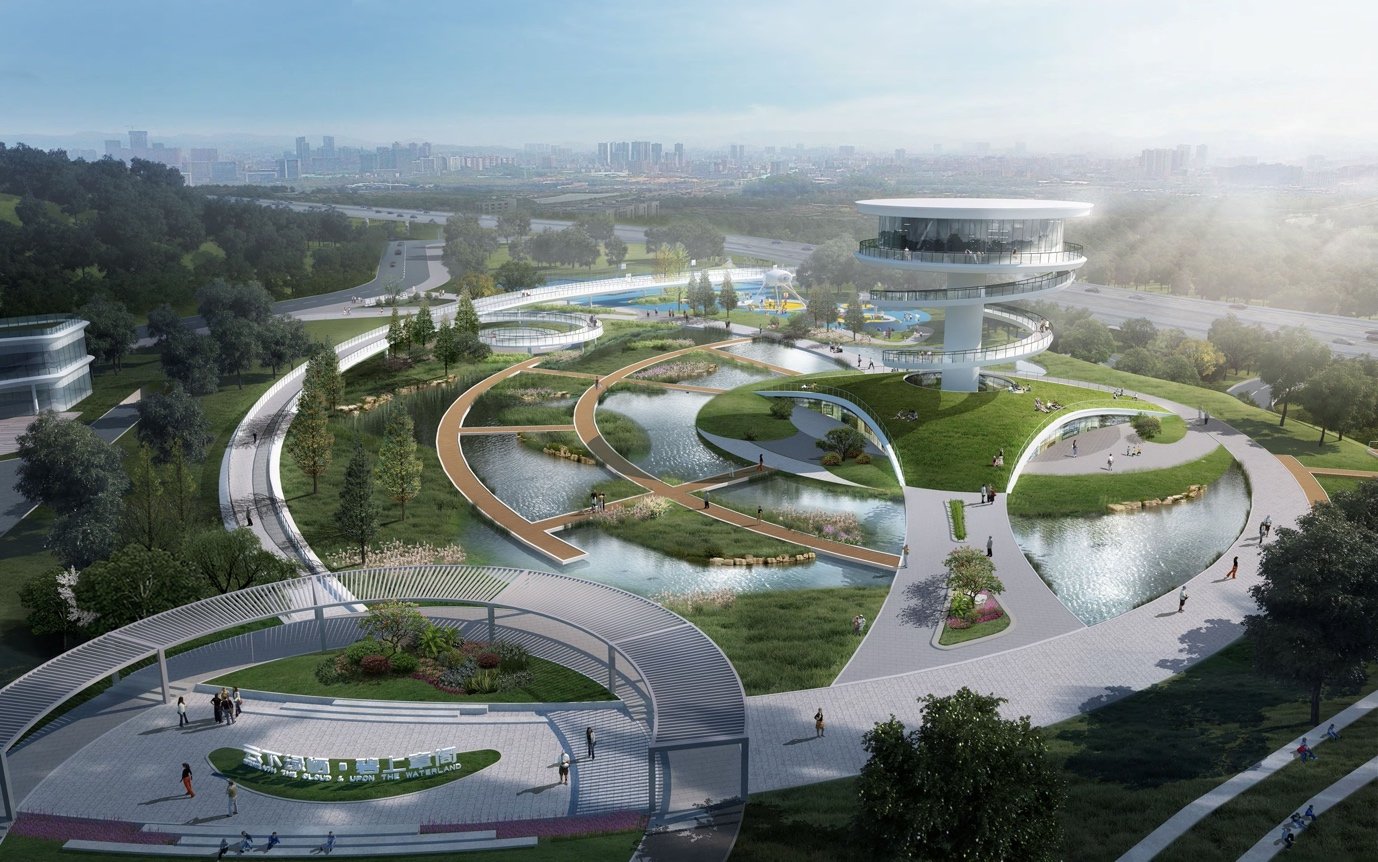
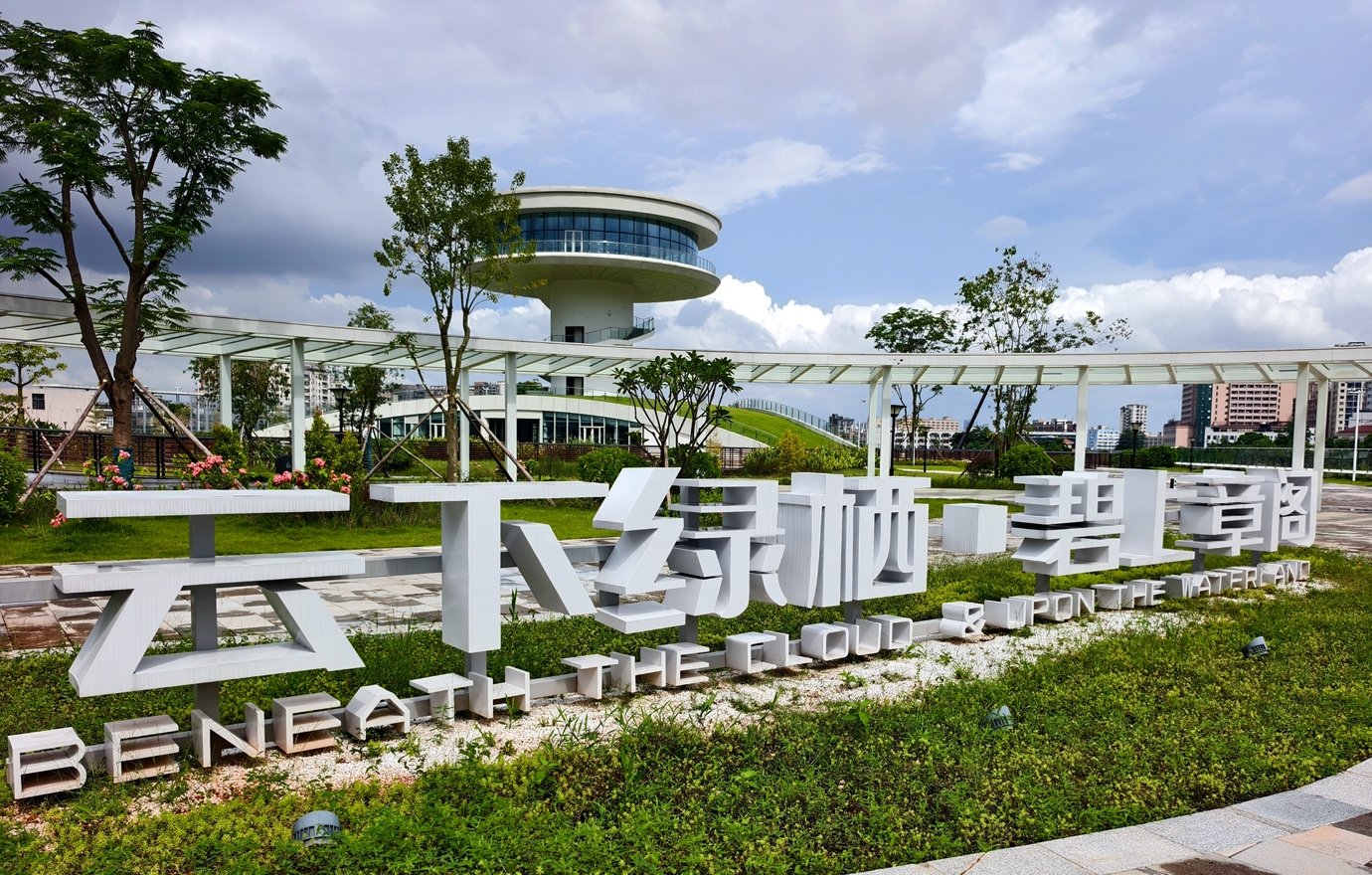
With the rapid development of the city, land resources in Shenzhen have become increasingly scarce. Traditional above-ground wastewater treatment plants have many drawbacks, including large land occupation, low spatial utilisation, poor landscape integration, and prominent NIMBY effects. The Zhangge Comprehensive Water Quality Purification Plant is a large-scale industrial wastewater advanced treatment facility built to support new-industry development. It has a designed daily treatment capacity of 45,000 tonnes of industrial wastewater, with effluent quality reaching the Class Ⅲ surface water standard. To solve the land-use challenge, the plant’s design abandons the traditional above-ground layout and adopts an innovative fully underground structural model. Through multiple innovative measures—such as integrated land use, ecological restoration with a rooftop park, photovoltaic energy conservation, natural lighting, and the integration of exhaust facilities with the landscape—the project upgrades a single pollution-control facility into an urban green public space that combines water purification, pollution treatment, ecological carbon sequestration, energy conservation and carbon reduction, public leisure and welfare, and landscape enhancement. It embodies the core philosophy of "Beautiful China" – “rational use of space, restoration of green ecology, and enabling a better life for people.”
Adhering to green and sustainable development, and grounded in the positioning of the pilot demonstration area of socialism with Chinese characteristics, the project is committed to building a safe, reliable, resilient, efficient, environmentally friendly, and grey‑green integrated urban wastewater system. It serves as a pilot in adapting to high-density urban development and promoting continuous improvement of the water environment, providing a Shenzhen paradigm for the sustainable wastewater system construction of megacities.
项目背景
集成电路生产企业排放废水具有成分复杂、化学物质种类多、处理难度大的特点,现有城市水质净化厂无法直接处理此类废水。为推进龙华区招商引资工作,便利行政主管部门监管,保护观澜河流域生态环境,亟需配套建设专门处理设施。
随着城市高速发展,深圳土地资源日趋稀缺,传统地面污水处理厂存在占地面积大、空间利用率低、景观融合度差、邻避效应突出等诸多短板。章阁综合水质净化厂是为新型产业配套建设的大型工业废水深度处理厂,日设计处理工业废水4.5万吨,出水达到地表Ⅲ类水标准。为破解用地难题,该厂设计摒弃传统地面厂区布局,创新采用全地下式结构建设模式,通过土地复合利用、上盖公园生态复绿、光伏节能、自然采光、排气设施与景观融合等多元创新举措,将单一治污工程升级为集净水治污、生态固碳、节能降碳、休闲惠民、景观提升于一体的城市绿色公共空间,践行美丽中国“合理利用空间、重塑绿色生态、赋能人居美好生活”的核心理念。
项目坚持绿色可持续发展,立足中国特色社会主义先行示范区建设定位,致力打造安全可靠、韧性高效、环境友好、灰绿融合的城市污水系统,在适应城市高密度发展、推动水环境持续改善方面先行先试,为超大城市可持续污水系统建设提供深圳范式。
Project Implementation
Throughout the entire process—from planning and design to construction and operation—the project has consistently adhered to the principles of intensive land use, ecology first, low‑carbon operation, and integration of landscape and treatment. Green space transformation and functional upgrading have been carried out in phases according to the construction schedule, ensuring that every stage meets the requirements of green development.
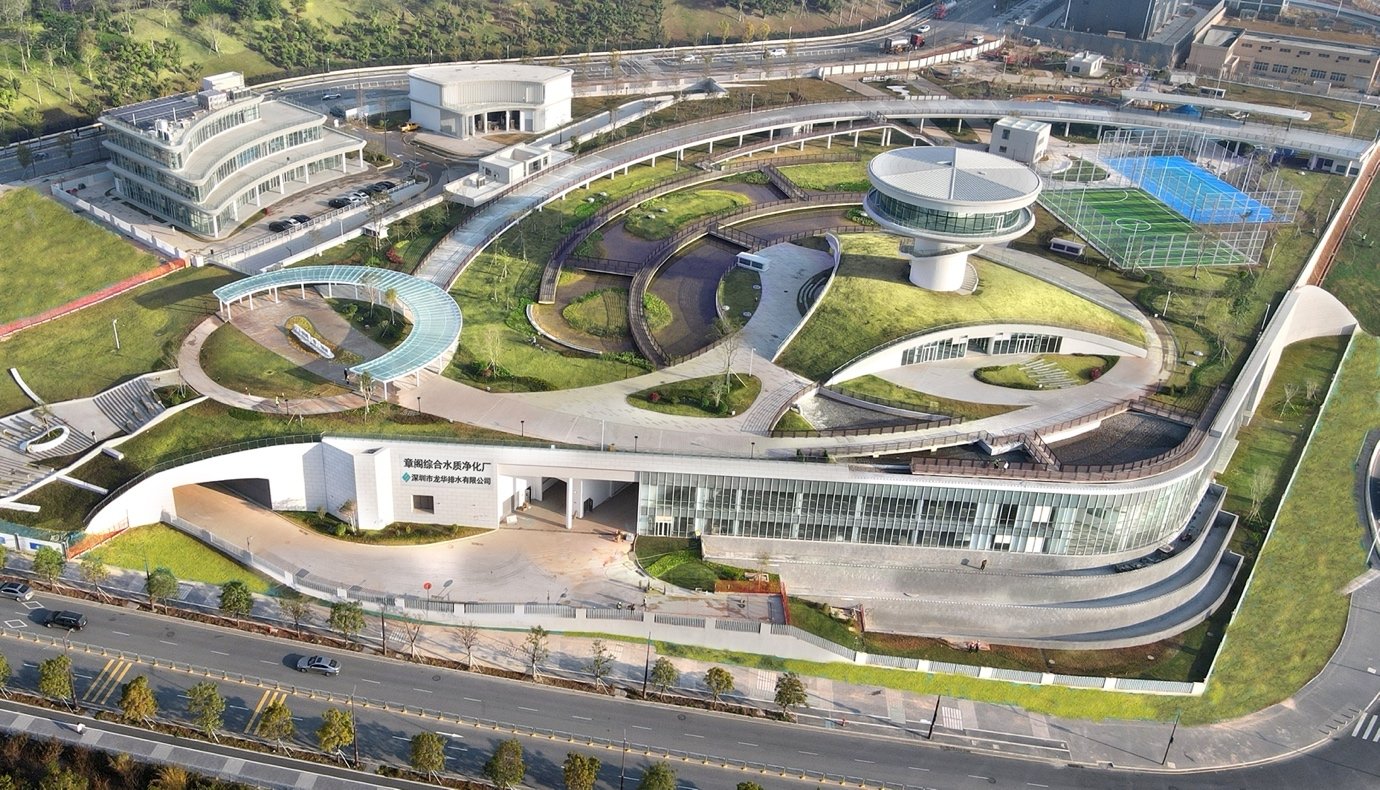
During the construction phase, the project deliberately abandoned the conventional design model of building treatment plants above ground. All wastewater treatment process units and supporting facilities were intensively integrated and arranged entirely in the underground space, maximising the saving of urban construction land. This approach eliminated visual pollution and NIMBY effects associated with traditional plants from the design source, achieving a harmonious coexistence between industrial facilities and urban space. At the same time, the underground space layout and daylighting design were optimised by installing natural light tubes on a large scale, using natural light instead of conventional artificial lighting, thereby reducing the energy consumption of the underground plant over the long-term operation and maintenance phase.
After the main structure of the plant was completed, the project fully implemented a roof greening project covering a total area of 35,000 square metres. An open urban wetland park was built in accordance with local terrain, climate, and other natural conditions, restoring and enhancing the growth conditions of regional native vegetation. This added a high-quality ecological green space to the city and increased the regional ecological carbon sink capacity. On the idle roof areas, a distributed photovoltaic power generation system was installed, utilising the unused surface resources of the plant to generate and consume clean electricity on-site, achieving self-sufficiency in clean energy. Together, these measures form a dual low‑carbon operating system combining photovoltaic energy conservation and daylighting‑based energy reduction.
In the waste gas treatment stage, the project broke away from the traditional approach of direct emission or installing conventional exhaust towers. Instead, it first subjects the production waste gas to multi‑stage deep purification until it meets the discharge standards, and then releases it through an innovatively designed landscape cloud tower exhaust system. This deeply integrates environmental treatment facilities with urban landscape design, achieving a trinity of treatment function, ecological function, and aesthetic value. It marks a comprehensive transformation of the wastewater treatment facility from a conventional "industrial plant" into an open “green public space.”
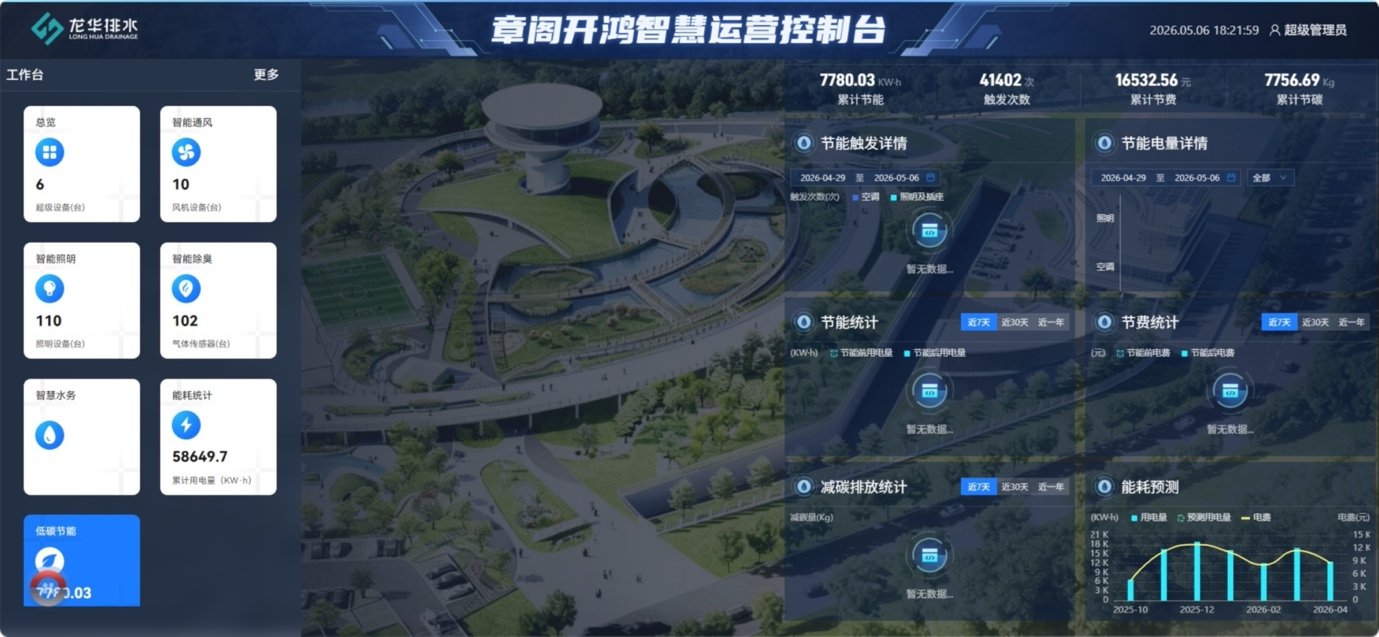
By creating a three‑dimensional composite spatial pattern of “centralised underground treatment and green park above ground,” the project effectively resolves the challenge of siting industrial support infrastructure in high‑density urban areas, enabling the synergistic development of industrial wastewater treatment functions and urban ecological service functions in the same space. The supporting intelligent operation and maintenance system is fully integrated with the HarmonyOS operating system, enabling real‑time, full‑coverage monitoring and dynamic intelligent regulation of key indicators such as influent and effluent water quality, overall plant energy consumption, and the operating status of core equipment. This ensures that the project consistently maintains efficient and low‑carbon operation. Ultimately, the project has formed an implementation pathway characterised by “spatial intensification – industrial adaptability – ecological value enhancement – public sharing,” providing a replicable and scalable mature practical model for other high‑density cities across China to treat industrial wastewater and create urban green public spaces.
项目实施
项目从规划设计到建设运营全过程,始终坚持“集约用地、生态优先、低碳运行、景治融合”建设原则,按照工程建设时序分阶段推进绿色空间改造与功能提质升级,确保各环节契合绿色发展要求。
建设阶段,主动摒弃传统地面建厂的固化设计模式,将全部污水处理工艺流程和配套设备设施集约化整合后整体布置于地下空间,最大限度节约城市建设用地,从设计源头消除传统厂区视觉污染与邻避影响,实现工业设施与城市空间和谐共生。同步优化地下空间布局与采光设计,规模化布设自然采光筒,利用自然光替代传统人工照明,从长期运维层面降低地下厂房能耗。
厂区主体工程完工后,项目全面实施总面积3.5万平方米的顶板复绿工程,结合场地地形、气候等自然条件因地制宜建设开放式城市湿地公园,修复提升区域原生生态植被生长条件,为城市新增高品质生态绿色空间,提升区域生态碳汇能力。在屋面空闲区域配套建设分布式光伏发电系统,依托厂区闲置地面资源实现清洁电力就近生产就近使用,达成清洁能源自给目标,构建起光伏节能、采光降耗的双低碳运行体系。
废气治理环节,打破传统废气直排、设置常规排气塔的设计思路,先对生产废气进行多层次深度净化处理,达标后通过创新打造的景观云塔排气系统有序排放,将环保治理设施与城市景观设计深度融合,实现治理功能、生态功能、美学功能三位一体落地,完成污水处理设施从传统“工业设施”向开放“绿色公共空间”的全方位转型。
项目通过构建“地下集中治污、地上打造绿园”的立体复合空间格局,有效破解高密度城区产业配套基础设施落地难题,实现工业污水处理功能与城市生态服务功能空间协同发展。配套智慧化运维体系全面接入鸿蒙操作系统,对进出水水质、全厂能耗、核心设备运行状态等关键指标实现全时段全覆盖实时监测与动态智能调控,保障项目始终保持高效低碳运行状态,最终形成“空间集约—产业适配—生态增值—公众共享”的实施路径,为全国同类高密度城市开展工业废水治理、营造城市绿色公共空间提供可复制可推广的成熟实践样本。
Project Outcome
1. Underground intensive plant construction to alleviate urban land scarcity and NIMBY challenges
The project adopts a large-scale, fully underground wastewater treatment model, significantly saving valuable land resources in the urban core, avoiding visual disruption caused by above-ground industrial facilities, and effectively resolving NIMBY pain points such as odour nuisance, poor aesthetics, and public resistance traditionally associated with wastewater treatment plants. This achieves a harmonious coexistence between environmental infrastructure and urban communities.
2. Rooftop wetland greening to add urban green space and enhance ecological carbon sinks
The plant roof is fully greened, creating a high‑quality urban wetland park of approximately 35,000 square metres, which greatly increases regional green coverage. The park’s robust vegetation forms a stable ecological carbon pool, with an average annual carbon sequestration of about 80 tonnes, filling the gap in urban ecological space while providing an open leisure area for the public.
3. Dual empowerment of photovoltaics + natural daylighting for comprehensive energy conservation and low‑carbon operation
Multiple underground daylight tubes are innovatively installed to maximise the intake of natural light, reducing year-round lighting electricity consumption in the underground plant. A rooftop photovoltaic power system is also deployed to enable self-generation and self-consumption of clean electricity. Together, these form a dual low-carbon operation and maintenance model—"natural light + new energy"—continuously reducing the project’s carbon emissions and operational energy use, with annual electricity savings of approximately 360,000 kWh.
4. Landscape-integrated waste gas treatment to create a landmark of high aesthetic and ecological value
After deep purification to meet emission standards, the waste gas is discharged through a distinctive landscape cloud tower, transforming functional environmental facilities into urban landscape features. This delivers multiple benefits including compliance with pollution control requirements, environmental friendliness, and enhanced landscape quality.
5. AI-empowered HarmonyOS foundation to ensure stable effluent quality and precise consumption control
Using the HarmonyOS system as the digital foundation, integrated with AI algorithms, IoT sensing, and intelligent early‑warning mechanisms, the project builds a “cloud‑edge‑device” integrated architecture that overcomes the common issues of scattered equipment and data silos in traditional plants. It enables device interconnection, data sharing, and intelligent coordination. Through AI model‑based predictive analysis of influent water quality and treatment processes, parameters are automatically adjusted to achieve precise chemical dosing and intelligent aeration, ensuring stable effluent quality while reducing chemical and energy consumption.
成果亮点
1.地下集约建厂,破解城市用地紧张与邻避难题
项目采用全地下大型污水处理建设模式,大幅节约城市核心区土地资源,避免地面工业厂区造成视觉干扰,有效破解传统污水处理厂异味扰民、观感不佳、群众排斥等邻避痛点,实现环保设施与城市社区和谐共生。
2.上盖湿地复绿,新增城市绿地、有效提升生态碳汇
厂区顶板全面实施复绿,建成面积约3.5万平方米的高品质城市湿地公园,大幅提升区域绿化覆盖率,公园优良植被形成稳定生态碳库,年均固碳约80吨,补齐城区生态空间短板,为市民提供开放式生态休闲空间。
3.光储+自然采光双赋能,全域节能降耗低碳运行
创新设置多组地下采光筒,最大化引入自然光,减少地下厂房常年照明用电;屋面配套光伏发电系统,实现清洁电力自发自用,构建“自然光+新能源”双低碳运维模式,持续降低项目碳排放与运行能耗,年节电约36万度。
4.废气治理景观化,打造高颜值生态环保地标
项目废气经深度净化达标后,通过特色景观云塔有序排放,将功能性环保设施打造为城市景观节点,实现治污合规、环境友好、景观提质多重效益。
5.鸿蒙底座加持AI,实现稳定出水、精准控耗
以鸿蒙系统为数字底座,融合AI算法、物联感知与智能预警,构建“云-边-端”一体化架构,破解传统水厂设备分散、数据孤岛难题,实现设备互联、数据互通与智能联动。通过AI模型预测分析进水水质与处理工艺,自动调整参数,实现精准加药与智能曝气,保障出水稳定,降低药耗能耗。
Project Highlights
1. Demonstration value in spatial utilisation.
The project innovatively explores a three-dimensional composite land-use model, simultaneously accommodating multiple functions—wastewater treatment, ecological greening, public leisure and welfare, and clean energy utilisation—within a limited space. It provides a replicable and scalable innovative paradigm for advancing environmental infrastructure construction in high-density urban areas.
2. Demonstration value in ecological low-carbon development.
Through wetland greening for carbon sequestration, photovoltaic energy conservation for carbon reduction, natural daylighting for energy-saving and carbon mitigation, and AI-based intelligent control for emission reduction, the project establishes a dual-direction low-carbon system of “carbon sink enhancement + emission reduction.” This effectively reduces the project’s carbon footprint over its entire life cycle and supports the realisation of regional carbon peaking and carbon neutrality goals.
3. Demonstration value in social and public welfare.
The project resolves the NIMBY conflicts often associated with wastewater facilities by transforming the enclosed treatment plant into an open and shared urban wetland park. It continuously improves the quality of the living environment in the area, enhances residents’ sense of ecological gain and well-being, and reshapes public perceptions of environmental infrastructure.
4. Demonstration value in industry innovation.
The project has pioneered a new five‑in‑one construction model—“underground water purification + above‑ground wetland + photovoltaic low‑carbon + daylighting energy conservation + cloud‑tower landscape.” It drives the transformation of environmental facilities from “space‑occupying” to “space‑creating,” and deeply interprets the action connotation of "green space practitioners" as advocated in the Beautiful China initiative.
成果影响力
1.空间利用示范价值。创新探索城市土地立体复合利用模式,在有限的空间内,同步承载污水治理、生态绿化、休闲惠民、清洁能源利用多重功能,为高密度城区推进环境基础设施建设,提供了可复制、可推广的创新范式。
2.生态低碳示范价值。通过湿地复绿增碳、光伏节能降碳、自然光降耗减碳、AI智控减碳,构建“增汇+减排”双向低碳体系,有效降低项目全生命周期碳排放,助力区域“双碳”目标落地落实。
3.社会民生示范价值。破解污水设施邻避矛盾,将封闭的治污厂区转型为开放共享的城市湿地公园,持续提升片区人居环境品质,增强群众生态获得感、幸福感,重塑公众对环保设施的认知。
4.行业创新示范价值。探索形成“地下净水+地上湿地+光伏低碳+采光节能+云塔景观”五位一体新型建设模式,推动环保设施实现从“占用空间”向“创造绿色空间”的转型,深度诠释美丽中国“绿色空间使用者”行动内涵。
Reviews & Honors
Grounded in large-scale industrial wastewater ecological treatment and green space regeneration, the project innovatively establishes an integrated model of “underground water purification, above-ground greening, low-carbon operation and maintenance, and landscape-treatment integration for public benefit.” This effectively addresses industry pain points in high-density urban areas—such as land scarcity for environmental facilities, prominent NIMBY issues, high energy consumption, and insufficient ecological space—while fully aligning with the action philosophy of "green space practitioners" under the Beautiful China initiative and the requirements of green and low‑carbon development. Since the project began operation, effluent quality has consistently met discharge standards over the long term, with notable achievements in low‑carbon energy conservation, ecological carbon sequestration, and spatial sharing. It has effectively improved the quality of the living environment and the public’s sense of ecological gain in the area, providing a replicable and scalable innovative model for the green space transformation, low‑carbon upgrading, and NIMBY resolution of wastewater treatment plants in high‑density cities across China.
评价与荣誉
项目立足超大规模工业废水生态治理与绿色空间再造,创新构建“地下净水、地上造绿、低碳运维、景治惠民”一体化模式,有效破解高密度城区环保设施用地紧张、邻避突出、能耗偏高、生态不足等行业痛点,全面契合美丽中国“绿色空间使用者”行动理念与绿色低碳发展要求。项目运行以来,出水水质长期稳定达标,低碳节能、生态固碳、空间共享成效显著。有效提升片区人居环境品质与群众生态获得感,为国内高密度城市污水厂绿色空间转型、低碳提质、邻避化解提供了可复制、可推广的创新样板。

近零碳社区的美育升级---- 长寿苑社区 “低碳实践 + 影像科普” 共建项目
4天前 · 来源:成都市武侯区火车南站街道长寿苑社区居民委员会 · 作者:成都市武侯区火车南站街道长寿苑社区居民委员会

以绿色金融之力推动中国新质生产力!
4天前 · 来源:国泰海通证券研究所ESG及美丽中国研究组 · 作者:国泰海通证券研究所ESG及美丽中国研究组
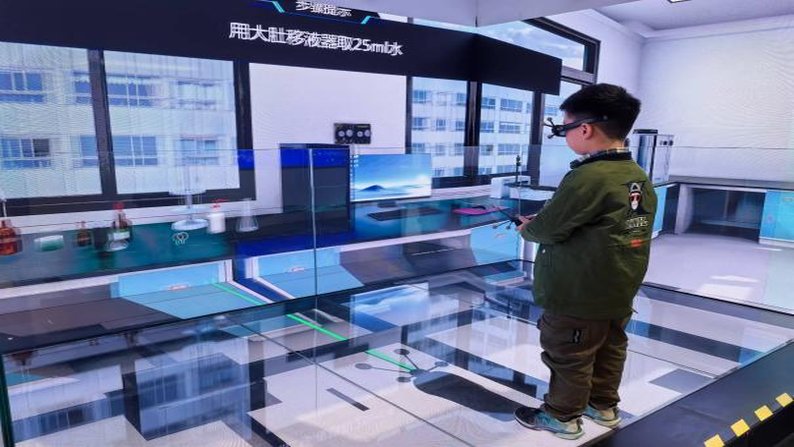
不择知行细流,蕴蓄蓝绿成深:雄安新区生态环境共享中心科普宣传空间营造雄安新区生态环境共享中心VR虚拟实验室(数字化仿真替代实体化学实验,实现科普零危废、低能耗)
6天前 · 来源:雄安新区生态环境监控中心 · 作者:雄安新区生态环境监控中心
