

Company/Organization Profile
JA Solar Technology Co., Ltd. (“JA”; Shenzhen Stock Exchange: 002459) is a leading global provider of photovoltaic power generation solutions, with more than 25,000 employees worldwide and a sales network spanning 180 countries and regions.
Guided by its corporate mission of “Develop solar power to benefit the entire human race” and its G2G (Green to Green, Green to Grow, Green to Great) sustainability philosophy, JA has deeply integrated green and low-carbon principles throughout corporate governance, production and operations, supply chain collaboration, and employee behavior.
The company’s science-based emissions reduction targets have been validated by the Science Based Targets initiative (SBTi). JA Solar has received an A rating for information disclosure from the Shenzhen Stock Exchange for three consecutive years, been named to Fortune China’s ESG Impact List, unveiled its “4F” Environmental and Climate Strategy at COP30, and spearheaded the launch of the Global Solar and Storage Sustainable Development Initiative (GSSA).
机构简介
晶澳太阳能科技股份有限公司(简称“JA晶澳”,深交所:002459)是全球领先的光伏发电解决方案供应商,在全球拥有2.5万余名员工,产品销售网络遍布180个国家和地区。公司秉持“开发太阳能,造福全人类”的企业使命与“G2G(Green to Green, Green to Grow, Green to Great)”可持续发展理念,将绿色低碳深度融入企业治理、生产运营、供应链协同与员工行为引导的全链条。公司已通过SBTi科学碳目标验证,连续三年获深交所信息披露A级评级,入选《财富》中国ESG影响力榜,并在COP30发布“4F”环境气候战略,牵头发起全球光伏行业可持续发展联合倡议(GSSA)。

Project Overview
Against the backdrop of the global green transition and China’s continued advancement toward its “dual carbon” goals, JA has been deeply engaged in the photovoltaic industry for two decades. While continuously expanding its global production capacity, the company has also been among the first to recognize the multidimensional challenges of “green space” governance.
As an advanced manufacturing enterprise, there is still room to optimize energy management and waste reduction in production and operations; with more than 25,000 employees and an extensive global supply chain network, guidance on low-carbon behavior needs to evolve from institutional requirements toward voluntary cultural awareness.
More importantly, we have increasingly recognized that genuine green transformation should not stop at energy conservation and carbon reduction within factories, but should extend to transforming technological capabilities into tangible public value that can be perceived and experienced by society.
With this in mind, JA extended its vision from production lines to coastlines. At the Coral Conservation Station on Shenzhen’s Dapeng Peninsula, we deployed the industry’s first off-grid integrated “photovoltaics + energy storage + seawater desalination” solution and, building on this technological foundation, provided immersive ecological education for customer families and media representatives. From “using clean energy to manufacture clean energy” to “using clean energy to protect the blue ocean,” we seek to answer a more fundamental question: the users of green spaces should not be limited to corporate employees, but should include every ordinary person who cares about nature.
项目背景
Project Overview
Project Implementation
Focusing on the two major pathways of “space operation optimization” and “public participation/behavior advocacy,” we advanced green space user actions across three settings: production lines, office desks, and coastlines.
Optimization of Physical Space Operations: Creating Green Production and Office Spaces
To address high energy consumption in production — intelligent energy management and clean energy substitution measures were adopted.
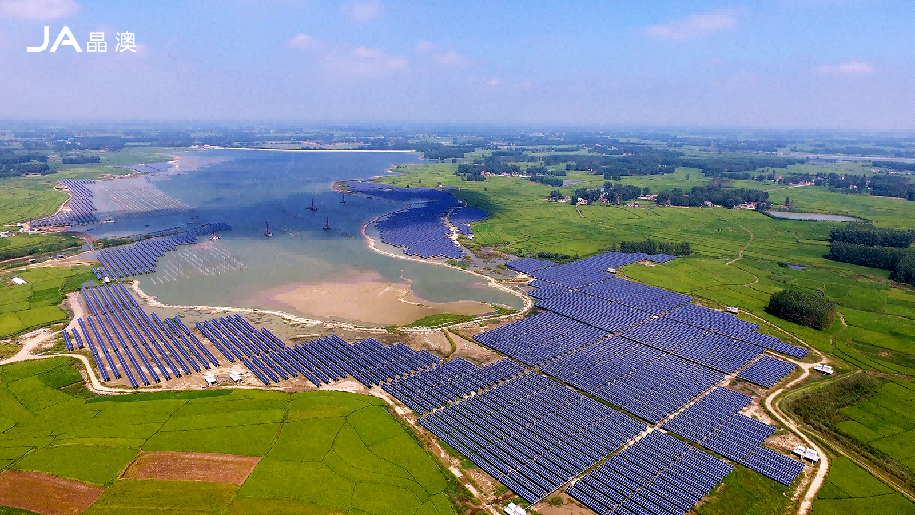
The company established a three-tier energy management system covering “headquarters–workshops–teams,” with Energy Management Systems (EMS) deployed across its production bases to enable real-time monitoring of energy consumption. The Yangzhou base has established a factory with dual “zero-carbon + green” certification, generating more than 22 million kWh of electricity annually and saving approximately 3,000 tonnes of standard coal each year through waste heat recovery; the distributed photovoltaic system at the Hefei base generates approximately 11.26 million kWh annually. On the supply chain side, the company encouraged core suppliers accounting for 74% of procurement expenditure to submit CDP carbon disclosures, while Scope 3 emissions decreased by 38.3% compared with 2024. These measures provide quantifiable green credentials for the company’s efforts to extend public education beyond its own operations.
To address resource waste in packaging and logistics — reusable packaging and green logistics were promoted.
The company comprehensively promoted the recycling and reuse of packaging materials. In 2025, film turnover boxes were reused more than 296,400 times, junction boxes more than 383,900 times, and battery boxes more than 2.07 million times. The loading capacity per wafer box was increased by 50%, unnecessary filling materials were eliminated, and wood-free edge protection was validated for domestic shipments. The company continued to replace fuel-powered forklifts with electric forklifts within its factories and explored the use of biofuels in maritime transportation; a total of 12,996 tonnes of solar modules were transported across borders using electrified railways, reducing annual carbon emissions by more than 940 tonnes, representing an emissions reduction rate of 72%.
To address weaknesses in suppliers’ carbon footprint management — a collaborative green supply chain mechanism was established.
ESG compliance requirements were deeply integrated into full-lifecycle supplier management, with 1,225 key suppliers subject to categorized and tiered management. Core suppliers accounting for 74% of procurement expenditure were successfully encouraged to submit CDP carbon disclosure questionnaires. Together with industry partners, the company launched the Global Solar and Storage Sustainable Development Initiative (GSSA), promoting standardized third-party ESG due diligence audits and a report-sharing mechanism. In 2025, ESG questionnaire assessments were completed for 93 major suppliers, identifying 18 as medium- to high-risk. Audit exemptions and remote corrective-action support were provided to small and medium-sized enterprises, and 16 suppliers completed corrective actions on schedule. The company has participated in the CDP Supply Chain Program for three consecutive years and pioneered a pilot application of the E-liability carbon accounting methodology at its Yangzhou base, completing detailed carbon footprint accounting for six mainstream TOPCon module products and providing a scientific basis for precise carbon reduction across the supply chain.
(II) Behavioral Advocacy in Cultural Spaces: Fostering a Green and Low-Carbon Culture
At the employee level, JA Solar fosters a shared commitment to low-carbon practices through an integrated system of “training + policies + activities”: the company issued its Code of Conduct to incorporate green office practices into daily standards, implemented an “Air Conditioning at 26°C” policy and green commuting initiatives, and conducted 444 environmental protection training sessions in 2025, reaching 21,777 participants.
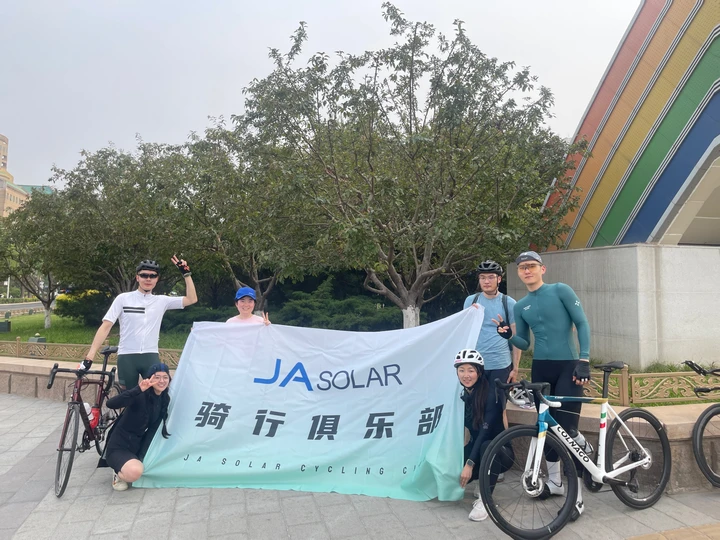
Among these initiatives, the company’s “New Life for Old Items” Circular Market has become a signature practice for guiding employee behavior: the event featured a variety of settings, including departmental stalls, a free-trading area, a books-for-vegetables exchange zone, a coffee-ground recycling display area, and ESG-themed booths. Employees were encouraged to exchange or trade unused items such as books, small household appliances, souvenirs, and handicrafts. Employees from different production bases also participated by mailing local specialties, while coffee vouchers were distributed to combine green consumption experiences with incentives for low-carbon behavior. The event promoted the circular concept that “an unused item is simply idle; it does not mean it has no value,” transforming the circular economy from a “slogan” into a “tangible part of everyday life.” Other branded initiatives were carried out simultaneously: “Clean Plate Week” reduced food waste by 240 kg, while the “Hiking and Mountain Cleanup” initiative removed 40 kg of waste, contributing to a behavioral shift from “passive management” to “active commitment.” The Cycling Club has transformed green travel from an advocacy initiative into a healthy lifestyle voluntarily embraced by employees. These practices have accumulated valuable methodologies for broader public participation.
(III) Breaking Boundaries: Building a Classroom Without Walls by the Sea
Pain Point Insight: The Coral Conservation Station on the Dapeng Peninsula has long faced the challenges of high freshwater acquisition costs and high carbon intensity — it is far from the municipal water supply network, transportation costs are high, and using diesel-generated electricity for desalination runs counter to the principles of ecological conservation. At the same time, the public lacks an intuitive understanding of how clean energy can solve real-world problems, with photovoltaic technology still perceived as an “industrial product” rather than part of “everyday knowledge.”
Action Plan: JA Solar partnered with the Shenzhen Dapeng New District Coral Conservation Volunteer Federation (“Dive4Love”) to deploy the industry’s first off-grid integrated “photovoltaic power generation + energy storage dispatch + seawater desalination” solution. Powered by JA Solar’s high-efficiency, weather-resistant photovoltaic modules, energy storage equipment, and AI-based intelligent energy management system, together with seawater desalination equipment, the system has a water production capacity of 400 L/h, with a maximum daily output of 9,600 L and a desalination rate exceeding 99%. In just one hour, it can produce enough water to meet a household’s daily needs, providing a zero-carbon solution to the freshwater challenge on islands.
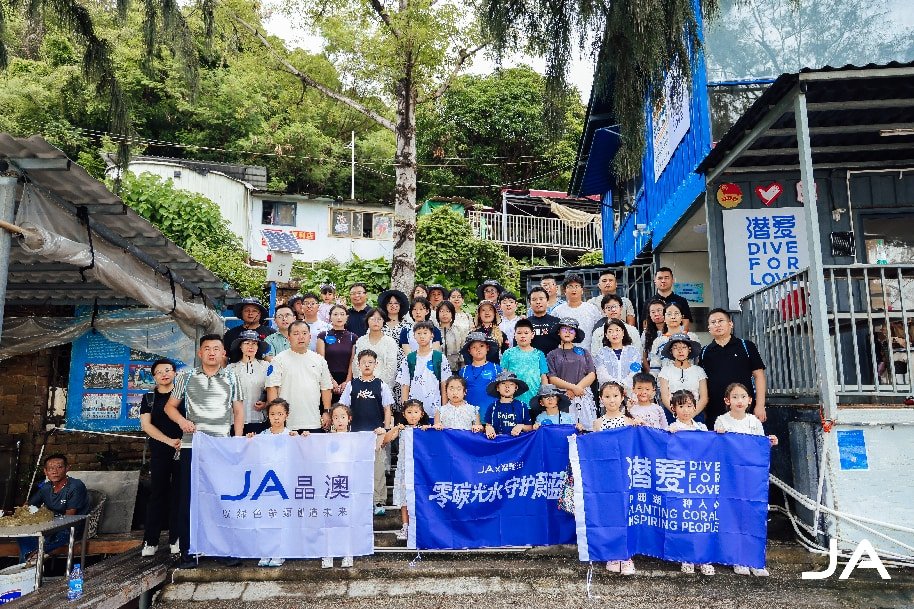
Building on this technological foundation, we transformed the solution into an educational setting by inviting key customer families and media representatives to Shenzhen’s Dapeng Peninsula for the “Zero-Carbon Solar Water · Protecting the Blue” Parent-Child ESG Experience Camp. Activities included:
Solar-Water Cycle Mini-Class: In a real coastal setting, instructors explained how photovoltaics power seawater desalination and the connection between clean energy and coral habitats — “Promoting clean energy and reducing carbon emissions is precisely a way to protect corals at the source”;
Discarded Fishing Net Upcycling Workshop: Parents and children used discarded nylon fishing nets recovered from the seabed by Dive4Love—which can remain in the ocean for hundreds of years and entangle corals and marine life—to weave everyday items, gaining a hands-on understanding of how a “marine threat” can be transformed into “resource regeneration”;
Field Visit to the Coral Conservation Station: Children gathered around the integrated solar-water system to observe the entire process—from photovoltaic power generation and energy storage dispatch to seawater desalination—while learning about the day-to-day work of coral conservation and underwater waste cleanup.
After the event, one child quietly asked a parent, “When the sun goes down, do the solar panels go to sleep? Will we still have water to drink at night?” This innocent question perfectly captured the company’s original intention: to let the next generation see how clean energy can protect their future
项目实施
围绕“空间运营优化”与“公众参与/行为倡导”两大路径,我们在生产线、办公桌、海岸线三个场域推进绿色空间使用者行动。
物理空间运营优化:打造绿色生产与办公空间
针对生产能耗高的问题——采取智能化能源管理与清洁能源替代措施。
公司构建“总部—车间—班组”三级能源管理体系,各基地部署能源管理平台(EMS)实现能耗实时监控。扬州基地建成“零碳+绿色”双认证工厂,年发电超2,200万千瓦时,余热回收年节约标准煤约3,000吨;合肥基地分布式光伏年均发电约1,126万度。供应链端,推动占采购额74%的核心供应商提交CDP碳披露,范围三排放较2024年下降38.3%。上述举措为“走出去”开展公众教育提供了可量化的绿色背书。
针对包装物流资源浪费的问题——推行循环包装与绿色物流。
全面推广包装材料循环利用,2025年实现胶膜周转箱循环使用29.64万余次、线盒循环使用38.39万余次、电池箱循环使用207万余次。硅片单盒装载量提升50%,取消非必要填充材料,在国内发货中完成去木护楞验证。持续推进厂内叉车“油改电”,探索海运生物燃料应用;通过铁路电气化方式完成12,996吨太阳能组件跨境运输,全年实现碳减排超940吨,减排率达72%。
针对供应商碳足迹管理薄弱的问题——构建绿色供应链协同机制。
将ESG合规要求深度融入供应商全生命周期管理,对1225家重点供应商实施分类分级管控。针对占采购额74%的核心供应商,成功推动其提交CDP碳披露问卷。联合行业伙伴发起全球光储行业可持续发展倡议(GSSA),推行统一标准的第三方ESG尽职审核与报告共享机制。2025年完成93家重要供应商ESG问卷评估,识别中高风险18家,对中小企业实行审核豁免与远程整改支持,16家按期完成整改。公司连续三年参与CDP供应链项目,并首创在扬州基地试点E-liability碳核算方法,完成6种主流TOPCon组件碳足迹精细核算,为供应链精准减碳提供科学依据。
人文空间行为倡导:培育绿色低碳文化
在员工层面,晶澳通过“培训+制度+活动”三位一体体系培育低碳共识:发布《行为准则》将绿色办公纳入日常规范,实施“空调26℃”制度与绿色通勤方案;2025年开展环保培训444次,覆盖21,777人次。
其中,公司曾举办过“旧物新生”循环市集成为员工行为引导的品牌化实践: 设置部门摊位交易区、自由交易区、以书换蔬专区、咖啡渣回收展示区及ESG主题展位等多元场景,鼓励员工将闲置物品(书籍、小家电、纪念品、手工艺品等)进行交换或交易,联动各基地员工寄送特产参与,并发放咖啡兑换券将绿色消费体验与低碳激励相结合。活动倡导“旧物仅仅是闲置,不代表没有价值”的循环理念,让循环经济从“口号”变为“可触摸的日常”。“光盘周”减少厨余垃圾240公斤、“徒步净山”清理废弃物40公斤等品牌活动同步推进,形成从“被动管理”到“主动承诺”的行为转变。骑行俱乐部将绿色出行从倡导转化为员工自发参与的健康生活方式。上述实践为更大范围的公众参与积累了方法论。
(三)破圈实践:在海边建一间没有围墙的教室
痛点洞察: 大鹏半岛珊瑚保育站长期面临淡水获取成本高、碳排放强度大的困境——距离市政管网远、运输成本高昂,且柴油发电制淡与生态保护理念相悖。同时,公众对清洁能源如何解决真实世界问题缺乏直观感知,光伏技术停留在“工业产品”而非“生活常识”的认知层面。
行动方案: 晶澳联合深圳市大鹏新区珊瑚保育志愿联合会(“潜爱”),落地行业首套“光伏发电+储能调度+海水淡化”离网式一体化方案——依托晶澳高效耐候光伏组件、储能设备与AI智能能量管理系统,搭配海水淡化设备,产水能力达400L/h,最高9,600L/天,脱盐率超99%,1小时可完成一户家庭全天用水供给,以零碳方式破解海岛淡水难题。
以此为技术底座,我们将方案转化为教育场景: 邀请核心客户家庭与媒体代表齐聚深圳大鹏半岛,开展“零碳光水·守护蔚蓝”亲子ESG体验营。活动包括:
光水循环小课堂: 在真实海岸场景中,导师讲解光伏如何驱动海水淡化、清洁能源与珊瑚栖息地的关联——“推广清洁能源、减少碳排放,正是从源头守护珊瑚的方式”;
废弃渔网重生工作坊: 使用潜爱从海底回收的废弃尼龙渔网(在海中可存留数百年,缠绕珊瑚与海洋生物),家长与孩子共同编织成日常用品,在指尖穿梭中理解“海洋威胁”如何转化为“资源再生”;
珊瑚保育站实地探访: 孩子们围在光水一体化系统旁,观察光伏板发电、储能调度、驱动海水淡化的全过程,了解珊瑚养护与海底垃圾清理的日常工作。
活动结束后,一位小朋友悄悄问家长:“太阳下山了,光伏板是不是就睡觉了?那晚上还有水喝吧?” 这个纯真的提问,恰好道出了公司的初衷:让下一代看见清洁能源如何守护他们的未来。
Project Outcome
(I) Mechanism Innovation: Establishing a Three-Tier Green Governance System Linking “Decision-Making–Management–Execution”
The Strategy and Sustainability Committee of the company’s Board of Directors reviews ESG matters at least twice a year. Executive compensation is directly linked to ESG performance indicators such as carbon emissions and energy consumption, forming a closed-loop management system of “strategic objectives–performance assessment–compensation incentives.” The company has obtained dual-standard certification under the ISO 37301 compliance management system, completed a review of its compliance management system in 2025, and received the BSI Standards Pioneer Award, providing a solid institutional foundation for green space governance.
(II) Technological Innovation: Driving Precise Emissions Reduction Through Digitalization
The company has established a full-chain R&D platform covering simulation analysis, module design, power generation performance prediction, and system validation. Its digital centralized control system has reduced the manual intervention rate across the entire process to below 8%, while the automatic detection rate for wafer-slicing anomalies exceeds 95%. The Yangzhou base pioneered a pilot application of the E-liability carbon accounting methodology, enabling detailed carbon footprint accounting for six mainstream TOPCon module products. The photoelectric conversion efficiency of TOPCon modules has reached 25.5%, while the pilot-scale efficiency of BC and TOPCon modules has exceeded 24%, with yields above 99%, reducing resource consumption per unit of output through technological breakthroughs.
(III) Model Innovation (Core Highlight): JA Pioneers a Cross-Sector Integration Model Combining “Technical Solutions + Scenario-Based Education”
JA Solar pioneered a cross-sector integration model combining “technical solutions + scenario-based education” — transforming the off-grid photovoltaic and energy storage system from an “industrial product” into an “educational medium.” In a real coastal setting, customer families can touch and experience the technology firsthand, gaining a deeper understanding of the connection between clean energy and ecological conservation. This model creates a complete value loop of “corporate carbon reduction–technological empowerment–public education–ecological conservation,” expanding the users of green spaces from employees to ordinary families。
Sustainability and Replicability: With the Dive4Love Coral Conservation Station as the first point of implementation, the integrated solar-water solution is planned for expansion into diverse scenarios such as island resorts, offshore operation platforms, and remote communities. In 2025, JA continued its international public welfare initiatives, including donations to the GRAACC childhood cancer support organization in Brazil, participation in charity cycling events in Australia, and donations to food networks in New Zealand, demonstrating the potential for the “technology + scenario + education” cross-sector model to be replicated across countries and cultures.
成果亮点
(一)机制创新:构建“决策—管理—执行”三级联动的绿色治理体系。
公司董事会战略与可持续发展委员会每年至少两次审议ESG议题,高管薪酬与碳排放、能源消耗等ESG绩效指标直接挂钩,形成“战略目标—绩效考核—薪酬激励”的管理闭环。公司通过ISO 37301合规管理体系“双标”认证,2025年完成合规管理体系复审,荣获BSI标准先锋奖,为绿色空间治理提供了坚实的制度保障。
(二)技术创新:以数字化驱动精准减排。
公司搭建了覆盖仿真分析、组件设计、发电性能预测及系统验证的全链条研发平台,数字化集控系统将全流程人工干预率降至8%以下,切片异常自动检出率超95%。在扬州基地首创试点E-liability碳核算方法,实现6种主流TOPCon组件碳足迹精细核算。TOPCon组件光电转换效率达25.5%,BC与TOPCon组件中试效率突破24%、良率超99%,以技术突破降低单位产出的资源消耗。
(三)模式创新(核心亮点): 晶澳首创“技术方案+场景教育”跨界融合模式——将离网光储系统从“工业品”转化为“教育载体”,在真实海岸场景中,让客户家庭通过亲手触摸、亲自体验,理解清洁能源与生态保护的深层关联。这一模式打通了“企业减碳—技术赋能—公众教育—生态守护”的价值闭环,让绿色空间的使用者从员工延伸至每一个普通家庭。
集市可持续性与可复制性: 以潜爱珊瑚保育站为首个触点,光水一体化方案已规划延伸至海岛度假、远洋作业平台、偏远社区等多元场景。2025年,晶澳在巴西持续捐赠GRAACC儿童癌症支持组织、参与澳洲慈善骑行、捐赠新西兰食品网络等国际公益行动,证明“技术+场景+教育”的跨界模式具备跨国、跨文化复制的潜力。
Project Highlights
Environmental Benefits: In 2025, greenhouse gas emissions from the company’s operations (Scope 1 + Scope 2) decreased by 42% compared with 2023, while Scope 3 emissions decreased by 38.3% compared with 2024; comprehensive energy consumption intensity decreased by 19% year on year; electrified rail transportation reduced emissions by 940 tonnes, representing a 72% reduction rate; distributed photovoltaic systems across the company’s production bases generated more than 30 million kWh of electricity annually; and water consumption per unit of product decreased by 30% compared with the previous year. The data were calculated in accordance with ISO 14064-1:2018 and independently verified by a third party.
Social Impact: Environmental protection training achieved 100% employee coverage, while participation in low-carbon activities exceeded 90%. The “New Life for Old Items” Circular Market has become a replicable internal green activity brand. More significantly, the “Zero-Carbon Solar Water · Protecting the Blue” Experience Camp brought customer families and media representatives into a real ecological setting, using a “classroom by the sea” to break down the boundaries of corporate green action, transforming photovoltaic technology from a “secret inside the factory” into something that inspires curiosity in children. In partnership with the NGO Dive4Love, the initiative established a cross-sector collaboration model combining “corporate technological empowerment + social organization operations + enhanced public awareness.” As a representative of China’s photovoltaic industry, JA unveiled its “4F” strategy at COP30, and the outcomes of this initiative will be formally presented at COP31.
成果影响力
生态环境效益: 2025年,公司运营范围内温室气体排放(范围一+范围二)较2023年降低42%,范围三排放较2024年降低38.3%;综合能源消耗强度同比下降19%;通过铁路电气化运输减排940吨(减排率72%);各基地分布式光伏年发电量超3,000万度;单位产品水耗较上年降低30%。数据依据ISO 14064-1:2018标准核算,经第三方独立验证。
社会影响效果: 环保培训覆盖全员100%,员工低碳活动参与率超90%。“旧物新生”循环市集已成为可复制的内部绿色活动品牌。更具示范意义的是,“零碳光水·守护蔚蓝”体验营将客户家庭、媒体代表引入真实生态场景,用“一间海边教室”打破企业绿色行动的边界——光伏技术从“工厂里的秘密”变成“孩子们眼中的好奇”。活动联合民间NGO组织“潜爱”,形成了“企业技术赋能+社会组织运营+公众认知提升”的跨界协同范式。作为中国光伏行业代表在COP30发布“4F”战略,本成果将在COP31正式亮相。
Reviews & Honors
Industry Honors:
Named to the S&P Global Energy Tier 1 Clean Energy Technology Companies list for two consecutive years (2025 and 2026), becoming one of only 15 photovoltaic module suppliers worldwide to be included.
Named to Fortune China’s ESG Impact List (2025).
Named among Forbes China Sustainable Development Industrial Enterprises (2024–2025).
Received the Ram Charan Management Practice Award – ESG Practice Award (Harvard Business Review).
Received the 2025 Sedex Environmental Contribution Award.
Selected as an “Outstanding Corporate ESG Case” by the Center for Environmental Education and Communications of the Ministry of Ecology and Environment (2025).
Selected as a “Best Practice Case for Sustainable Development of Listed Companies” by the China Association for Public Companies (2025).
Received the “2025 China Business Journal New Energy Green Development Model Enterprise” award.
Third-Party Certifications and Evaluations:
The Science Based Targets initiative (SBTi) officially validated the company’s greenhouse gas emissions reduction targets (2025).
Obtained dual-standard certification under ISO 37301:2021 & GB/T 35770:2022 compliance management systems and received the BSI Standards Pioneer Award (2025).
Obtained third-party independent verification of greenhouse gas emissions under ISO 14064-1:2018 (2025).
Eight production bases were recognized as “National Green Factories” by the Ministry of Industry and Information Technology, while the Yangzhou base received dual “zero-carbon + green” certification (2025).
Certified under international management systems and standards including ISO 9001, ISO 14001, ISO 45001, SA 8000, IEC 62941, ISO 27001, and ISO 27701.
评价与荣誉
行业荣誉:
连续两年入选标普全球能源(S&P Global Energy)Tier 1清洁能源技术企业榜单(2025、2026年),成为全球仅15家入选的光伏组件供应商之一。
入选《财富》中国ESG影响力榜(2025年)
入选福布斯中国可持续发展工业企业(2024-2025)
荣获“拉姆查兰管理实践奖-ESG实践奖”(哈佛商业评论)
荣获2025 Sedex环境贡献奖
入选生态环境部宣传教育中心“企业ESG优秀案例”(2025年)
入选中国上市公司协会“上市公司可持续发展最佳案例”(2025年)
荣获“2025中经新能源绿色发展典范企业”(中国经营报)
第三方认证与评价:
科学碳目标倡议(SBTi)正式验证公司温室气体减排目标(2025年)
ISO 37301:2021 & GB/T 35770:2022 合规管理体系“双标”认证,获BSI标准先锋奖(2025年)
ISO 14064-1:2018 温室气体排放第三方独立验证(2025年)
8个生产基地获工信部“国家级绿色工厂”称号,扬州基地获“零碳+绿色”双认证(2025年)
通过ISO 9001、ISO 14001、ISO 45001、SA 8000、IEC 62941、ISO 27001、ISO 27701等国际体系认证

近零碳社区的美育升级---- 长寿苑社区 “低碳实践 + 影像科普” 共建项目
4天前 · 来源:成都市武侯区火车南站街道长寿苑社区居民委员会 · 作者:成都市武侯区火车南站街道长寿苑社区居民委员会
以绿色金融之力推动中国新质生产力!
4天前 · 来源:国泰海通证券研究所ESG及美丽中国研究组 · 作者:国泰海通证券研究所ESG及美丽中国研究组
不择知行细流,蕴蓄蓝绿成深:雄安新区生态环境共享中心科普宣传空间营造雄安新区生态环境共享中心VR虚拟实验室(数字化仿真替代实体化学实验,实现科普零危废、低能耗)
6天前 · 来源:雄安新区生态环境监控中心 · 作者:雄安新区生态环境监控中心
